Nvidia Earnings Week: Why Japanese Institutions Can't Look Away
Jensen Huang's departure, a battered semiconductor sector, and a packed week of catalysts make this the pivotal moment for AI-capex positioning. Here's what Japanese institutions are watching — and why it matters globally.
The Departure That Changes Everything
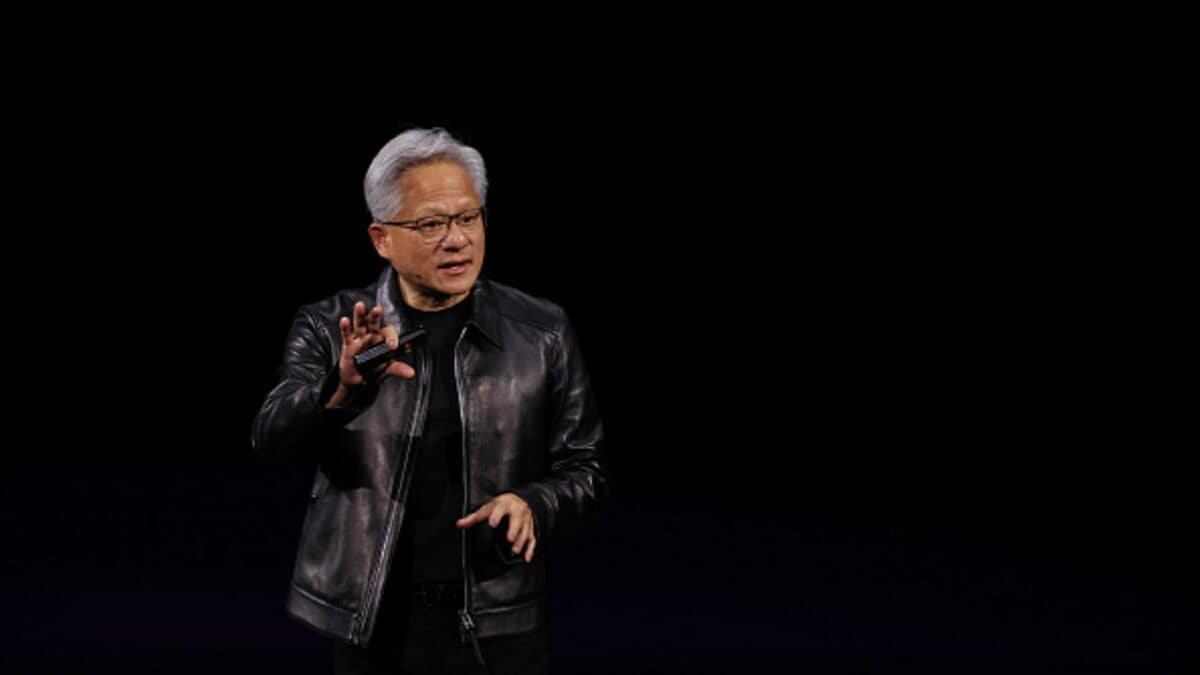
Jensen Huang didn’t just resign as Nvidia’s CEO on November 12th — he walked away from a company whose entire investment thesis hinges on his ability to pace the AI infrastructure buildout. The optics are striking. A man who became synonymous with the GPU revolution is leaving at the precise moment institutional investors are asking whether the next decade of AI capex is priced in or just beginning.
For Japanese portfolio managers, this isn’t abstract. Kioxia, the memory giant, fell more than 5 percent in a single session — the most-watched stock in the country right now. Fujikura dropped over 4 percent. Tokyo Electron shed nearly 2 percent. These aren’t marginal moves. They represent billions in institutional positioning being reassessed in real time.
What makes this transition particularly consequential for Asian investors is the question of succession continuity. Nvidia has operated under Huang’s vision for over two decades, and the market will be scrutinizing every signal about whether strategic direction changes after the handoff. Japanese institutions holding positions across the broader semiconductor value chain — from memory manufacturers like Kioxia to packaging specialists like Advantest — are evaluating whether the demand assumptions baked into current valuations survive leadership turnover. The uncertainty premium on names correlated with Nvidia’s trajectory has widened materially.
What Nvidia’s Report Actually Decides
The core question behind Thursday’s print isn’t whether revenue beats consensus. It’s whether the guidance narrative holds. The market needs to hear that hyperscaler spending hasn’t hit a wall — and that demand for next-generation training hardware remains unquenchable.
Here’s what most English-language coverage misses: the real signal for Japanese investors lives in the breakdown between data-center demand and everything else. Nvidia has spent months emphasizing that enterprise and sovereign AI adoption are accelerating alongside cloud majors. If that claim gets validated in the earnings call, it changes the calculus for memory names like Kioxia, which sit downstream in the same supply chain. NAND flash pricing recovery depends on whether data-center write volumes actually materialize — and those volumes depend on whether the AI pipeline stays open.
The source material from SBI Sumitomo Securities’ Shikiho report flags Kioxia specifically, noting that data-center NAND demand exceeded expectations and smartphone and PC demand expanded as well. Supply tightness is driving price improvements. Depreciation and labor costs rose, but earnings acceleration widened compared to the prior issue. That kind of incremental upgrade matters when you’re already trading at a discount to historical norms.
Beyond the headline numbers, Japanese allocators are parsing the operating margin trajectory and the capital allocation memo. Any sign that Nvidia is preparing for demand deceleration — through inventory adjustments, capacity curtailment, or revised capex guidance — would cascade through the Japanese semiconductor complex. The equipment makers in particular operate on a long order-to-revenue cycle; a pullback in chipmaker capex today means reduced orders for Tokyo Electron andscreen Solutions months from now. Memory producers face an even longer recovery arc, given the structural oversupply that has characterized the NAND space since 2023.
The Regulatory Wild Card
The political dimension arrived through an unexpected channel. Democrats retaking both chambers of Congress after the midterm elections shifted the regulatory landscape overnight. Stricter rules on data-center construction were feared, directly pressuring AI and semiconductor equities. This isn’t a fringe concern for Japanese exporters. Tokyo Electron and other equipment makers have meaningful U.S. revenue exposure. Any restriction on domestic data-center expansion ripples through ordering patterns for lithography, deposition, and testing gear long before it hits reported numbers.
The regulatory shift cuts in two directions simultaneously. Tighter environmental review and energy-consumption scrutiny could slow the pace of new facility openings — a headwind for demand forecasting. But it could also concentrate buildouts among larger operators with deeper pockets, potentially benefiting customers who are major buyers of advanced equipment. The net effect on Japanese suppliers depends heavily on which channel dominates, making this week’s Nvidia commentary on customer concentration and geographic demand distribution all the more critical.
Anthropic’s expected listing on November 19th adds another variable. It’s not just another AI name going public — it’s a bellwether for whether the market still believes in the generative-AI commercialization story at current valuation levels. A soft debut would reinforce the bears. A strong one would force a re-rate across the sector, including the Japanese hardware plays that have lagged.
The Geopolitical Overhang
Then there’s the third oddity in an already strange week: a proposed U.S.-China-Russia trilateral summit in Shenzhen on November 19th. Historically unprecedented. Practically irrelevant to near-term earnings, perhaps. But for institutions holding positions sized around China-exposure risk, any movement on technology-export controls or tariff frameworks shifts the discount applied to semiconductor names with significant China revenue streams. Tokyo Electron, Advantest, and others can’t ignore it.
Tokyo Electron derives roughly a quarter of its revenue from Greater China, a figure that has only grown as Chinese chipmakers accelerate domestic capability building despite export restrictions. A softening of U.S. enforcement posture — even rhetorically — could compress the risk discount on the stock. Conversely, any hardening of stance would amplify concerns about future revenue erosion. For Kioxia, the exposure is different but equally weighty: Chinese NAND buyers represent a meaningful portion of volume, and pricing power against those customers is a recurring negotiating challenge. The summit outcome, whatever it signals, forces position adjustments ahead of Friday’s close.
Who Wins, Who Loses
The upside scenario is clear: Nvidia guides firmly for continued demand growth, data-center NAND pricing strengthens further, and Anthropic’s debut signals renewed conviction in AI monetization. In that world, the beaten-down Japanese semiconductor names catch up rapidly — Kioxia leading, followed by equipment makers repricing higher on order-backlog optimism.
The downside path runs through weak guidance, any hint of hypervisor spend normalization, and a souring on Anthropic. Memory takes the longest to recover because it’s the most cyclical leg of the trade. Equipment follows, but with a lag — orders translate to revenue quarters later. Financials like Mitsui Sumitomo Banking Group and Tokio Marine, both showing notable daily declines, would feel secondary pressure from broader risk-off behavior.
A middle ground deserves attention too. Nvidia could deliver in-line results with cautious guidance — a scenario where the stock drifts sideways and the real action migrates to the second- and third-tier Japanese names whose valuations already reflect disappointment. That’s historically been where asymmetric opportunities emerge in semiconductor cycles, particularly in the packaging and materials sub-sectors where capacity constraints may favor incumbents regardless of macro sentiment.
What This Week Decides for Japan
Japanese institutions have been forced into a defensive posture over the past month. The CoreWeave shock, Alphabet’s free-cash-flow concerns, regulatory headwinds, and now the leadership change at Nvidia created a compounding wave of selling pressure. The market is compressed. One good report, one positive signal from Anthropic, and the rotation back into cyclicals accelerates fast.
The contrarian case is worth taking seriously. Kioxia trades at a fraction of its historical range despite improving fundamentals. Fujikura sits near multi-year lows even as fiber-optic and copper cable demand for data centers remains structurally intact. Tokyo Electron’s valuation doesn’t reflect the longevity of the AI buildout cycle.
The broader implication extends beyond any single stock. This week represents the first comprehensive stress test of the Japanese semiconductor thesis since the sector’s prolonged selloff began. How institutions respond — whether they double down on discounted cyclicals or retreat further into defensives — will set the directional bias for asset flows into and out of Japan through Q1 2026. The convergence of earnings, a major IPO, and geopolitical signals in a five-day window is unusual enough that the positioning decision won’t be made in isolation. It will be treated as a mandate or a warning label. Either outcome carries weight.