Okinawa's Election Shows How Fast AI Disinformation Crosses the Line
A gubernatorial race in Okinawa is becoming a real-world test case for AI-powered election interference. Deepfakes depicting candidates being crushed by construction equipment and forged pro-China panic videos are circulating widely on social media ahead of an August 13 vote.
The Road Roller Video
On August 6, a six-second video appeared on X. It showed a man who looked unmistakably like Okinawa’s sitting governor, Danny Tamaki, lying on the ground as a road roller moved toward him. People holding signs that read We heart Denny cheered moments before the attack. The clip carried a watermark crediting Grok Imagine, xAI’s image and video generation tool.
By August 10, it had been viewed more than 490,000 times. It had not been removed.
Users across the political spectrum responded with revulsion. Several supporters of other candidates said even they found the content unacceptable. X’s own policies prohibit content that targets individuals with harassment or intimidation. The video stayed up.
The poster, in any case, made no secret of their intent. On August 8, they posted a message directly naming Tamaki: I just want to exterminate you. Would you be okay if everything you have was taken from you?
Fear Without a Candidate Name
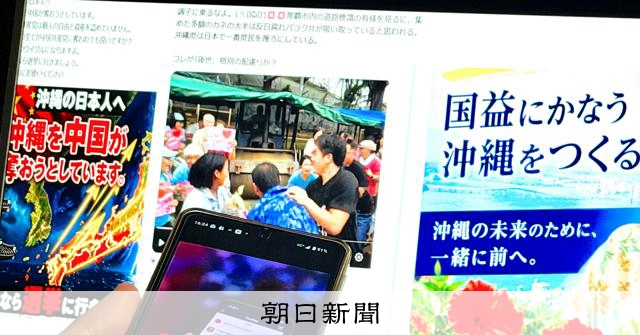
A second AI-generated video took a different tack. It carried no candidate name. Instead, it layered Japanese text over dramatic visuals with claims that China was seizing Okinawa, asking viewers whether they were fine with losing everything to the Chinese Communist Party, and invoking Urumqi as a cautionary parallel before closing with a prompt to vote.
Supporters of Tamaki’s opponent picked up the video and recast it as proof that reelecting the governor would hand the islands to Beijing. The original creator did not make that argument. The framing emerged organically in the reply chains.
The Fake Poster That Wasn’t
Later that same week, a third artifact entered circulation. It looked like a campaign poster for Kosha Genta, a first-time candidate in the race. The image showed a man resembling Genta alongside the phrase build an Okinawa that serves national interest.
A reporter at the Asahi tested it against SynthID, an OpenAI watermarking system built into ChatGPT and related tools. The detection flag came back affirmative: this content was generated using OpenAI tools.
Genta’s campaign denied creating or authorizing the image. Within days, a supporter came forward, claimed responsibility, and apologized on X. The original post was deleted. But copies continued to circulate as ammunition against Genta, who was already facing scrutiny over the phrasing itself. Critics noted that prioritizing national interest over local interest is a loaded frame in a prefecture that has borne the brunt of U.S. military infrastructure for decades.
The Race Itself
Six candidates are running. Polls conducted by the Asahi on August 5 and 6 showed Genta slightly ahead of Tamaki in what amounted to a two-horse race. The margin is narrow enough that a handful of displaced votes — or a cluster of undecided voters deterred from showing up — could flip the outcome.
Both campaigns have raised alarms internally. A senior Tamaki adviser told the Asahi they feared sophisticated disinformation would sway a significant number of voters. A Genta adviser acknowledged it was useful for the public to engage with Okinawa’s problems but warned that the current temperature was counterproductive.
Neither campaign has the legal or organizational apparatus to trace and takedown the content at scale. The videos are not legally defamatory in any conventional sense. They are AI-generated, openly attributed to commercial generative tools, and spread through algorithmic amplification that rewards outrage.
Why This Matters Beyond Okinawa
Japan has no comprehensive law governing AI-generated election content. The Public Offices Election Act prohibits defamation and false statements, but those provisions were drafted for print and broadcast eras. They do not address synthetic media that is technically truthful in its claim — I made this with AI — while being functionally deceptive in its effect.
The Okinawa race is exposing that gap in real time. A deepfake does not need to be perfect to be effective. The road roller video required no voice, no speech, no narrative explanation. Viewers understood the threat because the composition did the work. A synthetic poster needed only enough resemblance and one loaded slogan to distort a candidate’s positioning.
The pattern is portable. It works anywhere social media platforms moderate content based on individual reporting rather than proactive detection, and it works especially well in multi-candidate races where voters lack strong prior knowledge of any single contender.
The China Frame
The second video’s most striking choice was the Urumqi reference. Urumqi is the capital of China’s Xinjiang region and has been the site of repeated government security operations. Linking it to Okinawa is not an accident. It is a deliberate emotional trigger designed to activate existing anxieties about Chinese expansionism while simultaneously casting Tamaki’s pro-U.S., pro-base posture as ineffective.
That dual function is the disinformation strategy in miniature. The video does not advocate for any candidate. It does not identify any author. It simply makes the political landscape feel more dangerous than it is, which depresses turnout among moderate voters and pushes others toward whichever candidate promises safety.
Okinawa voters have lived with that safety debate for seventy years. The U.S. military occupies roughly 70 percent of the prefecture’s habitable land. Base-related crimes, noise, and accidents are not abstract issues. A synthetic video that borrows their vocabulary does not need to invent fear. It only needs to sharpen it.
What Comes Next
Platforms face a choice. X has not removed the road roller video despite its clear violation of harassment policies. Other platforms have been more aggressive in some elections and complacent in others. There is no consistent standard.
Japan’s electoral authority has signaled awareness of the problem but has not yet issued enforceable guidance specific to AI-generated content. The Ministry of Internal Affairs has discussed the issue in public forums. No regulation has followed.
The Okinawa election will produce a winner and a loser. But the real story is what the post-election data will show. If turnout drops below historical norms for a gubernatorial race, or if exit polls reveal a spike in voters who cite online content as a decisive factor, the lesson will be unambiguous.
Asian democracies are watching. Taiwan held its presidential election in 2024 and faced a well-documented wave of AI-generated disinformation. South Korea has experienced synthetic media attacks in local elections. The Philippines, Thailand, and Malaysia face similar vulnerabilities. Okinawa is not an outlier. It is a preview.
The governor who wins this race will inherit a prefecture that now knows its political process can be weaponized by a script and a subscription. The question is whether the institutions around it will adapt fast enough to matter.