Oman's Hormuz Diplomacy Hits a Wall
The last-minute cancellation of an Oman-brokered Iran-Gulf meeting over the Hormuz Strait exposes how deep Gulf fractures run. Bahrain's refusal to attend even as Iran and Oman appeared close to a temporary shipping deal shows de-escalation is far from secure.
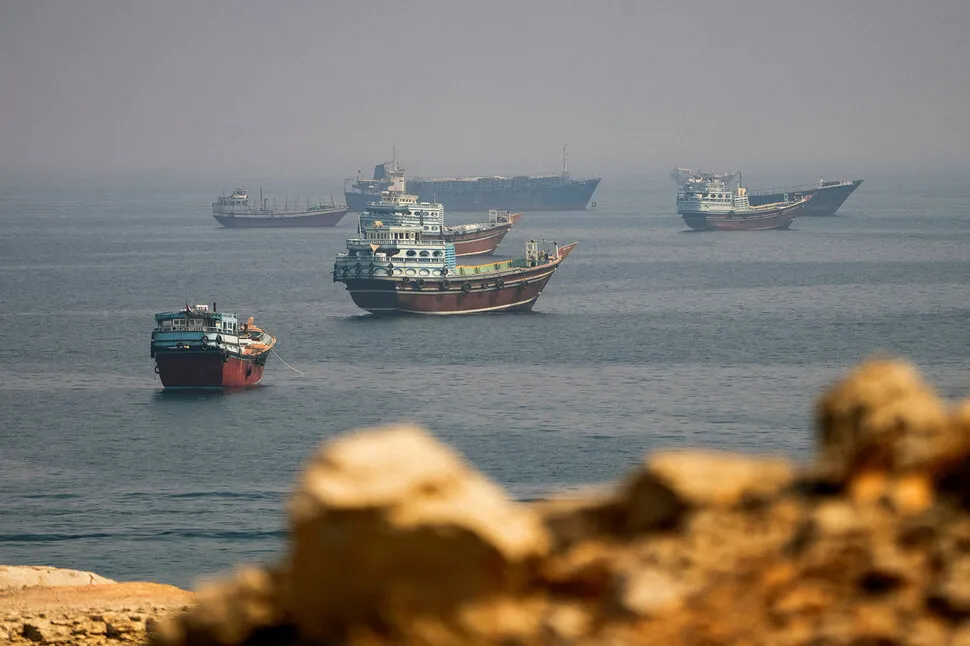
The Meeting That Never Was
An Oman-brokered meeting between Iran and Gulf foreign ministers was supposed to take place in Salalah on the 14th. It did not. The cancellation came with barely more than a courtesy — Foreign Minister Bader AlBusaidi posted on X that the gathering had been postponed, offering only that the participants had agreed to create conditions for constructive dialogue. No rescheduled date was offered. Iranian state media said other regional countries had requested the delay. That is the closest anyone has come to identifying who stood in the way.
What happened next tells the real story.
Bloomberg reported days before the meeting that Iran and Oman had already reached a preliminary understanding on a temporary shipping corridor through the Hormuz Strait — the world’s most critical oil chokepoint — and that the Salalah summit was meant to formalize the arrangement before presenting it to the rest of the Gulf. Ships, under this proposal, would use an alternative route with fees negotiated bilaterally between Tehran and Muscat. It was, by all accounts, the kind of practical deal Oman has specialized in for decades: low-profile, technical, designed to keep tanker traffic moving while avoiding the rhetoric that provokes Washington.
Then Bahrain spoke.
The breakdown was not merely a diplomatic inconvenience; it was a structural revelation. The deal had been negotiated at the working level between Omani and Iranian technical teams, the kind of quiet maneuvering Muscat has perfected since the 1990s. Oil traders in Dubai and Singapore had already begun pricing in the possibility of stabilized flows through the strait. Futures on Arabian Gulf crude tightened slightly on the news that talks were advancing. The assumption in maritime insurance circles was that a bilateral arrangement, even an informal one, would lower the risk premium on tankers transiting the 21-mile-wide channel. That assumption now rests on nothing.
The Bahrain Veto
Bahrain’s foreign ministry announced it would not attend any meeting that included Iran until diplomatic relations were restored — a reference to a period when Bahrain severed ties with Tehran over Iranian interference accusations. The statement was unambiguous: no Iran, no table. Since Oman’s entire strategy depended on bringing both sides together, Bahrain’s refusal effectively killed the meeting before it started.
This is not new information to readers tracking the region. But the timing matters. The temporary shipping arrangement was nearly finalized. A technical solution to one of the most dangerous flashpoints in global energy markets was being presented as a fait accompli to the GCC — and one member state exercised a veto by simply refusing to show up.
Bahrain’s posture is anchored in its relationship with Saudi Arabia, its larger neighbor and patron across the King Fahd Causeway. Riyadh has consistently opposed any framework that treats Iran as a negotiating partner rather than a destabilizing force. Manama’s refusal to attend is almost certainly coordinated with Riyadh, even if no formal joint statement preceded it. The message is clear: Gulf de-escalation will proceed only on terms acceptable to Saudi strategic leadership, and Muscat’s independent mediation carries no weight when it conflicts with that red line.
The implication is uncomfortable for Muscat. Oman has positioned itself as the region’s quiet mediator since before the current crisis escalated. It maintained channels with Iran when other Gulf states shut them down. It hosted backchannel talks between Washington and Tehran. It has bet its diplomatic credibility on the idea that pragmatic engagement with Iran prevents worse outcomes. Now it looks like the architecture it built rests on a foundation of one dissenting voice — a voice that, in practice, speaks for much of the Gulf.
Who Wins, Who Loses
Bahrain wins in the short term — it scores points with Saudi Arabia and the United States by drawing a hard line against Tehran, reinforcing the Gulf security posture that has defined the post-2019 era of renewed Iran hostility. Iran loses its best opportunity to establish a bilateral shipping arrangement that would have given it leverage over a waterway it has threatened to close multiple times. Oman loses whatever political capital it was about to collect from delivering a deal that kept global oil flowing.
The United States, meanwhile, registered its position with characteristic minimalism. President Donald Trump, visiting Ireland, was asked whether he objected to Gulf states meeting with Iran. He said he did not care, that it was up to them. That non-answer is itself a signal: Washington has no active stake in the Oman-brokered process, and it will not prop it up if it stalls. The burden now falls entirely on Muscat to rebuild the framework — or watch it collapse quietly.
There is a second-order consequence that deserves attention. The failure of this deal removes a pressure valve that was keeping tensions below the threshold of crisis. Every week that passes without a mechanism to manage shipping through Hormuz increases the probability that an incident — a boarded tanker, a missile test that strays too close to commercial routes, a miscalculation by Iranian Revolutionary Guard vessels — will escalate into something wider. The absence of diplomacy is not a neutral condition. It is an active risk factor.
The Bigger Picture
The Hormuz Strait carries roughly 20 percent of global petroleum consumption and about a third of all LNG traded internationally. Any disruption sends shockwaves through energy markets. The fact that a temporary, bilateral workaround was under negotiation — and failed before it reached the table — is worth watching closely. It means the options for keeping the strait open without triggering a wider confrontation are narrower than they appeared a week ago.
Oman’s framing of the cancellation as “creating conditions for constructive dialogue” reads as diplomatic cover for something more accurate: the group photo never happened because one participant refused to stand in it.
The collapse also exposes a broader pattern in Gulf diplomacy. Oman has repeatedly proven willing to do the tedious work of keeping lines of communication open — hosting talks, shuttling messages, drafting technical arrangements — while its neighbors reserve the right to walk away from anything that looks like normalization with Tehran. The dynamic is exhausting and unsustainable. It rewards states that set maximalist preconditions and penalizes states that invest in the plumbing of de-escalation. Over time, that incentive structure narrows the range of options available to everyone.
What Comes Next
The next move belongs to Muscat. If it tries again — and there is no indication it will retreat — it will need either a revised format that excludes Bahrain or a concession from Tehran that makes Bahrain’s participation politically survivable for Riyadh. Neither is obvious. A two-track approach, with Oman and Iran discussing shipping arrangements separately from a broader GCC dialogue, could preserve some of the technical progress while sidestepping the political veto. But that fragments the very unity Oman has sought to project.
Iran, for its part, has every reason to wait. The status quo favors Tehran in the short term: the strait remains a potential lever of coercion, and any deal Muscat brokers implicitly recognizes Iran’s stake in the waterway. Patience is a form of power here. The longer Oman hunts for a format that satisfies all parties, the more likely it is that external events — a U.S. naval deployment, an Iranian military exercise, a flare-up in Gaza or Yemen — will reset the terms of discussion entirely.
A rescheduled date, if one emerges, will likely come through Omani intermediaries rather than public announcements. Iran’s state media has already started the pattern of attributing the delay to unspecified regional requests — a template for blame allocation that will deepen if talks stall further. And any future proposal for temporary shipping corridors will face the same structural problem: Bahrain’s veto, Saudi Arabia’s silence, and Washington’s indifference make a multilateral deal nearly impossible to broker through Oman’s existing channel.
The strait remains open. For now. But the diplomatic architecture meant to keep it that way just revealed a crack that may not close easily. The alternative — managing the Hormuz without Oman, or without Bahrain, or without a framework that both Tehran and the Gulf can accept — is a landscape defined by incident and escalation rather than negotiation and restraint. That is the cost of a mediation that reaches too far and binds too loosely.