OpenAI's dots: Why Japanese media's 'virtual human' framing reveals a blind spot
Japanese tech press is calling OpenAI's always-on AI agent "dots" a virtual human. That framing misses what actually matters: autonomy without a monitor. The real shift isn't companionship — it's work that continues while you sleep.
What the Japanese press got right
Japanese tech media is describing OpenAI’s dots — the always-on autonomous agent announced September 29th — as something genuinely new: a “virtual human” already living in cyberspace, working while your PC is off and you’re asleep.
That framing is wrongheaded. But it points to something real about what these agents actually change.
The real shift: work without a supervisor
The conventional AI assistant requires you — the human — to be present, prompting, waiting, checking. You open ChatGPT. You type. You wait. You read. You decide what’s next.
Dots removes that loop. It doesn’t wait for your prompt. It works autonomously across gaps in your attention, tracks progress, makes decisions within your stated boundaries, and reports back when something matters or needs your input.
This is not incremental. This is a structural change in how knowledge work gets done.
Why “virtual human” is the wrong frame
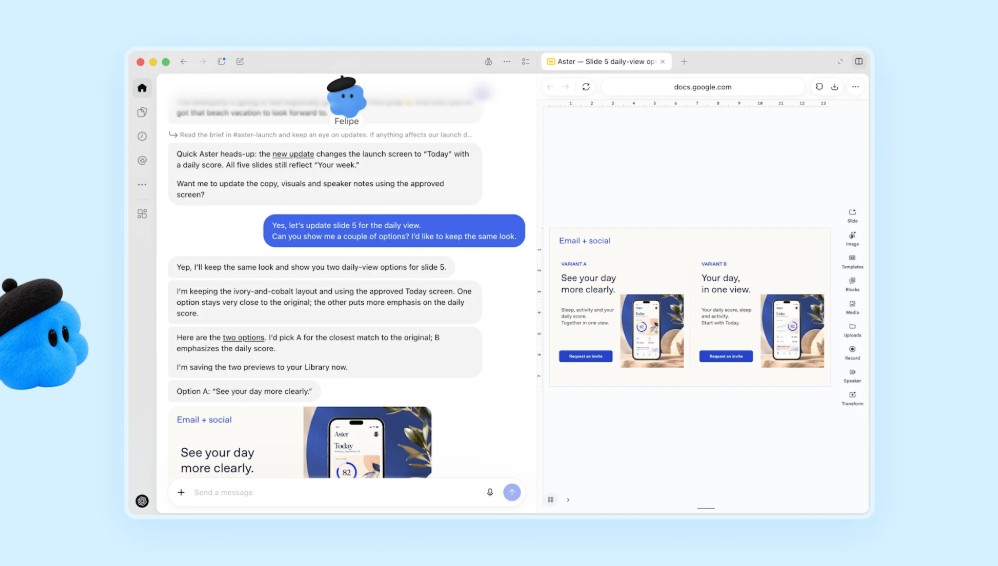
The Japanese press calls dots a “virtual human” because it has a customizable avatar — you can give it a name, shape, color, eyes, glasses, accessories. You can message it, call it, talk to it via Slack or Teams or even iMessage. It has continuity: it remembers what you’ve said, what you’ve decided, what you prefer.
But continuity of memory is not the same as personhood. Calling it a virtual human suggests the value is in companionship, in simulation, in something that feels like interaction with another mind.
The value is in the work itself. Getting done while you’re not there.
What actually changes about work
Consider the typical workflow today:
You have a research task. You open ChatGPT. You paste context. You wait 30 seconds. You read the output. You decide it’s incomplete. You refine the prompt. You wait again.
With dots, you start the task. You say “research Q3 competitor positioning and send me findings by Friday.” Then you close your laptop. You go to a meeting. You sleep.
Dots runs the research across the gap. It uses the browser to navigate. It reads the documents. It synthesizes. It drafts the report. It catches your attention only when something needs your decision — a contradiction in the data, a gap in coverage, a judgment call you need to make.
You receive the notification on your phone. You open the message. You review the findings. You decide what to adjust. You reply: “push harder on the pricing analysis.”
Dots continues. It never forgets. It tracks progress. It reports back.
This is not automation of tasks. This is delegation of ownership.
The technical architecture matters more than the framing
OpenAI describes dots as a cloud-resident always-on agent powered by the flagship model GPT-6 Astra. It has its own dedicated cloud computer and browser, operating independently from your PC’s power state.
The technical implications are significant:
It maintains continuity across gaps in your attention. It tracks progress against deadlines. It makes decisions within boundaries you set. It reports back when something requires your input.
It can run multiple background agents in parallel. It can monitor multiple projects simultaneously. It can sleep and resume at self-determined intervals, tracking what’s next and deciding when to act.
It connects through a plugin ecosystem to over 4,000 apps — Gmail, Google Drive, GitHub, Microsoft Teams, Slack. It operates within your existing permissions. It can even connect to your PC directly, handling local files and applications.
The chat history, the memory, the preferences, the decisions — all persisted, all accessible, all building context for the next interaction.
Why Japanese media covered this with depth
The Japanese press is describing dots with a particular cultural lens: the idea of the virtual human, the always-present companion, the service rendered without visible labor. There’s a tradition in Japanese media of framing technology through relationships, through personhood, through the social dimension.
That framing may miss the structural shift. But it captures something true: these agents are changing the relationship between human and machine from tool to collaborator. Not because they feel like humans. Because they work like employees.
The business implications
For Pro users, dots is included at no additional charge. For Business Premium, same. The agent starts free — you just add it to your existing plan.
The catch: the tasks dots initiates or manages through ChatGPT or Codex still count against your product usage limits. The work itself is free. The resources it consumes are not.
OpenAI is also offering a limited preview of specialized dots for enterprise — agents with dedicated IDs and clear roles, handling procurement, invoice processing, customer support. These will operate within organizational boundaries, with defined permissions and accountability.
Microsoft is partnering on distribution. Dots can be accessed through desktop apps, desktop browser versions of ChatGPT, and mobile apps. Messages, calls, iMessage, RCS — all carry the same context, the same memory, the same dot.
What happens next
The structural shift is this: knowledge work no longer requires your presence to progress.
You can delegate ownership. You can set boundaries. You can receive updates only when judgment is needed.
This is not automation of tasks. This is delegation of responsibility.
The Japanese press may call it a virtual human. That framing misses the point. The value is not in the appearance of personhood. The value is in the absence of supervision.
Work that continues while you sleep. Progress tracked without your oversight. Decisions made within your boundaries.
That is the shift. Not companionship. Autonomy.
Not virtual human. Virtual employee.
And that changes everything about how work gets done.