OpenAI's GPT-6 Turns Chatbots Into On-Demand Software
OpenAI is shipping GPT-6 with self-assembling interfaces — charts, calculators, maps, even custom tools generated from a single prompt. The real story isn't the feature: it's the tiered rollout strategy that signals OpenAI is moving from a chatbot company to a software platform.
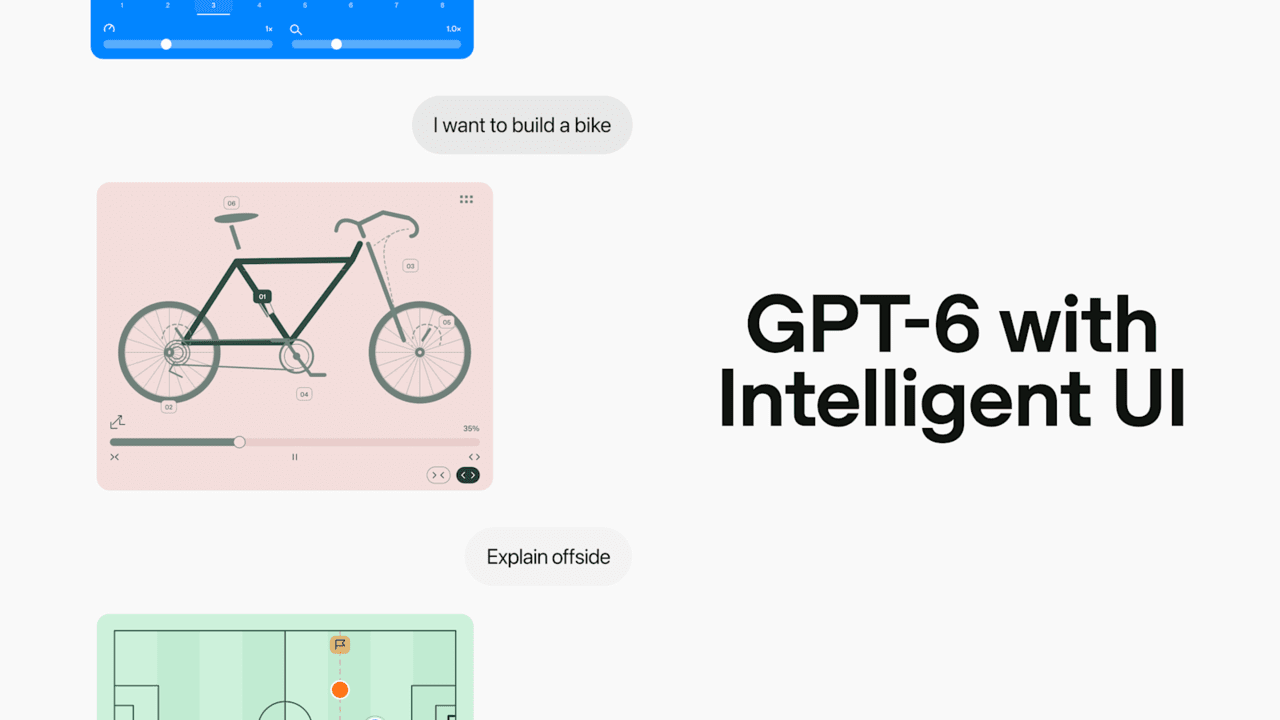
The Screen That Builds Itself
OpenAI didn’t just ship a better language model on July 7. It shipped a better kind of output.
GPT-6, now rolling out to the 1.2 billion weekly active users of ChatGPT, can look at your question and decide what form the answer should take — not just words on a screen, but a living interface. Compare two products? It builds a side-by-side comparison layout. Ask for a travel itinerary? A map with stops plotted appears. Want to split a dinner bill with friends? A calculator assembles itself inside the chat. OpenAI calls this “Intelligent UI,” and the Korean tech press is already calling it something else: the moment a chatbot becomes software on demand.
The mechanism matters less than the implication. GPT-6 doesn’t render one response format for every query. It has been trained — using a native streaming component library and compiler OpenAI built specifically for this purpose — to assess whether a question calls for a chart, an interactive diagram, a map, or plain text. It then composes the right combination of elements and streams them into view incrementally, so you see the interface forming in real time rather than waiting for a full response to materialize at once.
For context, this is the same team that spent two years perfecting a text dialog system. The pivot to self-assembling screens isn’t incremental. It’s a different product identity.
Why Korean Coverage Is Ahead of the West
The AI Times report on GPT-6, written by Park Chan, is short on speculation but dense on deployment details — and that’s precisely why it’s worth reading for an international audience.
Western headlines have focused on the feature itself. Korean outlets are dissecting the rollout strategy before most English-language analysts have finished their first paragraph.
Here’s what they’re tracking. OpenAI is shipping two variants of GPT-6 on different tiers: GPT-6 Sol for paying subscribers (Plus, Pro, Business, Enterprise) and GPT-6 Luna for free and Go users. Both are fine-tuned for daily conversation and tasks, but they are not identical models. The company is also keeping the update confined to the ChatGPT chat experience — it does not touch ChatGPT for Work or Codex, the coding-specific product.
That segmentation is deliberate. It signals that OpenAI treats the interface layer as a differentiator between paid and free users, not just the underlying reasoning capability. The Korean press notes this as a commercial strategy question that Western coverage hasn’t fully absorbed: when the UI itself is the value proposition, the freemium boundary becomes much sharper.
The Speed Argument Is Real
Performance numbers from OpenAI’s internal evaluations deserve attention beyond the usual model-update noise.
GPT-6 Instant started responding to web-search-dependent questions 44 percent faster than GPT-5.6 Instant, according to the company. More interestingly, GPT-6 Extra High matched the response-start latency of GPT-5.6 Medium while scoring higher on综合能力 than GPT-5.6 Extra High. The model reasons in parallel with output generation — it answers what it can immediately and refines the response as it gathers more information, presenting the final result as a single coherent reply rather than a series of updates.
This architecture choice explains the streaming UI design. The interface builds progressively because the reasoning process is progressive. That’s a systems-level decision, not a polish pass.
Safety Changes That Signal Maturity
OpenAI also disclosed improvements to its safety layer that are quietly significant. The company says it has strengthened resistance to jailbreak attempts that progress across multiple turns of conversation — meaning attackers who try to slowly steer the model into harmful territory over a prolonged dialogue face a tougher defense. At the same time, OpenAI is reducing false refusals on benign requests by using conversational context to distinguish genuine risk from noise.
The dual focus — harder to exploit, softer on legitimate users — is the hallmark of a product that has moved past the early-growth phase of “ship features and fix safety later.” Korean commentators noted this as evidence that OpenAI is treating safety infrastructure as a product constraint rather than a compliance checkbox.
Who Wins, Who Loses
The winners are obvious: ChatGPT users get a richer experience at no additional cost. Enterprise customers get early access to Sol. OpenAI extends its moat by making the interface itself proprietary — you can’t simply drop GPT-6’s UI engine into a competitor’s model without rebuilding the streaming layer from scratch.
The losers are the startups that bet on a thin API wrapper around a base model. If the value shifts from raw inference speed to interface composition, the commoditization thesis weakens. Anthropic, Google, and xAI all have strong reasoning models. None currently offer a self-assembling UI stack comparable to what OpenAI is deploying at scale.
There is a third group worth watching: the Korean tech sector itself. OpenAI’s rollout includes Enterprise availability, and the pricing tiering means Korean corporations evaluating AI adoption will see a clear feature gap between paid and free tiers. That affects procurement decisions in a way that pure benchmark comparisons never capture.
What Happens Next
The rollout begins with paid users on July 7 and expands to free and Go users the following day. Enterprise availability depends on organizational admin settings, which means some of the most impactful deployments may lag behind the consumer launch by weeks or months.
The immediate follow-on question is whether other model providers will build analogous UI layers. The technical path is clear — OpenAI proved it with its native streaming library — but the investment required is not trivial. A component library, a compiler, training data for interface layout decisions, and evaluation pipelines for clarity and usefulness: this is infrastructure, not a feature patch.
For now, OpenAI holds a lead measured in months, not years. But in AI, months at the frontier are a long time.
The deeper shift is cultural. A chatbot that generates screens changes the mental model of what an AI product is. It stops being a conversational interface to a model and becomes a model that builds interfaces. That distinction matters for every company that has been planning an AI product around text input and text output.
The interface war has begun. OpenAI just turned on the lights.