The Pajero Revival Hides a Bigger Shift in Japanese Auto
Mitsubishi's new Pajero may look like a nostalgic off-roader, but its shared ladder frame with Nissan's upcoming Terrano reveals a fundamental change in how Japanese automakers survive the China and EV cost crunch.
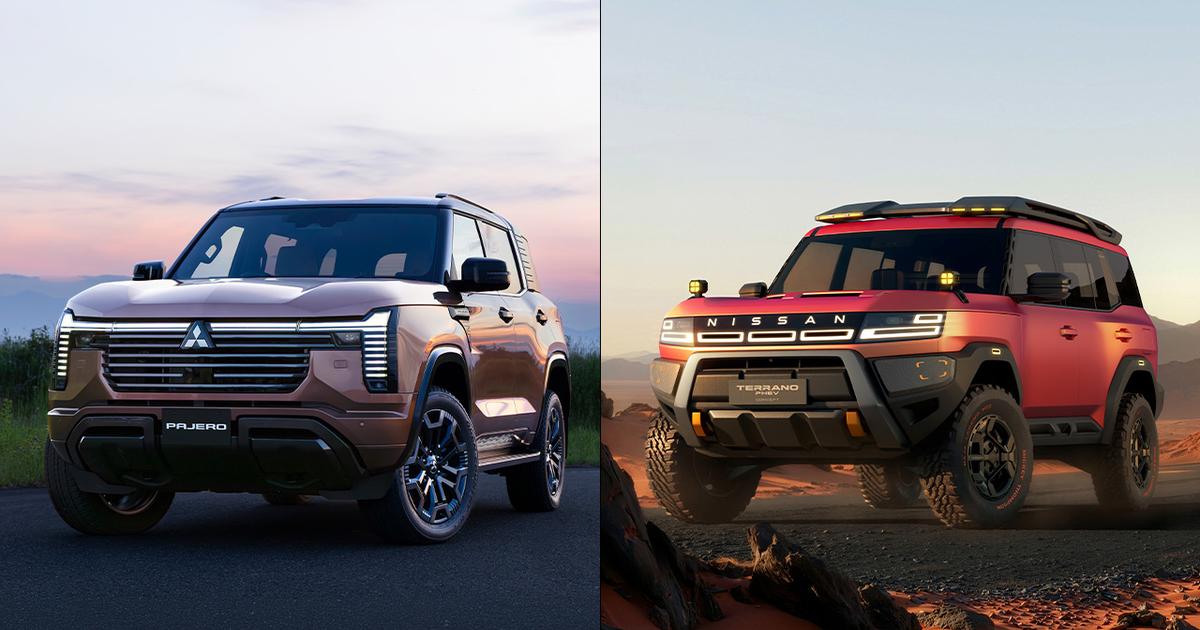
The Pajero Returns — But the Real Story Is Who Built It
Mitsubishi’s new Pajero arrived in September 2026, the first one since 2019. At 4,920 millimeters long, it sits firmly in the large-SUV tier alongside a Land Cruiser 250. It carries a 2.4-liter diesel producing 204 horsepower and up to 480 newton-meters of torque, paired with an 8-speed automatic and the Super Select 4WD-II system that defined every generation before it.
The specifications read like heritage. The reality underneath does not.
This Pajero was not built in isolation. Its ladder frame comes from the Triton pickup. Its adaptive driver-assistance features draw on Nissan’s ProPILOT ecosystem. Its dual 14.3-inch display concept mirrors the one Nissan recently introduced in the updated Elgrand. Mitsubishi kept its driving dynamics in-house — the 5-link rear suspension with coil springs, the S-AWC vehicle dynamics control, the off-road tuning — but the electronics, the screens, the safety systems all lean on the Renault-Nissan-Mitsubishi alliance.
That division of labor is the actual news.
Why This Division Matters
Mitsubishi sells roughly 800,000 vehicles annually. That is not enough volume to independently refresh the electronic architecture of a flagship SUV every three to five years, especially when Chinese manufacturers are pushing out connected, screen-laden vehicles at half the development cost.
Every modern car feature — the infotainment SoC, the camera-basedADAS stack, the over-the-air update capability — requires continuous investment. A single manufacturer at Mitsubishi’s scale cannot sustain that independently and still fund electrification. That is the structural problem behind the Pajero’s existence.
The alliance’s 2022 roadmap, called Alliance 2030, committed to sharing not just platforms but electronic systems across 45 vehicle types and more than 10 million units by 2026. The Pajero is a concrete example of that commitment working as designed. Mitsubishi borrows Nissan’s electronic development scale. Nissan gains a ladder-frame SUV without building one from scratch. Neither company does everything alone.
The Terrano Question
The more provocative detail appeared in April 2026, when Nissan unveiled the Terrano PHEV concept at the Beijing Motor Show. Nissan stated it would reveal a production version within a year. The concept’s side and rear proportions closely match the new Pajero.
Officially, no relationship has been confirmed. Unofficially, the signs are difficult to ignore.
The Navara-Triton relationship in Australia provides the template. Since late 2025, Nissan has sold the Navara in Oceania as a rebadged, lightly adapted Triton manufactured at Mitsubishi’s Rayong plant in Thailand. That was not a simple badge swap — Nissan made body and tuning adjustments for its market. But the ladder frame, the manufacturing base, and the development cost were shared.
If the Terrano follows that pattern on a larger scale, Nissan would bring a PHEV powertrain and ProPILOT suite to the same ladder-frame architecture Mitsubishi uses for the diesel Pajero. Two brands, different powertrains, different driving positions, one shared backbone.
That is not what happened in the 1990s. Back then, the Pajero and the Terrano were rivals — separate engineering teams, separate markets, competing for the same off-road buyer. Thirty years later, they could be siblings under the same alliance umbrella. The rivalry that defined an era is being replaced by a cost-sharing arrangement that neither company could afford alone.
Who Wins, Who Loses
The winners are clear: consumers who get a genuinely capable off-road SUV with modern electronics at a price point that would be impossible if Mitsubishi developed everything independently. And the alliance itself, which now has a working example of co-development that extends beyond platform sharing into full vehicle categories.
The losers are the Japanese domestic suppliers who expected to serve each brand with exclusive components. The days of brand-exclusive dashboards, proprietary ECUs, and single-source suspension parts are ending faster in the alliance than outside it. That transition creates friction.
The larger loser, though, may be the myth that Japanese automakers can survive on vertical independence. The Pajero’s revival is framed as a return to form. It is actually a surrender to reality — no mid-tier manufacturer can now afford to build everything alone, not against Chinese EV producers who are already pricing these vehicles out of their own markets.
The Pajero Series Ambition
Mitsubishi has explicitly discussed expanding the Pajero into a series, not a single model. The historical precedent exists: the Pajero Mini, the Pajero Io, the Pajero Junior once occupied different size tiers under the same name. The current plan likely envisions a compact and a small SUV eventually carrying the Pajero badge, complementing the full-size flagship.
That ambition only works if the alliance delivers the platforms underneath. A smaller Pajero-based model sharing electronics and possibly the same ladder architecture with a Nissan counterpart would replicate the Terrano-Pajero dynamic at a lower price point. It would also make the Pajero name relevant to buyers who do not need a 5-meter, seven-seat diesel.
What Comes Next
Thailand is manufacturing the new Pajero. Japan and Australia receive it first in 2026. Over 100 countries, including ASEAN, Latin America, and the Middle East, follow from 2027. Mitsubishi is positioning this as a global strategy, not a Japan-only nostalgia play.
The Terrano production reveal — expected sometime in 2027 based on Nissan’s timeline — will tell us whether the alliance is truly moving toward shared SUV architectures or whether the Pajero remains a one-off experiment. If the Terrano shares the ladder frame and the Pajero gets its smaller siblings, the model shifts from co-development to co-platforming. That is a bigger change than either company has attempted in decades.
The Pajero is back on sale. The real question is whether the alliance that built it can survive long enough to make it matter.