Panama Canal's Climate Crisis Is a $4M Game of Shipping Throne
El Niño drought has pushed Panama Canal passage fees to $4 million, reshuffling global supply chains and hitting US consumers hardest. Korean logistics firms with diversified Pacific routes may absorb the shock better than American counterparts dependent on the shortcut.
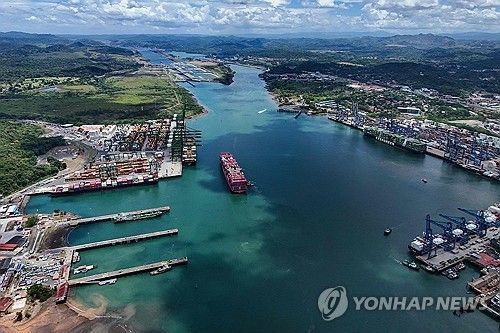
The $4 Million Shortcut
A single container ship paid $4 million on August 10 just to skip a month-long排队 behind rivals waiting to transit the Panama Canal. That figure—roughly 550 million won at the current rate—is not a typo or a one-off stunt. It is the price of urgency in a waterway that has become the strangest bottleneck in global trade: not blocked by geopolitics, not damaged by war, but simply too dry to function.
The canal, which handles roughly 5% of world maritime cargo and about 40% of containers entering the United States, is running on fumes. Rainfall along the dividing watershed has dropped 34% below normal. Lake Gatún, the artificial freshwater reservoir that powers every lock cycle, is shrinking. The Panama Canal Authority responded by cutting daily transits to 34 ships on August 4 and 32 by August 15. Draft limits fell from 15.2 meters to 14.6 meters, meaning vessels can no longer load full cargo depths. Less water in, less weight out.
Who Pays the Bill
The immediate victim is the American consumer. About 70% of all cargo moving through the canal is bound for or originating in the United States. When canal transit slows and surcharges climb, those costs flow straight into shelf prices for everything from pharmaceuticals and electronics to clothing and agricultural goods.
MSC, the world’s largest container line, announced on August 12 that it would raise its Panama Canal transport surcharge on cargo bound for the US East Coast and Gulf Coast from Korea, China, Japan, and Southeast Asia. The surcharge is a direct attempt to offset thinner margins caused by reduced vessel capacity per transit and longer queue times.
But the damage does not stop at the dock. West Coast ports like Los Angeles and Long Beach are absorbing overflow—cargo that shippers abandon mid-Pacific rather than wait weeks for a canal slot. That surge is pushing up intermodal truck and rail rates across the US interior. Pollo4PL’s Armenia Shabazyan told reporters his company is already struggling with overloaded domestic rail lines and trucking capacity at its limit. The canal crisis, in other words, is no longer a maritime problem. It is a land-transport problem too.
The Cape of Good Hope Returns
The alternative route is older than the canal itself. Energy analysts at Vortexa report that as of August, roughly half of all LNG tankers heading to Asia from the US Gulf chose the Cape of Good Hope around Africa rather than transit the canal. That is a ten-year high for that particular routing choice. The math is brutal: Houston to Tokyo takes 26 days through the canal, 45 days via the Cape. Extra fuel, extra crew days, extra insurance premiums—all rolled into the cost of every cubic meter of gas and every container of manufactured goods.
Shippers who can absorb the delay will. Those with just-in-time inventory, contracted delivery windows, or thin margins cannot. The ones who pay the most are not the ones causing the problem.
Why This Matters for Korean Logistics
The source material frames this as a blow to the US domestic economy. That is accurate but incomplete. The real question for an international readership is who gains when the canal falters—and that points directly at Korean logistics firms.
South Korean carriers and freight forwarders have spent the past decade building redundancy into their Pacific routes. Hanjin, HMM, and the broader ecosystem of Korean 3PLs have alternative port partnerships, diversified routing agreements, and established relationships with West Coast and East Coast US terminals that give them flexibility the canal-dependent strategy does not. While American shippers scramble to re-route cargo through overburdened land bridges, Korean operators with pre-negotiated multi-modal arrangements can pivot faster.
The surcharge MSC is imposing on cargo from Korea, China, and Japan to the US East Coast is a blunt instrument—it affects everyone equally. But Korean logistics firms that already operate significant Pacific transoceanic capacity rather than relying on canal shortcuts are insulated. They do not need to bid $4 million for priority passage. They never counted on it.
The Climate Multiplier
This is not a temporary disruption. The US National Oceanic and Atmospheric Administration projects a 90% or greater chance that the current El Niño event will persist through the end of next year. That means the canal will likely remain constrained well into 2027. Meanwhile, the Hormuz Strait situation adds a second supply-chain headache on top of the first, as Stimson Center analyst Benjamin Gedan noted.
When two independent geopolitical and climate shocks converge on the same global trade system, the result is not additive. It is multiplicative. Every delay at the canal amplifies the cost pressure from Red Sea disruptions. Every rerouted vessel ties up capacity that could have served another lane. The system has no slack left.
Who Wins, Who Loses
Winners: Korean and European logistics firms with diversified routing, multi-port strategies, and Pacific transoceanic contracts that do not depend on the canal. Shippers who already invested in nearshoring or regional supply chains. Port authorities on the US West Coast, at least in the short term, as cargo volumes swell.
Losers: US retailers and manufacturers reliant on just-in-time imports from Asia via the canal. American trucking and rail networks already at capacity. Consumers facing sustained price increases on everyday goods. Small and mid-sized shippers who cannot afford $4 million transit bids or the insurance premiums of longer routes.
What happens next is not dramatic—it is slow and expensive. The canal will either adapt with desalination or deeper dredging (both costly and slow) or continue operating at reduced capacity through at least next year. Shipping lines will keep passing the surcharge onto customers. American supply chains will keep paying for the luxury of a shortcut that no longer functions as designed.
The Panama Canal was built on the assumption that climate would be stable. That assumption is now expired.