A Pilot Stabbed, Not Hijacked — What the FZ1073 Attack Really Means
The FlyDubai pilot who stabbed a colleague and tried to crash a flight to Israel rewrites the post-9/11 playbook. Inside the cockpit threat, the fragility of reinforced doors, and what the Middle East routes now face.
The weapon was a knife. The target was Israel.
The attack on FlyDubai flight FZ1073 does not fit the thumbnail we have of airline terrorism. There was no bomb. No hijacker with a manifesto strapped to his chest. No group claiming responsibility in the usual hours after the fact. The threat came from the left seat or the right — one of the two people authorized to fly the plane — who stabbed a colleague with a blade and began steering a 180-passenger Airbus toward the ground.
That detail matters more than the headline. It changes what we think we know about how an airliner gets turned into a weapon.
What happened, stripped of the noise
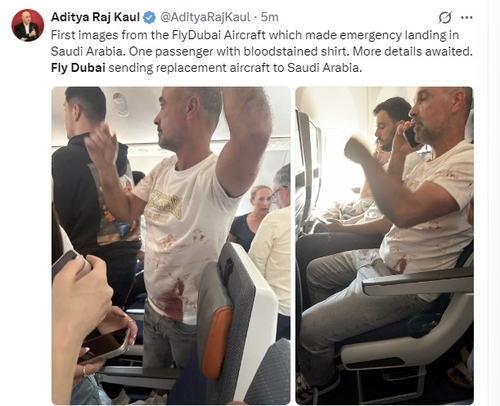
On the morning of October 30, the Dubai-to-Tel Aviv flight issued an emergency signal mid-flight. Israeli fighter jets scrambled. The plane diverted to Saudi Arabia and landed safely. Inside, an Israeli passenger and a flight attendant broke through the cockpit door, subdued the rogue pilot, and prevented the crash. Nearly all 180 passengers were Israeli, according to Prime Minister Benjamin Netanyahu, who held a televised address later that day.
Netanyahu described it as a severe security incident. Israel’s Defense Minister, Israel Katz, went further: he identified the attacker as a member of the undergroundist extremist movement, framing it as a jihadist terror attempt. Saudi authorities confirmed they are interrogating the suspect. Netanyahu also directed Israel’s security agencies to prepare preventive measures against similar attacks.
The facts are still emerging. What we do know places this firmly in a category aviation security has spent two decades trying to guard against — but never fully solved.
The reinforced door was supposed to be the answer
After 9/11, the single most visible change to commercial aviation was the hardened cockpit door. Bulletproof, lockable, designed to keep a hijacker out. It worked for decades. Then attackers started bringing knives. Then they started sitting in the cockpit.
The FZ1073 incident proves the next iteration of the old problem: the door does not protect against someone already inside it. Once the cabin crew or a passenger physically breached the cockpit to stop the attack, it confirmed that the door can be forced. Reinforced does not mean impervious. The design trade-off — keep terrorists out while ensuring crew can enter in an emergency — remains unresolved.
Inside-the-cockpit attacks are the blind spot
Post-9/11 security focused almost entirely on what happens before a plane boards: airports, screening, passenger lists. The cockpit became a fortress precisely because the lesson of United 93 was that an unprotected flight deck is catastrophic. But fortifying the cockpit against outsiders does nothing when the threat is already inside, armed with a utensil and access to the controls.
No major aviation authority currently mandates armed cockpit guards or systematic monitoring of pilot behavior during flight. The assumption has been that pilot licensing and background checks are sufficient. That assumption just collided with a man who passed those checks and then used his authority to attempt mass murder.
Why the Middle East angle is new
This is not the first threat directed at flights to Israel. But the profile here — a low-cost carrier operating a regional route, an inside-job attack, a diversion to a third country — reflects a geography that has grown far more dangerous for aviation since October 2023. The Houthi missile attacks on commercial traffic, the tightening of airspace over Lebanon and Syria, the repeated closures of Iranian and Iraqi corridors — all of this has compressed Middle Eastern flight paths into narrower, riskier corridors.
Gulf carriers have adapted. Flight routing has shifted. But adaptation to surface-to-air threats does not prepare you for a hostile pilot. That is a completely different risk calculus, and no one has built it into their protocols.
Who wins, who loses, what changes
FlyDubai’s brand sits on affordability and frequency. An incident like this will hit reputation first, operations second. Passengers on Israel-bound flights from the Gulf will notice the military escort that accompanied FZ1073 — Israeli fighter jets scrambled to intercept the plane — and wonder whether that becomes standard.
Saudi Arabia’s role as the alternate landing field is significant. The Kingdom has positioned itself as a mediator in regional conflicts and a stabilizer in Gulf aviation. Its cooperation in this incident — accepting the diversion, detaining the suspect, promising preventive policy changes — adds a quiet diplomatic layer that Israel and the UAE may both find useful.
Netanyahu’s framing of the attacker as an undergroundist extremist is politically loaded. Whether it holds up under Saudi interrogation remains unclear. But it signals how Israel will interpret this: not as an isolated mental-health crisis, but as part of the same insurgent ecosystem that has targeted the country since October 2023.
The real takeaway
We spent twenty years making airports harder to breach. We forgot to ask what happens when the breach comes from the front row of the cockpit. The FZ1073 attack is a reminder that aviation security is not a series of moats and drawbridges. It is a chain. And the link between pilot and co-pilot, between two people alone in a pressurized tube at thirty-five thousand feet, remains the weakest link by far.
Until there are behavioral monitoring systems, until cockpit occupancy rules change, until airlines treat the pilot himself as a potential vector — the same protocols that kept planes safe for two decades will look as outdated as metal detectors did after 2001.
This is not a story about a madman with a knife. It is a story about a system that assumed the madman would come from the terminal. He didn’t. He was already at the controls.