600,000 in Paris: The Vatican is betting big on France
Pope Leo XIV drew a quarter-million in Paris alone — a number that quietly rewrites the Church's trajectory in a country that has spent two centuries managing its Catholic past. What the crowds and the migration emphasis reveal about Rome's next move.
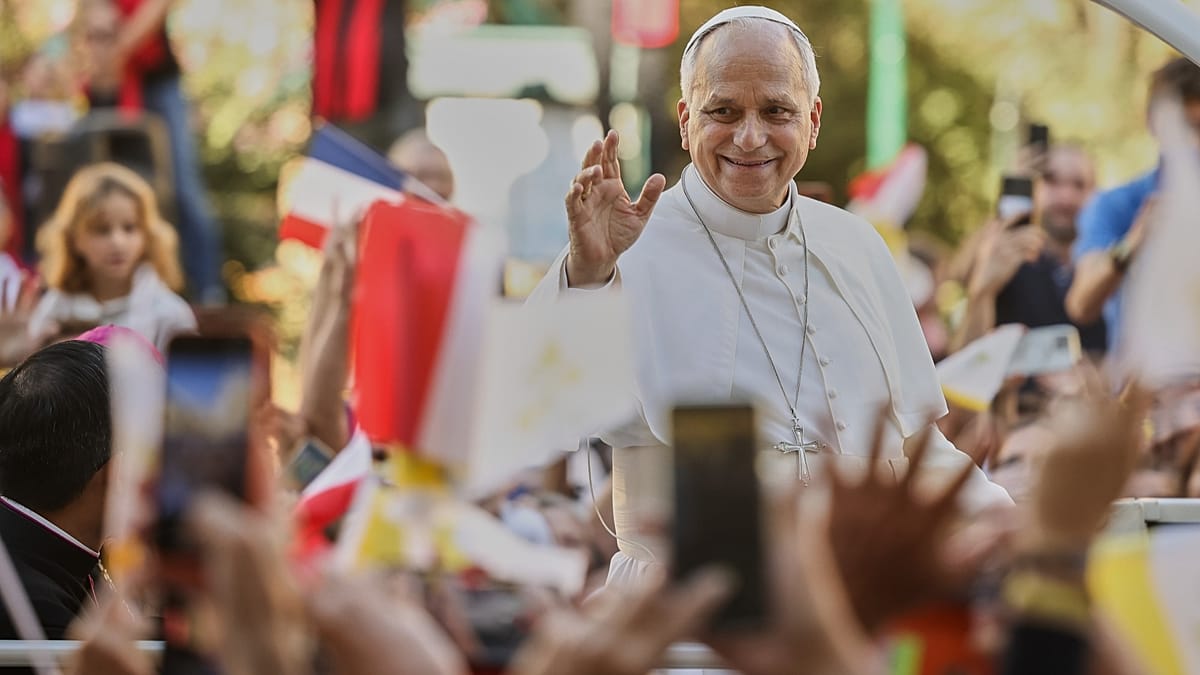
Who counted who came
Three hundred thousand in the popemobile. Eighty thousand at the Stade de France vigil. Six hundred thousand assembled on Place de la Concorde — a number that would have required four Louvres worth of attendees, standing shoulder to shoulder from the Tuileries to the Seine.
That last figure is the headline. The smaller ones are the signal.
The Vatican did not publish this visit to generate photographs. It published it because 600,000 is a demographic statement. France has spent roughly two centuries negotiating its Catholic past — the Revolution stripped the Church of land, the Third Republic expelled its orders, the 1905 law separated church from state with such vigor that the memory still shapes French politics. The Church’s institutional footprint in Paris today is modest: a handful of diocesan associations, two cathedrals open to pilgrims, a Catholic Institute that counts baptisms the way other civic bodies count births.
And yet. Three hundred thousand people filling the streets for a moving pontiff. Eighty thousand young people choosing a vigil over a Saturday afternoon.
That is not nostalgia. That is attendance.
The migration pivot — and what it costs
Saturday morning, before the mass, Pope Leo visited Maison Bakhita, a diocesan association that welcomes migrants. Several of them — Christians, Muslims — met him personally. That choreography is deliberate. The Vatican has been repositioning its migration rhetoric for years, but doing so on French soil adds a dimension that exists nowhere else in Europe.
France receives fewer migrants than Italy or Germany, but it debates them more fiercely. The political vocabulary around immigration in Paris is sharper, more abstract, more tied to republican identity than to labour-market reality. A pope who arrives and immediately shakes the hands of Muslim and Christian migrants in a Parisian district is making a statement about who belongs in the French imagination — a statement that lands differently here than it would in Madrid or Rome.
Karine, a Maronite from Paris, told Euronews she was praying intensely for the Middle East. Her presence in that crowd — Eastern Catholic, French citizen, displaced by regional conflict — is exactly the kind of human detail the Vatican wants remembered. She is also the kind of detail that complicates the simple narrative of a Church welcoming everyone: Maronites fled Lebanon’s wars; they do not arrive in Paris as tourists.
The baptism signal
At the Catholic Institute of Paris, Pope Leo welcomed the rise in baptisms. This is the quietest data point in the report and arguably the most important.
France has roughly 4.6 million Catholics in a population of 68 million — about 7% of the total, down from roughly 80% a century ago. The Church has accepted that trajectory as irreversible for decades. Baptism numbers in metropolitan France flatlined or declined through the 2010s. A reversal, even a small one, would reshape how European bishops think about secularism.
The Vatican does not publish baptism statistics separately for each diocese, so “the rise” is reported by the Institute’s own account rather than by a universal table. Even so, the pope’s public welcome carries institutional weight: it tells French priests that growth is possible and it tells lay organizers that their work matters. In a Church that has spent decades managing decline, that shift in tone is a strategy in itself.
France as the unexpected frontline
Several analysts have noted the parallel between this visit and previous papal stops in secular Europe — Madrid, Lisbon, Prague — but the Paris case is distinct. Those cities host Catholic majorities by cultural habit even when they do not by practice. France hosts a Catholic minority that has spent generations defining itself against the state.
French secularism, or laïcité, is not simply the absence of religion from government. It is a constitutional commitment to keeping religion private, to framing civic identity in terms that exclude denominational language. The Church has learned to live within that framework; it has not stopped trying to expand its voice inside it.
A popemobile route through central Paris, past monuments that have hosted revolutions and republican marches, with 600,000 people lining the street — that image does not argue against laïcité. It argues alongside it. It says: we are still here, we are visible, we are not asking to govern, we are asking to be counted.
Why Lourdes matters next
The day ended with a flight to Lourdes. That is not incidental. The shrine attracts roughly 5 million visitors annually — more than the Eiffel Tower, more than Versailles. It is one of the few places in France where religious attendance remains genuinely mass-scale, and it sits in a country that otherwise struggles to fill cathedrals on Sundays.
A pope who moves from a migrant shelter to a baptism institute to a crowd of 600,000 and then to Lourdes is tracing a line: the Church is present among the displaced, it is present at the threshold of conversion, it is present in public space, and it is present at the ancient sites of devotion. Each stop answers a different charge against institutional religion — that it is irrelevant, that it is exclusive, that it is private, that it is backward.
None of those charges disappear after a single visit. But the arithmetic changes. Three hundred thousand is a number that French newsrooms will sit with for months. Six hundred thousand is a number that policymakers will sit with longer.
What happens next
The immediate question is whether the baptism rise holds. Institutional momentum in France moves slowly; a single papal visit cannot sustain a trend that depends on parish staffing, catechesis funding, and the willingness of young families to register children. What it can do is shift the internal calculus of French bishops — from managing attrition to experimenting with recruitment.
The migration emphasis will also reverberate. France’s political debate around immigration is not resolved by papal photographs, but the Vatican’s decision to make that its opening act in Paris sends a clear message to European Catholic networks: the Church’s moral vocabulary on displacement is not secondary to its sacramental life. It is central.
And the 600,000 figure will enter the historical record. It may be the largest single Catholic gathering in French secular history — a number that previous popes did not reach in metro Paris, even during Jubilee years. Whether that represents a rebound or simply a convergence of the already-devout remains to be seen. But it is a baseline from which the next decade of French Catholicism will be measured.