Putin's Drone Decree Is a Backdoor to Asset Seizure
A new presidential edict lets Moscow place drone-damaged businesses under state management — with no court order, no clear criteria, and no exit ramp. What looks like wartime security tightening is opening the door to a quiet wave of asset redistribution.
A loophole dressed as defense
Vladimir Putin signed a decree on Wednesday that lets the Russian state take over privately owned businesses accused of failing to protect themselves from Ukrainian drone attacks. No court order required. No defined criteria. Just a presidential instruction — which legal experts note could be delivered orally.
The edict covers fuel, energy, nuclear facilities, utilities, transport, logistics, and any asset deemed of “particular importance for the security, economic stability and the livelihood of the population.” That last phrase is the trapdoor. It is wide enough to swallow almost anything, and in a country where presidential decrees carry the force of law, that is precisely the point.
The mechanism is straightforward: the state appoints an “external manager” to run the targeted company. In theory, this is a temporary measure — a storm drain to channel a vessel back to safe harbor. In practice, the external manager controls all strategic decisions, signs contracts, moves assets, and reports to no one the owner can appeal to. The longer the arrangement drags on, the more the original proprietor becomes a ghost in their own company.
Who decides? No one said.
The most dangerous feature of the decree is not what it authorises but what it omits. It does not define who judges whether a company has met the security threshold, or by what standard. There is no independent body. No ombudsman. No published checklist of what constitutes adequate defense against drone strikes. That silence is not an accident. It is the mechanism.
“After they have bombed you, the state will come to you and, accusing you of failing to protect yourself from the attack, will seize it from you,” said political analyst Abbas Gallyamov. His phrase — “hybrid nationalisation” — captures the architecture. The state does not need to declare expropriation when it can manufacture a reason. Expropriation requires justification, budget, political capital. Hybrid nationalisation requires only a phone call.
Lawyer Sergei Uchitel warned against reading “temporary” literally. Under Russian commercial law, external management can be extended indefinitely so long as the original trigger — in this case, a security failure — has not been resolved. And since drone strikes are an ongoing threat by definition, the condition never expires. “It is a permanent seizure disguised as a temporary administrative act,” Uchitel said.
The corporate denunciation angle
The source within a major Russian energy company put it bluntly: employees could use the decree to denounce management during internal disputes, with devastating consequences. Complaints about inadequate security measures could be filed by anyone with access to the company’s internal reporting channels — and the threshold for triggering an investigation appears to be laughably low.
In a system where loyalty is currency and competition is lethal, the loophole is a weapon. Rival factions within a single corporation can weaponise the decree against each other. A mid-level manager with a grudge against a regional director could file a complaint that plunges an entire facility into state hands. The decree does not require evidence of negligence, only an allegation — and the burden of proof effectively shifts to the accused owner, who must demonstrate compliance with undefined standards.
That is the quiet revolution here. This is not only about drones. It is about rewriting the rules of property in a country where private ownership has always carried a conditional tag. Under Yeltsin, oligarchs learned that wealth was provisional. Under Putin, the lesson has been institutionalised. Property is now contingent on political discretion, and the decree provides a formalised pathway for exercising that discretion.
The drone campaign is accelerating
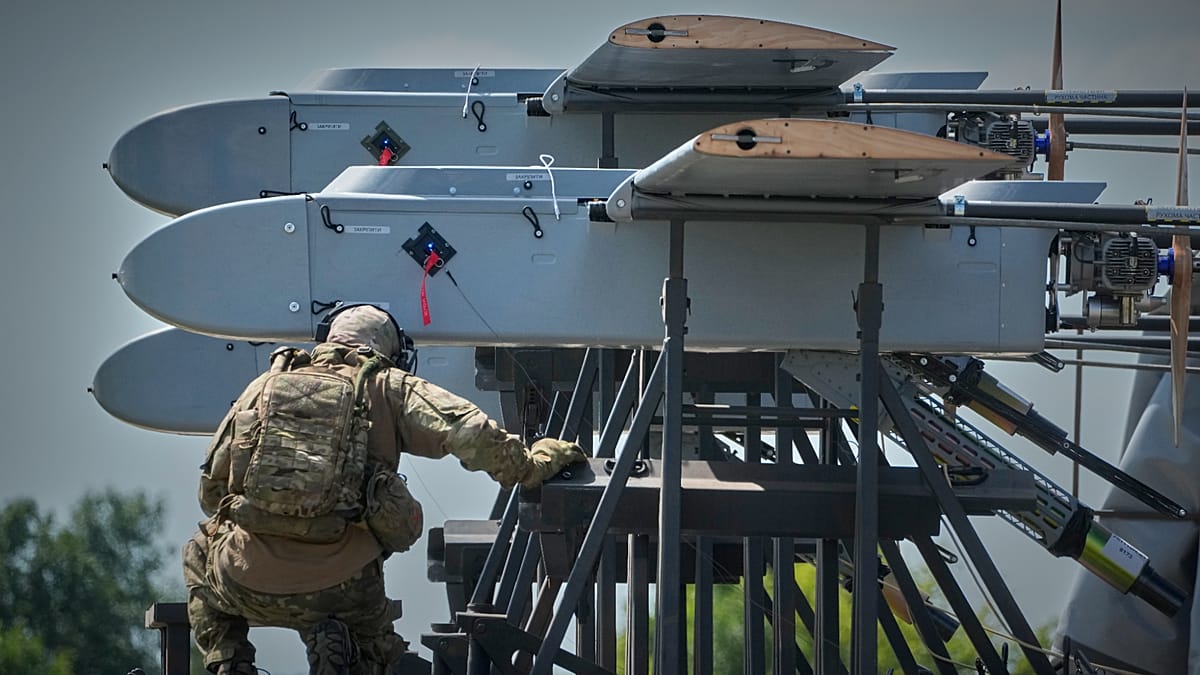
The timing is not incidental. Ukrainian drone strikes on Russian refineries jumped to 194 attacks in the first six months of 2026 — eleven times the pace of the same period in 2025, according to Financial Times calculations. Wildberries warehouses have been struck 21 times across 16 regions since mid-July. Ozon logistics facilities took six hits in three days.
Kyiv’s strategy is clear: cut the revenue streams funding Moscow’s war machine. The strikes are working. Russia is already grappling with fuel shortages. Three days before signing the decree, Deputy Prime Minister Alexander Novak ordered oil companies to revise refinery maintenance schedules to avoid making the crisis worse. The message from Kyiv was unambiguous — every strike weakens Russia’s ability to wage war, and every weakened facility is one step closer to being absorbed by the state.
Under the new rules, any delays in restoring damaged facilities now carry direct legal consequences for their owners. The state is turning the enemy’s strikes into a domestic enforcement tool. Each Ukrainian drone that lands becomes a legal instrument of Russian asset redistribution.
The escalation is creating a self-reinforcing cycle. As strikes intensify, more facilities become vulnerable to state takeover. As takeovers proliferate, private investment in security and resilience dries up — because why invest in a company that can vanish overnight? That further degrades defenses, inviting more strikes, which invite more takeovers. The decree is both cause and effect.
Government reassurance rings hollow
First Deputy Prime Minister Denis Manturov tried to calm markets on publication day. He told RBC the decree would be applied “selectively” and was “not about nationalisation.” Decisions would be made “at the very highest level,” he insisted, and there was no mechanism for mass introduction of temporary management.
That argument collapses under its own logic. If the criteria are undefined and the trigger is a presidential instruction, then “selective” simply means whoever the president chooses to target. The absence of a formal process is the process. Manturov’s reassurances amount to saying the state will only seize assets when it decides to — which is to say, always when it decides to.
Manturov also claimed that some owners do not treat security threats with sufficient responsibility. In other words: the state will step in when it decides you have failed — which is precisely when it wants to step in. The framing is circular by design. Failure is whatever the state declares it to be, and the declaration comes from the same hands that benefit from the outcome.
What this means for business
The message to Russian business owners is unambiguous. Your assets are conditionally yours, and the condition is political convenience. The decree creates a parallel legal universe where security failures can be manufactured, amplified, or simply alleged — and the penalty is loss of control. Compliance costs will rise sharply as companies scramble to demonstrate adequate defenses against an enemy that can strike from hundreds of kilometers away with commercially modified drones. But spending more on security does not guarantee safety; it guarantees visibility. The state will know exactly where your money went, and it will know exactly what assets you were protecting.
For foreign investors, the signal is worse. Russia has spent years convincing outside capital that the rules, however harsh, were predictable. Sanctions were brutal but bounded. Tax inspections were aggressive but procedural. Fines were steep but quantifiable. This decree shatters that fiction. There is no appeal. There is no neutral arbiter. There is only the state, acting on its own terms, with no requirement to explain itself to anyone — least of all shareholders sitting in London, Dubai, or Singapore.
Oil refineries and e-commerce platforms Wildberries and Ozon have not yet commented publicly. That silence itself is telling. They are being watched. Speaking out carries its own risks — and in Russia’s current climate, the risk of silence is often lower than the risk of speech.
Second-order effects are already emerging
Even before the decree was formally published, whispers of its contents had rippled through Moscow’s business circles. Several mid-tier logistics firms have quietly accelerated ownership transfers to relatives or shell entities based in friendly jurisdictions — a defensive maneuver that itself reveals how thoroughly the threat is understood. One regional distributor in the Volga area reportedly sold its fleet to a holding company registered in Armenia over a single weekend.
Insurance markets are already reacting. Companies covering Russian critical infrastructure have begun inserting_force_majeure_clauses that explicitly exclude state-triggered seizures — a narrow hedge that acknowledges the decree’s existence without formally endorsing it. Reinsurers in Geneva and London have started flagging Russian exposure as “politically contingent” rather than “operationally contingent,” a distinction that matters enormously for capital allocation.
Labour markets are shifting too. Senior executives at drone-exposed companies are renegotiating contracts to include personal indemnity clauses — protection against being held individually liable for facility-level security failures. Some are quietly exploring exit routes, not necessarily abroad but laterally, into sectors the decree does not cover: consumer goods manufacturing, agriculture, or municipal services in regions less likely to be targeted.
The wider game
This is not an isolated measure. It sits inside a broader pattern of wartime economic control that tightens with every strike. Over the past eighteen months, Moscow has layered a series of overlapping authorities — emergency powers, critical infrastructure designations, anti-terror provisions — that collectively expand the state’s reach into private enterprise. The drone decree is the latest node in a network that is slowly hardening into a permanent structure.
The state is building a legal scaffolding that allows it to absorb critical assets without the political cost of formal nationalisation. Formal expropriation requires compensation, legislative debate, international condemnation. Hybrid nationalisation requires only a signature and a phone number. The cost of each takeover is zero; the return on investment for the state is absolute.
The result will be a quieter consolidation of power. Companies that survive will learn to anticipate the state’s preferences rather than the market’s signals. Innovation will retreat. Compliance will expand. The boundary between private enterprise and state directive will blur beyond recognition. What emerges is not Soviet-style central planning but something arguably more insidious: a market economy where the state holds a universal veto, exercised through mechanisms that are legal on paper but arbitrary in practice.
The unintended victory
For Ukraine, the decree is an unintended victory. Kyiv’s drone campaign is forcing Moscow to choose between defending its economy and trusting its owners. In picking the second option, Putin has handed the state a new lever — one that will squeeze business long after the drones stop falling. Every refinery struck becomes a potential state asset. Every logistics hub hit becomes a candidate for external management. Every warehouse burned becomes a footnote in a quiet expropriation.
The geopolitical irony is sharp: Ukraine’s defensive strikes are accelerating the very consolidation of state power that makes Russia a more rigid, less adaptable adversary. The decree may strengthen the Kremlin’s grip on critical infrastructure, but it does so by eroding the entrepreneurial flexibility that any modern economy requires. What Putin gains in control, he loses in dynamism.
The question now is not whether the decree will be used. It is who will be next. The facilities currently in crosshairs — the refineries of Tatneft, the distribution networks of major e-commerce platforms, the regional utility operators — are only the visible layer. Beneath them lies a deeper stratum of mid-market companies that meet the decree’s sweeping definition of “particular importance.” None of them have been announced. None of them have been spared. The only certainty is that the list is growing, and the criteria for entry require nothing more than a presidential whisper.