Putin's Open Door to Europe Reshapes Ukraine Peace Talks
Moscow's reported willingness to include European representatives in Ukraine peace negotiations signals either a real diplomatic opening or a calculated move to drive wedges between Washington and its allies. What changes — and who loses ground.
A Door Crack, Not Wide Open
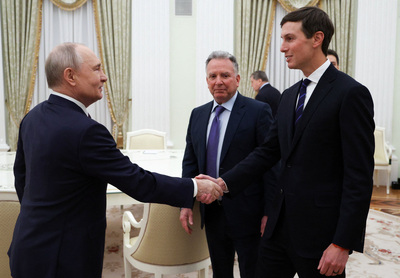
Steve Witkoff returned from Moscow with a statement that sent ripples through diplomatic capitals on Friday: Vladimir Putin has reportedly signaled he would allow European representatives to participate in the next round of Ukraine peace negotiations. Jared Kushner echoed the point bluntly — without Europe at the table, there is no deal.
The problem is that neither the Kremlin nor Putin himself has formally confirmed this. The New York Times reported Saturday that Moscow has offered no official acknowledgment. Yuri Ushakov, the president’s foreign policy aide, offered only the vaguest deflection, saying merely that Europeans are making “every effort” to join — a phrase that could mean anything from genuine preparation to diplomatic theater.
That ambiguity is itself telling. Putin appears willing to float the idea, let it generate expectations, and then control how far it goes. That is a familiar Kremlin playbook.
What Putin Actually Said
The details matter. During the November 12 audience at the Kremlin — held immediately after the Abu Dhabi trilateral negotiations concluded — Putin told his American visitors that Russia has never opposed dialogue with the EU and that Europe broke communications, not Moscow. He framed the issue as Europe choosing isolation over engagement.
Then came the hard boundary: Putin stated explicitly that he opposes any deployment of European troops to Ukraine under a future settlement. He called such a scenario a threat to Russian security and predicted it would restart the war.
He also issued what amounted to a challenge directed at Washington — asking American envoys to help their European allies “decide whether they truly want peace or war.” It is a neatly crafted framing that puts European leaders on the spot, forcing them to justify their positions publicly while sidestepping any direct commitment from Russia itself.
Tatiana Stanovaya, a senior fellow at Carnegie Russia Eurasia Center, put it plainly: if Europe does enter the talks, Putin will likely interpret it as validation of his long-standing strategy — that Moscow simply needs to wait out European patience and political fragmentation until concessions become inevitable.
Who This Benefits First
Europe faces an immediate and awkward calculus. On one side, participating in negotiations gives the EU and individual member states a seat at a table that could reshape the security architecture of the continent for decades. On the other, attending without guaranteed outcomes risks legitimizing terms favorable to Moscow and reinforcing the narrative that sustained resistance fractures Western alliances.
Finland’s President Alexander Stubb, who recently spoke with Putin alongside Norway’s Prime Minister Jonas Gahr Støre, acknowledged the moment modestly — noting that a real possibility of European participation exists and calling it progress. But acknowledging possibility is not the same as securing influence. If European delegates arrive at a negotiating table where territorial concessions have already been informally discussed behind closed doors with American intermediaries, their presence becomes ceremonial rather than decisive.
Kyiv’s position is the most compressed. Volodymyr Zelensky welcomed the news from Dublin, expressing hope that ceasefire and tension-reduction measures would appear on the agenda. His phrasing — that everything must return to normal processing — carried the quiet urgency of a leader aware that negotiation momentum shifts toward whoever controls the narrative of exhaustion.
Zelensky cannot afford to oppose European inclusion; it would look like Kyiv resisting broader international engagement. But he also cannot afford a process where Europe negotiates Russian demands independently and then presents a finished framework to Ukraine as fait accompli.
The NATO Fracture Risk
This is where the stakes extend well beyond any single negotiation session. Russia has long argued that a new European security order requires direct dialogue with the EU — an explicit challenge to NATO’s centralized role in defending Eastern members. If individual European capitals begin parallel tracks with Moscow, the alliance’s coherence weakens not through any dramatic rupture but through incremental divergence.
Germany, France, and Poland already hold markedly different views on how much leverage Ukraine retains and what concessions might be acceptable. A negotiated settlement that includes European state actors alongside American mediators multiplies those fault lines instead of bridging them.
Washington’s strategy — routing negotiation authority through Trump-affiliated figures like Kushner and Witkoff while formally sidelining European institutions — carries its own contradictions. It maximizes speed but minimizes durability. Deals struck outside institutional frameworks tend to unravel when political winds shift, and the next administration may have little incentive to honor agreements made by its predecessor’s informal channels.
What Happens Next
Several scenarios deserve attention. The first is the simplest: Moscow continues using the promise of European participation as leverage without meaningfully intending to follow through, keeping pressure on Kyiv and dividing NATO members who interpret the signal differently.
A second scenario involves actual European delegations arriving at a negotiating table where substantive boundaries have already been defined. This would be the worst outcome for Kyiv — participation without power, visibility without leverage.
The third, less probable but possible, is that European involvement forces transparency into a process otherwise dominated by back-channel discussions between Washington and Moscow. If Brussels insists on formal representation and publishes its red lines, it complicates rushed deals built on ambiguity.
None of these paths guarantee Ukrainian sovereignty will be preserved intact. But they do reveal who holds initiative right now. Putin has moved the conversation from “whether Europe participates” to “on what terms” — a deliberate reframe that places the burden of next moves on Kyiv, Brussels, and Washington rather than on Moscow. The question is no longer whether the door opens. It is who gets squeezed when it does.
The Bottom Line
Until Russia formally confirms European participation, the announcement should be treated as a probe, not a breakthrough. The strategic value to Putin lies partly in the uncertainty itself — keeping allies guessing, testing how eagerly European capitals pursue access, and creating conditions where division looks like diplomacy. For Ukraine, the warning is simple: every seat at the negotiating table gains legitimacy for whoever controls what sits on it.