Russia's 7-km Drones Expose NATO Air Defense's Ceiling Problem
Russia's jet-powered Geran-4 and Geran-5 drones are flying at 7 km — above the effective ceiling of most short-range air defense systems in Ukraine. The implications for NATO doctrine are larger than one battlefield.
The Ceiling Gap
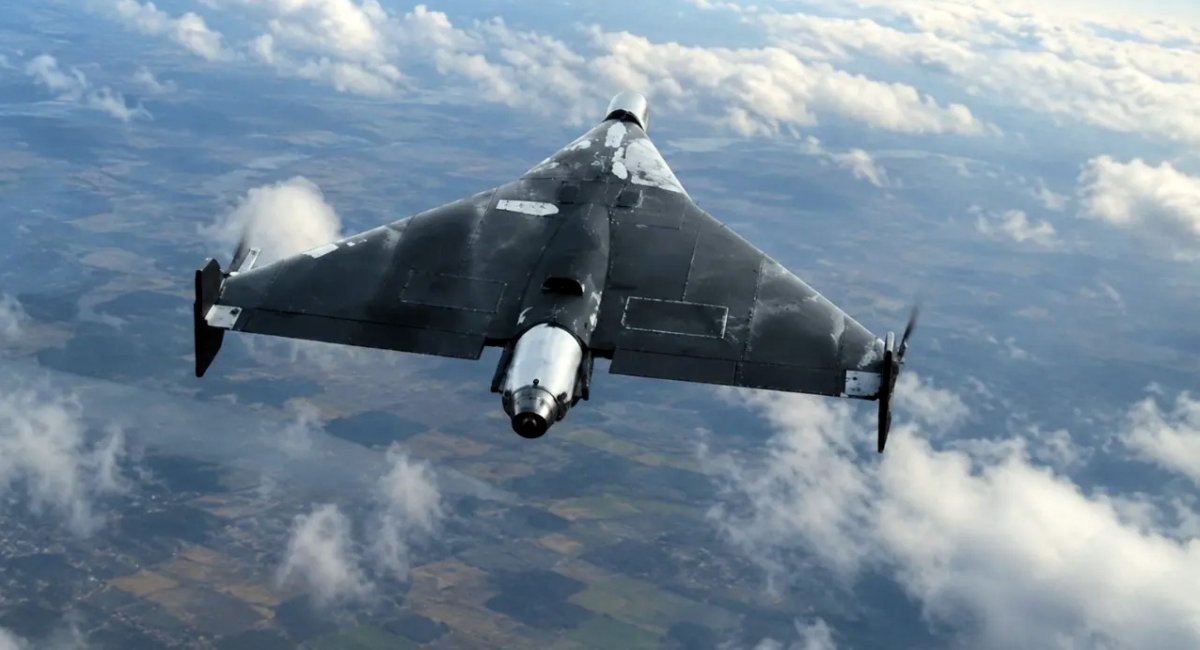
Russia has quietly solved a problem that has plagued its drone campaign since 2022. By flying jet-powered Geran-4 and Geran-5 drones at 7 km during their cruise phase, Moscow has placed the majority of Ukraine’s air defense envelope out of reach.
This is not a fringe capability test. Flight altitudes of approximately 7 km have been recorded in operational missions against Ukrainian targets. For context, a target at that altitude puts most of Ukraine’s integrated air defense picture into silence. The Gepard self-propelled anti-aircraft gun — one of the most widely used and effective systems in the country — can engage targets up to roughly 3.5 km. The Skyranger 35, a newer system operated by the 1020th Anti-Aircraft Missile and Artillery Regiment, tops out around 4 km.
Man-portable systems face an even steeper wall. The American FIM-92 Stinger reaches approximately 3.5 km. Poland’s Piorun gets to about 4 km. France’s Mistral 3 can engage at roughly 6 km — the highest among the systems discussed here. Even the IRIS-T SLS, one of the most capable short-to-medium range systems Western powers have supplied, has a stated engagement ceiling of about 6 km. A Geran-5 at 7 km sits above its radar lock.
The math is stark. An entire class of air defense systems — from the Gepard and Skyranger to Stinger, Piorun, and IRIS-T SLS — becomes irrelevant the moment the adversary chooses to operate a kilometer higher than the system’s published ceiling allows.
Why This Works
The conventional wisdom of low-altitude penetration has two components: terrain masking and reduced time in the engagement zone. A Shahed-type drone at 100 to 200 meters uses ground clutter to defeat radar detection. At 1 to 2 km, it is still within the reach of anti-aircraft artillery and anti-drone interceptors.
Russia’s high-altitude approach flips the logic. The drones remain clearly visible to radars. The advantage is no longer stealth — it is impossibility. A target at 7 km is detectable, trackable, and utterly unreachable by the systems that dominate the current Ukrainian air defense architecture.
This is not accidental. It reflects a deliberate shift in Russian doctrine that took years to mature. During the early years of the war, Russia flew propeller-driven Shahed drones at very low altitudes because that was the only way to penetrate defenses. When Ukraine adapted — developing mobile fire groups, upgrading anti-aircraft artillery, and fielding interceptor drones — Russia raised the flight altitude of propeller drones to 1 to 2 km. Those systems remained vulnerable. The next logical step was to build a platform that could operate where nothing in Ukraine’s inventory could reach it.
The answer came in the form of a turbojet-powered derivative, the Geran-4 and its follow-on, the Geran-5. These drones now operate in a flight regime that makes most of Ukraine’s layered air defense picture a series of gaps rather than a cohesive shield.
The Economic Problem
Even when systems can reach the target, the economics often cannot sustain the response.
Engaging a 7 km target requires medium- and longer-range surface-to-air missile systems. In Ukraine’s inventory, that means Buk-M1 platforms — including FrankenSAM configurations that have been refitted with RIM-7 Sea Sparrow missiles — and the IRIS-T SLM, the longer-range land-based variant of the same family.
These systems exist. They are limited in number. And firing a FrankenSAM or an IRIS-T SLM battery against a single Geran-5 is asymmetric in the wrong direction. A Geran-4 or Geran-5 costs a fraction of a FrankenSAM missile. The same is true for the IRIS-T SLM. Russia has demonstrated repeatedly that it can absorb losses at this exchange rate. Ukraine cannot.
Fighter aircraft represent the remaining economically viable option. F-16s equipped with APKWS in an air-to-air role can engage high-altitude drones at reasonable cost. But even this solution is imperfect. AIM-9 missiles are more expensive than the drones they intercept and are produced at rates far too low to sustain a war of attrition against thousands of launched systems.
The result is a defensive posture in which the most effective systems are either out of reach or prohibitively expensive to deploy against the actual threat being faced.
The Frankenburg Problem
The same ceiling gap applies to an entire generation of low-cost counter-drone systems that were designed to solve exactly this kind of problem.
The Frankenburg Mark I, a compact surface-to-air missile developed specifically for drone defense, can engage targets from the ground up to about 1.5 km. Systems built on the APKWS family face similar constraints. These were never intended to reach 7 km.
Interceptor drones face a different but related challenge. At 7 km, the air is thin enough that propeller-driven interceptors struggle to generate sufficient lift. The first interceptor must climb to that altitude before it can begin its engagement run. The second interceptor must climb through the same thin air while carrying the additional mass of guidance and control systems. The physics are unforgiving.
What This Means for NATO
The implications extend well beyond Ukraine. They touch the core assumptions underlying NATO’s air defense doctrine across Eastern Europe.
Most short-range and medium-range air defense systems fielded by NATO allies — Gepard, Skyranger, IRIS-T SLS, Stinger, Piorun — were designed and tested against threats that operate below 5 km. The assumption of a ceiling gap has never been a central design consideration because, historically, adversaries rarely operated above that line with swarm-capable platforms.
Russia’s shift changes that assumption. If a single adversary can systematically render the lower envelope of a NATO air defense network useless by choosing to fly at 7 km, the same logic applies to any other state actor that invests in similar capabilities.
The second-order consequences are already visible in procurement discussions. Defense ministries across Eastern Europe are reassessing the value of systems that top out at 4 or 5 km when the threat envelope has moved a full kilometer higher. The Gepard, which has proven extraordinarily effective at low altitude, is now partially obsolete by technicality alone. The Skyranger faces the same calculation.
Procurement cycles move slowly. The Geran-5 does not need to wait. It is already at 7 km. Every month that NATO procurement boards spend evaluating whether to upgrade existing systems or buy new ones is a month in which the ceiling gap remains unaddressed.
The Production Constraint
Even if NATO decides to field new systems capable of engaging targets at 7 km and above, the production reality is unfavorable. Medium-range surface-to-air missile systems like the IRIS-T SLM and Patriot require batteries, launchers, and missiles that are produced in limited numbers. Expanding production takes years. Matching the launch rate of a drone campaign that can field thousands of systems per month is a different order of magnitude entirely.
This is not a novel problem. It has been described in the literature as the “cost exchange” challenge of drone warfare. But the altitude dimension adds a second constraint. It is not only about cost per shot. It is about the fact that an entire class of systems — the ones that were supposed to provide the dense, layered coverage that makes air defense credible — simply cannot reach the target.
The Future Architecture
The operational pattern is clear and likely to persist. Russia will continue flying jet-powered drones at altitudes that exceed the engagement ceiling of most short-range systems. Ukraine will continue relying on Buk and IRIS-T SLM batteries for high-altitude coverage, supplemented by fighter aircraft when available. The economics will remain asymmetric in Russia’s favor.
The broader strategic lesson is equally clear. Any air defense architecture that assumes a ceiling below 7 km is operating with a blind spot. As jet-powered drone technology continues to improve — in range, endurance, and altitude capability — that blind spot will widen rather than contract.
The question for NATO is not whether to address the ceiling gap. The question is how quickly it can be done before the gap becomes not just a problem but a doctrine.