Russia Rehearses Invasion of Central Asia With Chinese Tanks
Center-2026 drills show Russian forces practicing seizure and occupation of a neighboring Central Asian state, with Chinese PLA tanks on display. The exercise signals contingency planning far beyond the CSTO's stated mission.
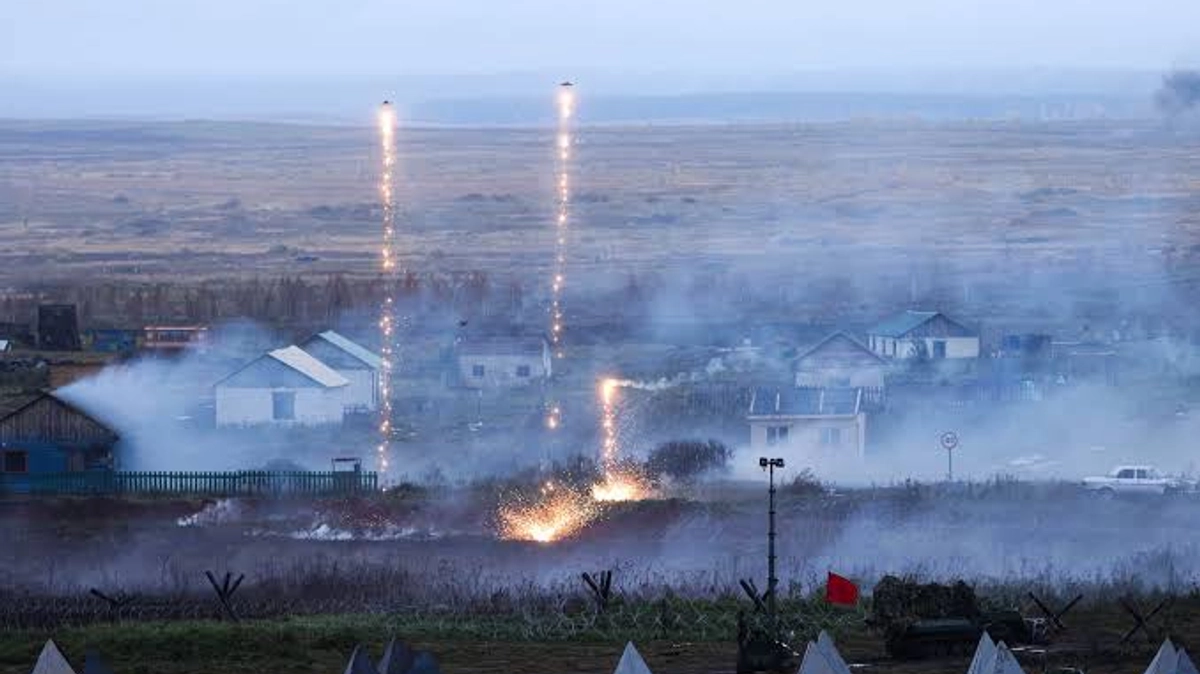
The Exercise Wasn’t About Defense
Center-2026, Russia’s largest strategic military drill of the year, concluded on October 3 in Chelyabinsk Oblast with a scenario that says far more about Moscow’s intentions than its stated purpose. Forty-seven thousand personnel, 2,000 pieces of equipment, 90 aircraft, and 77 warships took part. But the numbers that matter are buried in Deputy Defence Minister Yunus-bek Yevkurov’s report to Vladimir Putin.
The coalition force, he said, was conducting offensive operations to “liberate the captured territory and create a security zone in the adjacent territory.” This was not a defensive exercise. It was a rehearsal for invasion and occupation.
The target, almost certainly implied, is Kazakhstan. It shares a border with Chelyabinsk Oblast. It has Caspian Sea access, which figured in the scenario’s Caspian security objective. Four long-range aircraft conducted strikes against simulated critical infrastructure belonging to the aggressor. The geography is not ambiguous.
The Secret in the Details
Russia’s defence ministry confirmed that the units involved were not currently deployed in Ukraine. Putin himself stressed that all tasks were being conducted with Ukrainian combat experience in mind. The implication is deliberate: Russia is treating its war in Ukraine as a live training laboratory, and the lessons are being applied to a second potential theater — one far from Ukraine’s borders.
This is the non-obvious takeaway that Western reporting has mostly missed. Center-2026 is not a standalone drill. It is a testing ground where commanders practice combined-arms operations, then file those tactics away for future use. The “security zone” language mirrors the exact terminology Moscow used when describing its initial objectives in Ukraine: seize territory, establish a buffer, isolate the capital’s authority. The template is familiar.
Why China’s Tanks Matter
A contingent from China participated in Center-2026, and PLA armor was visible. This is not routine. China is not a CSTO member. Its presence signals something strategic: Moscow wants Beijing to see the Central Asian flank, and Washington needs to know it saw it too.
For Kazakhstan, the message is unambiguous. Russia has two neighbors — China to the east and Russia to the north. Both powers fielded forces in a drill that practiced occupying Kazakh territory. For a country that has carefully balanced between Moscow and Beijing since independence, that is a narrowing corridor.
Kazakhstan has already felt Moscow’s pressure. In January 2022, it called on the CSTO for help during domestic unrest, and Russian-led troops entered the country — briefly, then withdrew. The episode exposed the CSTO’s asymmetry: Russia could deploy into Kazakhstan instantly, but Kazakhstan had no reciprocal claim on Russian soil. Center-2026 makes that structural imbalance explicit.
The History Is a Pattern
Russia has rehearsed this scenario before. Centre-2015 drew roughly 95,000 personnel. Centre-2019 mobilized around 128,000 and included a scenario neutralizing a simulated hostile state in southwestern Russia accused of starting a war and spreading terrorism. The language was always about liberation and security zones. The geography always pointed toward Central Asia.
Each iteration has grown in scale and sophistication. Center-2026 continues that arc. The inclusion of Pakistani and Mongolian contingents alongside CSTO members suggests Moscow is also testing interoperability with partners outside the alliance structure — a signal to New Delhi and Ulaanbaatar, and to Washington watching from a distance.
Who Wins, Who Loses
Moscow wins the most obvious advantage: it retains the option to intervene militarily in Central Asia without triggering a formal declaration of war. The CSTO framework provides plausible deniability. The “security zone” concept provides legal cover. Ukrainian combat experience provides operational refinement.
Kazakhstan loses the most. Its sovereignty is theoretically respected in Nur-Sultan’s diplomacy, but Center-2026 reminds every policymaker in the country that Russia has the capacity to move forces across the 7,500-kilometer border at short notice. The exercise validates fears that have lingered since the 2022 CSTO deployment.
China gains strategic visibility. Its tanks in a Russian drill on Kazakhstan’s doorstep tell Ulaanbaatar, Astana, and Washington that Beijing is willing to operate alongside Moscow in ways that go beyond economic cooperation. The Belt and Road Initiative has invested heavily in Central Asian infrastructure. Security for those investments now has a military dimension.
Washington loses influence it never fully held. The United States has no formal security commitment to Central Asia, and Center-2026 reinforces that reality. Regional capitals are being reminded that their security architecture is dominated by two powers — one nuclear-armed and actively fighting a war, the other economically dominant and militarily present.
What Comes Next
The exercises ended October 3. But the political fallout will extend well beyond the training grounds in Chelyabinsk. Kazakhstan’s leadership will interpret Center-2026 through the lens of January 2022 and decide whether further diversification of its security relationships — perhaps deeper ties with Turkey, India, or even quiet engagement with NATO’s Partnership for Peace — is necessary.
Russia’s defence ministry will publish after-action assessments. Those documents will likely refine the invasion playbook for a Central Asian theater, incorporating lessons from Ukraine about urban combat, drone warfare, and information operations. The next Center exercise may not be three years away.
The most important line in the entire drill was Yevkurov’s. “Creating a security zone in adjacent territory.” That is not defensive language. It is the vocabulary of conquest, practiced in full view of the world.