The Russia-North Korea Bridge Is a Sanctions Bypass, Not Just a Road
The new road bridge over the Tumen River is infrastructure with a deeper purpose. It formalizes a sanctioned corridor between two pariah states and gives Moscow and Pyongyang a physical link beyond trains and flights.
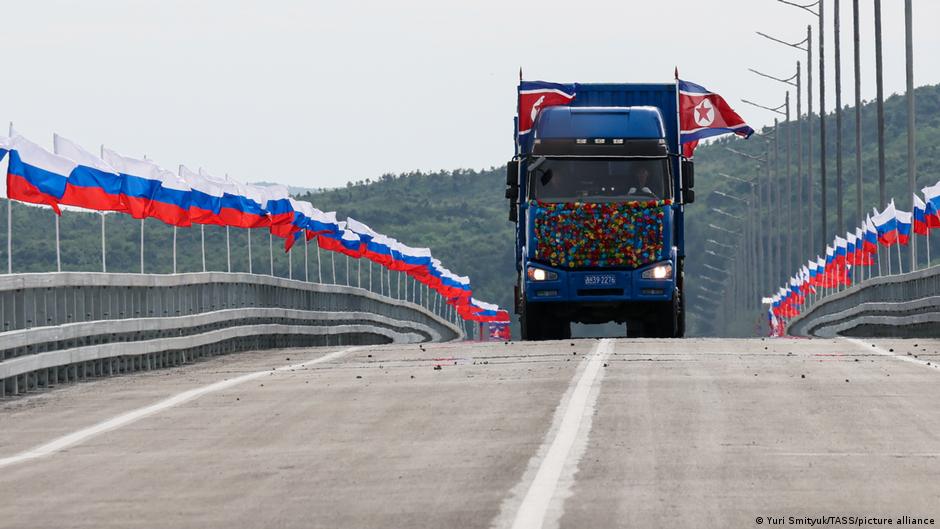
A bridge with two names
The new crossing over the Tumen River has an official name — it carries the title of Yakov Novichenko, a Soviet Red Army officer credited with saving Kim Il Sung’s life during the Korean War. But the bridge also has an unofficial name, one whispered in sanctions-enforcement circles: the loophole.
Russia and North Korea cut the ribbon on Monday. It is the first road bridge connecting the two countries, completing a trio of transport links that now includes the 1959 Friendship Railway Bridge and direct air corridors. The ceremony was staged near the old rail crossing, a deliberate choice that tied the present moment to a half-century of Soviet-Korean infrastructure cooperation.
Relatives of Novichenko attended. Russian Prime Minister Mikhail Mishustin joined by video link. The symbolism was polished; the substance is what matters.
The geometry of evasion
A road bridge between two sanctioned states sounds like a modest infrastructure project. It is not. It is a sanctioned-state trade corridor in physical form.
Both Russia and North Korea have been subject to sweeping international sanctions since 2022 — Russia for its full-scale invasion of Ukraine, North Korea for its nuclear program and human rights record. The sanctions regimes prohibit or severely restrict trade in energy, metals, arms, luxury goods, and financial services. They also criminalize assistance to sanctioned entities. A road bridge changes the calculus of how goods move between the two countries, and how third parties facilitate that movement.
Prior to this bridge, overland trade between Russia and North Korea relied on the Friendship Railway Bridge, which carries rail traffic only. Trucks and heavy vehicles could not cross directly. They had to route through China — crossing into the Chinese side, transloading onto trucks, traversing Chinese territory, and re-entering North Korea. That route adds weeks, cost, and a third sovereign jurisdiction that can be pressured into inspection and delay.
The new bridge removes that friction. Trucks can now drive straight from Russia into North Korea. The same applies in reverse. The Tumen River crossing does not create new trade volumes overnight, but it removes a structural bottleneck that previously made overland road transport impossible between the two countries.
Why now matters more than what
Construction began in April 2025, shortly after Putin’s visit to Pyongyang in 2024, when the two leaders signed a comprehensive strategic partnership agreement that included explicit provisions for transport infrastructure. The timing is notable because the bridge opens as Russia faces intensifying Western enforcement of its sanctions regime — the EU has imposed multiple packages, the US has expanded secondary sanctions, and global shipping companies have been instructed to avoid Russian ports.
North Korea, meanwhile, has been quietly rerouting its trade through alternative channels since 2022. Shipments of coal, minerals, and labor have been diverted through intermediary states. Arms exports — particularly artillery shells and missiles to Russia — have been documented by Western intelligence. The bridge formalizes what has been operating in the shadows.
The presence of North Korean troops in Russia’s Kursk region, confirmed by multiple open-source reports, signals that this partnership is not limited to trade. It is military as well. A road bridge enables logistics — the movement of equipment, supplies, and personnel — that rail cannot accommodate with the same flexibility.
Who wins, who loses
Russia wins最直接: a second overland supply route to a country that produces many of the components Russia needs — rare earths, certain industrial metals, and in recent months, ammunition. North Korea wins access to Russian energy, machinery, and technology that it cannot easily obtain elsewhere. Both win the political signal: a physical monument to a relationship that Western capitals have treated as peripheral.
The losers are harder to name precisely because the beneficiaries prefer opacity. But the European Union and its allies lose credibility in their sanctions architecture. Every new physical link between sanctioned states erodes the assumption that isolation works. The bridge tells other sanctioned actors that alternatives exist — and that they can be built with enough political will.
Third-party enablers also lose. Chinese and Southeast Asian firms that previously profited from being the intermediaries through which Russia-North Korea trade flowed now face a more direct route. The bridge compresses their role, though it does not eliminate it entirely. Much of the high-value goods still transit through China because of North Korea’s limited road infrastructure on its own side.
What happens next
The bridge itself is the easy part. The harder question is what flows across it. Russia and North Korea have both indicated ambitions for increased trade volume, but concrete targets remain vague. No customs data has been released. No inspection protocols have been publicized.
What is likely is gradual escalation. The bridge lowers the barrier to trade; once trucks begin crossing regularly, the volume follows. Energy shipments from Russia into North Korea, industrial goods in the reverse direction, and potentially dual-use items that Western inspectors would flag. The bridge makes all of that easier to hide inside legitimate commercial traffic.
The naming of the bridge after Novichenko — a figure from the 1950s — is worth watching. It frames the partnership as a return to a Cold War-era alliance, not an adaptation to contemporary conditions. That framing serves domestic audiences in both countries. It also sends a message to Washington and Brussels: the relationship is historical, not tactical, and will outlast any single administration.
The 1959 Friendship Railway Bridge still exists beside the new crossing. Trains continue to run across it. The road bridge will carry trucks. Together, they form a dual corridor — one for bulk freight, one for speed and flexibility. That combination is exactly what a sanctioned-state trade network needs to function at scale.
The ribbon was cut on Monday. The traffic will follow.