Russia's Shadow War on NATO: Why Poland's Warning Changes Everything
Polish intelligence has identified a credible Russian plan to launch 'accidental' drone strikes on NATO territory, a strategy designed to fracture alliance cohesion and test Article 5 commitments. The revelation forces a fundamental recalibration of European deterrence.
The Calculus of Plausible Deniability
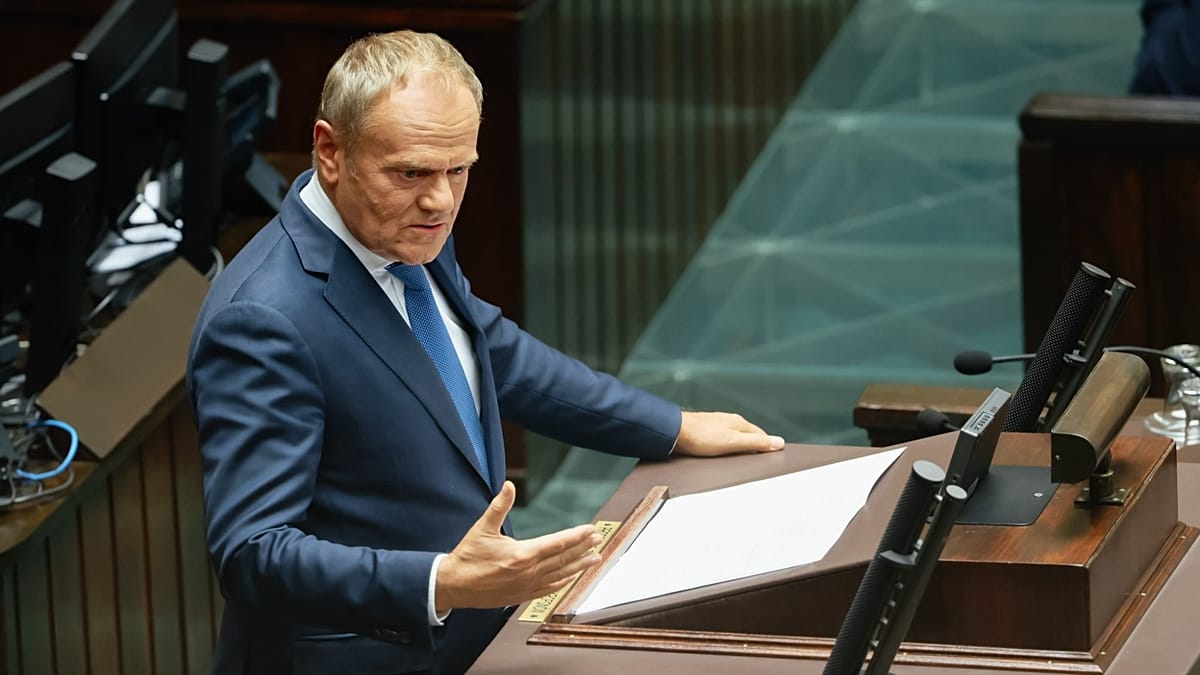
Donald Tusk did not mince words when he addressed the Sejm on Tuesday. The Polish prime minister presented intelligence assessments describing what he called “the most probable scenario for the coming few months” — a winter offensive by Russia that would include drone and missile strikes on NATO territory, specifically Poland. The timing, he noted, aligns with late autumn and early spring being identified as the most critical phase of the Russian-Ukrainian conflict.
What makes this warning distinct from previous rhetoric is its specificity. Tusk described jet-powered drones operating at high altitude with significantly greater speed than previously deployed systems. “Hardly anyone is effectively prepared to counter them,” he acknowledged, signaling that European air defenses face an emerging capability gap. These are not the slow, propeller-driven drones seen in the early stages of the Ukraine war; they represent a qualitative leap that exploits vulnerabilities in existing interceptor architectures designed for slower, lower-altitude threats.
But the more strategically significant element of the Polish assessment is the predicted pattern of attack. Russia’s objective, according to Tusk, is not territorial conquest but psychological warfare — launching strikes that can be framed as “accidental” while deliberately testing whether NATO will actually invoke Article 5. This represents a deliberate doctrine of calibrated ambiguity, where the Kremlin orchestrates incidents designed to remain in the space between provocation and act of war.
The historical parallel is instructive but imperfect. Moscow’s 2014 hybrid campaign in Eastern Ukraine exploited precisely this gray zone, using unmarked soldiers and plausible deniability to achieve strategic gains without triggering a conventional response. The current strategy applies that same logic to NATO territory itself, targeting the alliance’s eastern flank with incidents calculated to create political paralysis rather than military catastrophe.
The Article 5 Problem
Article 5 has never been tested. It exists as both shield and symbol within the alliance, but its practical application remains unproven. Russia appears to be designing a strategy that exploits exactly this uncertainty.
The scenario Tusk outlined involves drones or missiles entering the territory of one or several NATO countries on the eastern flank, causing destruction, while the official narrative attributes the incident to accident rather than intentional aggression. If repeated such incidents occur, the cumulative effect would be to convince alliance members that collective defense commitments are theoretical rather than practical.
This represents a sophisticated understanding of NATO’s political vulnerabilities. The alliance operates by consensus, and even a single member state hesitant to respond to an attack could paralyze collective action. Tusk explicitly warned about politicians in Europe who are “just waiting for an alibi” — those ready to argue that member states should not “die for Poland” or “perish for Latvia or Lithuania.”
The legal dimension adds further complexity. Article 5 requires an armed attack to be determined before collective defense obligations activate. A drone strike that causes limited damage but results in casualties creates a definitional battleground: is it an armed attack requiring response, or an isolated incident below the threshold? Russia’s strategy depends on generating enough ambiguity to make unified response politically impossible, regardless of the factual evidence.
The threat is not merely military but political. Russia is attempting to create conditions where Article 5 appears irrelevant through sustained ambiguity rather than dramatic escalation. Each incident that fails to trigger a robust response lowers the threshold for the next, creating a descending spiral of alliance credibility.
The Industrial Gap
Tusk’s acknowledgment that Europe lacks effective countermeasures against these new jet-powered drones points to a deeper structural problem. European defense industrial capacity has not kept pace with the requirements of modern aerial warfare, particularly regarding high-altitude, high-speed drone interception systems.
The number of locomotives destroyed by Russia in recent weeks — more than 300 Ukrainian railway engines — illustrates the scale of infrastructure targeting that defines this phase of the conflict. Similar attacks on energy infrastructure near Polish border crossings demonstrate how close the fighting has come to NATO territory without triggering alliance mechanisms. These strikes serve dual purposes: degrading Ukraine’s logistical capacity while testing NATO’s threshold for response.
European defense producers will face intense pressure to accelerate development and deployment of counter-drone systems, particularly those capable of engaging targets at high altitude and speed. The timeline Tusk described — with the coming months identified as critical — suggests that procurement processes may need to bypass normal bureaucratic delays. Emergency procurement frameworks already exist within NATO structures, but their activation requires political will that remains uneven across member states.
The supply chain constraints are substantial. Missile systems capable of engaging high-speed, high-altitude drones share components with air defense systems deployed across Europe. Diverting these stocks to forward positions could create vulnerabilities elsewhere in the alliance perimeter. This zero-sum dimension makes bilateral arrangements attractive to frontline states but potentially destabilizing to overall alliance posture.
Poland’s announced trip to Ukraine to discuss cooperation within an anti-ballistic coalition indicates that bilateral arrangements may develop faster than pan-European solutions. Such arrangements could create capability gaps between eastern and western NATO members if not coordinated carefully, producing a two-tier alliance where frontline states possess layered defenses while rear-area members rely on deterrence by punishment alone.
The Domestic Dimension
Tusk’s address contained a clear domestic political message directed at right-wing parties, particularly the Confederation faction. He warned that promoting narratives hostile to the European Union, NATO allies, or Ukrainian supporters amounts to implementing Russia’s strategic objectives, whether deliberately or inadvertently.
The reference to forthcoming elections across Europe is significant. Political forces described as openly pro-Russian could benefit from the uncertainty and division that such hybrid attacks are designed to create. Tusk’s appeal for politicians to “speak with one voice” reflects anxiety that domestic political fragmentation could undermine alliance cohesion from within. The 2024-2025 election cycle in Hungary, Slovakia, and potentially Germany and the Netherlands creates a vulnerability window that Moscow has every incentive to exploit.
The prime minister’s framing of security as a moment requiring patriotism across party lines suggests he views the threat as existential rather than conventional. Whether this rhetoric unifies or polarizes remains to be seen. In Poland’s deeply divided political landscape, security appeals can consolidate nationalist sentiment or reinforce existing fault lines depending on who controls the narrative. Tusk’s government faces the dual challenge of preparing for conflict while preventing societal panic that could erode democratic institutions from within.
The information domain represents another battlefield. Russian disinformation campaigns have repeatedly amplified divisive narratives within NATO countries, targeting populations with stories designed to weaken resolve. The combination of actual hybrid attacks and coordinated propaganda creates a compounding effect where populations experience real threat while receiving conflicting signals about its severity and origin.
What Comes Next
The next few months will test whether NATO can respond coherently to threats that exist in the gray zone between peace and war. If Russia successfully launches multiple incidents that can plausibly be denied while causing damage on NATO territory, the alliance faces a choice between disproportionate response — which risks escalation — and perceived weakness — which risks gradual erosion of deterrence.
European defense industrial mobilization will likely accelerate, but the timeline for deploying effective countermeasures against jet-powered drones remains uncertain. Existing systems like the Patriot and SAMP/T were designed for different threat profiles, and retrofitting them for high-speed, high-altitude drone interception requires testing and validation that cannot be rushed. Poland and other frontline states are likely to pursue rapid procurement of specialized systems, potentially drawing on partnerships with South Korea, Israel, or the United States.
NATO’s political structures will face enormous strain. The consensus requirement that strengthens alliance legitimacy also makes it vulnerable to manipulation by a single dissenter. Any mechanism for fast-tracking Article 5 deliberations in ambiguous scenarios would require treaty-level agreement — or a willingness by members to proceed without full consensus, fundamentally altering the alliance’s decision-making architecture.
The ultimate question is whether Article 5 can survive a strategy designed to make it seem irrelevant through repeated small provocations rather than single catastrophic attacks. Tusk’s address makes clear that Poland considers this the defining challenge of the coming months. The answer will shape not just the Ukraine war’s trajectory but the credibility of the entire post-Cold War security order in Europe.