Russia Struck a Train Two Kilometers from NATO. That Changes Everything
A Russian drone hit a locomotive at a Ukrainian railway station just 2 kilometers from Poland, killing no one but sending a seismic political shock through NATO capitals. The timing — with former British PM Boris Johnson and ex-CIA chief David Petraeus at the same station — turns an act of war into a direct probe of the alliance's red lines.
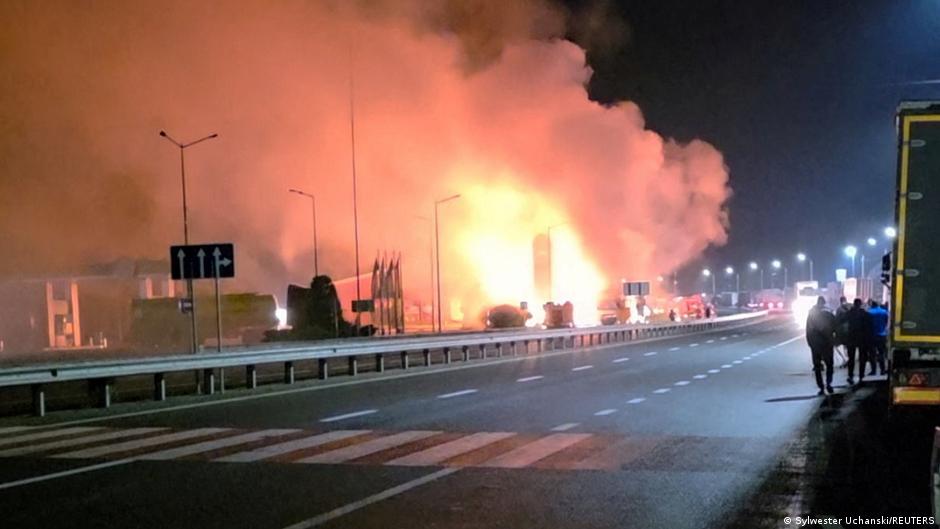
The train was empty when the drone hit it. The politics were not.
On the night between Saturday and Sunday, a Russian drone struck a locomotive at Yahodyn railway station in western Ukraine, roughly two kilometers from the border crossing into Poland. The passenger train aboard had already been evacuated after an early warning from monitoring teams. No one was injured. A gas station nearby was set ablaze by falling debris. The locomotive, Ukrainian President Volodymyr Zelenskyy said, was deliberately burned.
What makes this incident so politically volatile is not the damage — which is measurable but contained — but the calculus behind it. Russia has bombed Ukrainian cities, rail yards, and energy infrastructure before. But hitting a stationary civilian train at a station two kilometers from NATO territory, minutes after a diplomatic train carrying former European leaders had passed through the same platform, is qualitatively different. It is a probe. And probing is how wars get wider.
The guests at the station
Ukrainian railways confirmed that a diplomatic train bearing security advisers from several EU member states, former British Prime Minister Boris Johnson, and former CIA Director David Petraeus had been at Yahodyn station shortly before the strike. Another train carrying former Swedish Prime Minister Carl Bildt was also present at the moment of impact. None were on the Warsaw-bound passenger train that was hit.
The sequence matters. These are not random visitors. They are the kind of figures who advise governments on defense policy, who have shaped NATO strategy, and who carry direct lines to capitals that fund Ukraine’s war effort. Their presence at a border station in Volyn suggests a high-profile inspection tour — the kind Western leaders undertake to signal solidarity. It also makes the location strategically conspicuous.
Johnson did not mince words afterward. He called Putin’s decision to strike a stationary locomotive near the Polish border incomprehensible and used the moment to reiterate demands that had been circulating for months: unfreeze the €140 billion in Russian central bank assets held in Belgium and the roughly £10 billion held in London. Britain, he said, should lead the way.
Bildt described the attack as a near miss for people who were not even on the train. His tone, measured but grave, carried the weight of someone who understands how quickly border incidents escalate.
Poland is no longer assuming safety
The Polish response has been sharper than diplomatic courtesy would require. Foreign Minister Radoslaw Sikorski called the strike an escalation and framed it as part of a pattern of Russian aggression that threatens not just Ukraine but anyone who stands beside it. Prime Minister Donald Tusk convened an emergency meeting and issued a warning that deserves to be quoted carefully: Poland cannot rule out attacks on its own territory in the coming weeks and months. He described a period of intense Russian activity ahead.
This is not bravado. Poland shares an 800-kilometer border with Ukraine and has become the primary logistical hub for Western military aid heading to Kyiv. Yahodyn sits on one of the critical transit routes. Every railcar of ammunition, every shipment of fuel, every generator and medical supply passes through corridors that Russia can now reach with drones launched from occupied territory or fired across the border.
Tusk’s acknowledgment that Polish soil may be targeted is a shift from the previous posture of calibrated reassurance. It signals that Warsaw’s intelligence community has assessed a real and growing risk — and that the Polish government is preparing its population for the possibility that the war is coming closer than anyone expected.
What Moscow is testing
Russia has not commented officially on the strike. That silence is itself a signal. When a government hits a civilian target near a NATO border and says nothing, it is usually because it is waiting to see what the target and its allies do next. The question being tested is simple: Will NATO treat a strike two kilometers from its border as a boundary violation? Will Article 5 — the collective defense clause — be discussed in private even if it is not invoked publicly? How much warning will the alliance give before it acts?
The answer will shape the next phase of the war. If Western powers respond with sanctions announcements and rhetorical condemnations, Moscow will learn that its probes carry limited cost. If they respond with concrete measures — enforced no-fly zones over western Ukraine, accelerated air defense deployments, prepositioned forces along the Polish border, or restrictions on dual-use rail traffic — Moscow will recalibrate. The strike may have been meant to gather data. What it gathers depends entirely on what happens next.
The gas station and the border checkpoint
The secondary damage at Yahodyn deserves attention. A gas station near the border checkpoint was set on fire by debris from the drone strike. Border infrastructure is sensitive by definition — it is where customs, immigration, and security screening converge. Attacking it sends a message that Russia is willing to disrupt the logistics chain that sustains Ukraine’s war effort and to intimidate the civilian infrastructure that supports cross-border movement.
Ukrainian Foreign Minister Andrii Sybiha framed it plainly. He said Putin’s terror was knocking directly on the doors of the EU and NATO, and urged Western partners to move beyond half-decisions toward full trade embargoes, comprehensive entry bans, and crippling sanctions on Russia’s military-industrial complex. His language was deliberate: he is asking Europe to treat this incident as a turning point, not another item on an endless list.
Who wins and who loses
Russia wins if the world treats this as another routine strike and moves on. It wins if NATO debates the legal thresholds while Russian drones keep coming. It wins if Poland and the EU fragment over how far to escalate.
Ukraine wins if Western governments interpret this strike as a clear boundary violation and respond with the kind of uncompromising measures Zelenskyy has been requesting — unfrozen Russian assets, long-range missile access, and a reinforced air defense umbrella over western Ukraine. It wins if the incident galvanizes support that had been wavering under fatigue and political distraction.
Poland wins if the incident accelerates the buildup of NATO forces on its territory and secures a permanent, hardened logistics corridor insulated from Russian retaliation. It loses if the alliance treats the border as a line that Moscow can test without consequence.
What happens next
The next few weeks will determine whether Yahodyn becomes a footnote or a hinge. Poland’s emergency meeting is a sign that Warsaw intends to push for a coordinated NATO response. Johnson and Bildt will carry their accounts back to capitals where defense ministers are already reviewing border posture. The frozen-asset debate, dormant for months, may regain traction as politicians face constituents who now understand that the war is closer than they thought.
Zelenskyy’s claim that the locomotive was deliberately burned implies intent beyond military necessity. Whether that intent was to send a message to NATO, to disrupt aid flows, or to gather intelligence on Western reactions remains unclear. What is clear is that the message was received. The question now is whether the response will be proportional to the provocation — or proportional to the political convenience of the moment.
The train kept going. After customs clearance, it continued toward Warsaw with 206 passengers, none of them Polish. The locomotive that was struck will not be running again anytime soon. And the border it sits near may never look the same.