Samsung's Lee Family Finalizes Multi-Trillion Won Share Transfer
Hong Ra-hee completes the last major transfer of inherited Samsung shares to CEO Lee Jae-yong in a landmark move for one of the world's most important tech companies. The 2.6 trillion won gift marks the end of a six-year inheritance process that began after founder Lee Kun-hee's death.
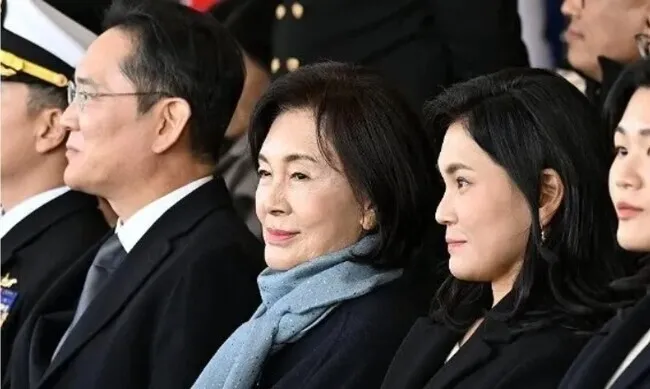
Samsung’s Last Legacy Move
The Lee family is closing a chapter that began with one of South Korea’s most consequential deaths.
Samsung Electronics disclosed on November 13 that Hong Ra-hee, the honorary director of the Leeum Museum of Art and widow of the late Samsung chairman Lee Kun-hee, has agreed to gift 11.158 million shares of Samsung Electronics to her son Lee Jae-yong, the company’s current heir apparent and de facto leader.
At the prevailing market price, the transfer is worth roughly 2.6 trillion won ($1.9 billion). The deal was struck on November 12, with the formal settlement scheduled for December 12.
This is not just another family transaction. It is the final act in a six-year restructuring of ownership that began when Lee Kun-hee died in October 2020, and it closes out the last major block of shares held by his widow.
The Math of Consolidation
Before this transfer, Lee Jae-yong held 1.58% of Samsung Electronics — already the single largest voting bloc in a company where no institutional investor comes close. After the gift, his stake rises to 1.75%, a gain of 0.17 percentage points.
Hong Ra-hee’s stake drops from 0.99% to 0.82%. She started with more — 11.158 million shares were part of the 83.091 million she inherited from her husband in April 2021. What remains in her name is her own, not her late husband’s estate.
For context, Samsung Electronics has approximately 5.9 billion shares outstanding. A 1.75% stake translates to roughly 103 million shares — tiny in absolute terms for a company with a market capitalization exceeding $400 billion, but enormous in practical influence. The company’s board, its strategy, and its succession lines all revolve around whoever controls that voting threshold.
The Full Disposition
What makes this transfer notable is its completeness. Hong Ra-hee has now sold or gifted every share she inherited from Lee Kun-hee.
Between 2022 and 2024, she liquidated portions of her holdings in block trades to raise cash for inheritance tax payments. The total tax bill across the Lee family — spread over six separate installments from 2021 through this year — came to approximately 12 trillion won ($8.9 billion), one of the largest private tax payments in Korean history.
The most recent installment was settled in April 2024. With the tax obligation discharged, there was no longer a liquidity reason for Hong Ra-hee to hold onto the remaining shares. Gifting them to her son was the logical endpoint.
She had already given Lee Jae-yong her entire Samsung C&T stake — 1.809 million shares — in January of this year. The Samsung Electronics transfer is the mirror image of that move, completing the consolidation of the family’s operating holdings into his control.
The Price That Matters
One detail investors will scrutinize is the gift tax calculation. Under Korean law, the taxable base for listed-share gifts is determined by averaging the stock price over two months before and after the transfer date — four months in total.
Samsung Electronics closed at 233,500 won on November 13, down from 259,500 won in early September. If the four-month average lands near current levels, the gift tax on a 2.6 trillion won transfer could approach 1.3 trillion won, though the exact figure depends on the final averaged price.
The top marginal gift tax rate in Korea is 50% for estates exceeding 30 billion won in taxable value. That bracket almost certainly applies here.
Whether the family will sell additional shares to cover the tax bill, or absorb it from other assets, remains unclear. But the math is straightforward: this transfer is both the last major disposition of Lee Kun-hee’s estate and one of the largest intergenerational wealth movements in the technology sector.
Why It Matters Beyond Korea
The transfer reshapes the governance of the world’s largest memory chipmaker at a moment when Samsung’s strategic autonomy is under direct pressure from U.S. and Chinese policy.
Samsung Electronics is the dominant supplier of DRAM and NAND flash memory — products that feed everything from smartphones to data centers to military systems. Its fabrication plants in South Korea, the United States, and China are exposed to export controls, investment restrictions, and subsidy regimes that treat the company as a geopolitical asset rather than a commercial actor.
Lee Jae-yong has spent his tenure navigating these pressures. He oversaw Samsung’s $44 billion investment in a Texas fabrication complex, a project designed to align with U.S. chip-supply-chain decoupling from China while protecting Samsung’s own market position. He also maintained operations in China through Samsung’s massive Pyeongtaek and Xi’an facilities, even as Washington tightened controls on advanced semiconductor equipment sales.
The concentration of voting power in a single family does not change that calculus. But it does remove a potential source of friction. As long as Hong Ra-hee held shares, there was a second major shareholder with independent interests — however small. With those shares now fully transferred, there is no internal voting bloc outside the Lee family orbit.
That simplifies decision-making. It also eliminates a check.
The Structural Picture
Samsung Electronics is controlled through a web of cross-shareholdings and affiliate companies. The Lee family’s direct ownership of 1.75% represents only the visible tip. Through Samsung Electronics’ ownership stakes in subsidiaries, affiliate trading companies, and foundation-linked entities, the effective voting control is substantially higher.
The foundation side — the Samsung Foundation and related charitable trusts — holds an additional block of shares, but these are not independently directed. They function as a governance buffer, not a competing power center.
What this transfer does is remove the final autonomous shareholder position that existed between the founding generation and the current leadership. Lee Kun-hee’s estate is now fully integrated into Lee Jae-yong’s personal holdings. There is no longer a separate wealth pool tied to his name.
The Timing Question
The announcement came on a weekday with no market-moving corporate event on Samsung’s own agenda. There was no earnings release, no major product launch, no board reshuffle attached to the disclosure.
That raises the question of whether the timing is driven by tax planning — locking in a valuation before year-end — or by a desire to close the inheritance file cleanly before any regulatory or political headwinds intensify.
South Korea’s new government has signaled skepticism toward chaebol governance practices. Opposition lawmakers have repeatedly called for reforms to cross-shareholding structures that concentrate control. While no legislation targeting Samsung has advanced, the political cost of high-profile wealth transfers tends to rise in election years.
December 12, the scheduled transfer date, falls just weeks before the end of the Korean fiscal year and months before anticipated parliamentary sessions where corporate governance reform could return to the legislative agenda.
Whether the family is aware of that timeline is impossible to know. But the instinct to finalize a multi-year process before a potentially hostile political environment emerges is one that wealthy families in emerging markets have practiced for generations.
The Aftermath
For Samsung Electronics shareholders, the transfer changes nothing materially. The company’s operations, its competitive position in memory chips, and its relationships with U.S. and Chinese regulators were never dependent on Hong Ra-hee’s voting stake.
For the Lee family, it changes everything. The estate of Lee Kun-hee — the founder who built Samsung Electronics into a global technology leader — is now fully consolidated under his son. The final tax bill is paid. The final shares are transferred. The inheritance chapter is closed.
What remains is the question of what happens next. Lee Jae-yong now holds the largest single voting bloc in a company that may well be the most strategically important in the global semiconductor supply chain. There is no countervailing shareholder to balance his influence.
How he chooses to wield it — in boardrooms in Suwon, in policy discussions in Washington and Beijing, in the memory-chip markets that underpin everything from AI training clusters to defense systems — will define Samsung’s next decade.
The transfer is complete. The inheritance is over. The strategy begins.