Samsung Just Rewrote the Rules of Home Appliances
At IFA 2026, Samsung swept four innovation awards by repositioning appliances as AI companions that read your habits, not just your home. The real story is what this pivot reveals about where the home tech battle is heading.
The Awards Are the Easy Part
Samsung took home four Innovation Awards at IFA 2026 in Berlin — including a double win for its Bespoke AI Windless Combo Pro wall-mounted air conditioner, which claimed both the Design Grand Prize and a Home Appliance Excellence Award. The other three went to the AI Family Hub refrigerator (Design Excellence) and the 4-Door Kitchen Fit Max (Home Appliance Excellence).
But the awards themselves are almost beside the point. What matters is the pitch Samsung is making across every one of these winners: your home appliances should stop behaving like machines and start behaving like companions.
The message was front and center at Samsung’s booth, themed around “AI as a daily companion.” The subtext was clear — Samsung is trying to shift the competitive frame from raw performance specs to ambient intelligence. And it’s a pivot that Western brands are struggling to match.
The Air Conditioner That Knows You’re Sleeping
The 2026 air conditioning market has been a race in the wrong direction for years: louder fans, sharper angles, more visible vents. Samsung’s Bespoke AI Windless Combo Pro does the opposite. It smooths the front panel into a flat surface, hides the micro-vents at the bottom, and wraps the whole thing in what the company calls “quiet interior design.”
But the real trick is underneath. A radar sensor tracks your position and movement in the room, adjusting airflow patterns in real time — seven custom breeze modes powered by what Samsung calls AI MotionBreeze. The heat exchanger controls humidity at a micro level, and here’s the part most Western reviews will gloss over: the unit pairs with a Galaxy Watch to read your actual sleep rhythm, then modulates cooling through the night accordingly.
That last feature is the one that redefines the product category. Most air conditioners respond to what the room is doing. Samsung’s is responding to what you are doing. It’s the difference between a thermostat and a butler — and the line between those two things is exactly where Samsung wants the conversation to live.
The Refrigerator That Looks at Your Food and Thinks
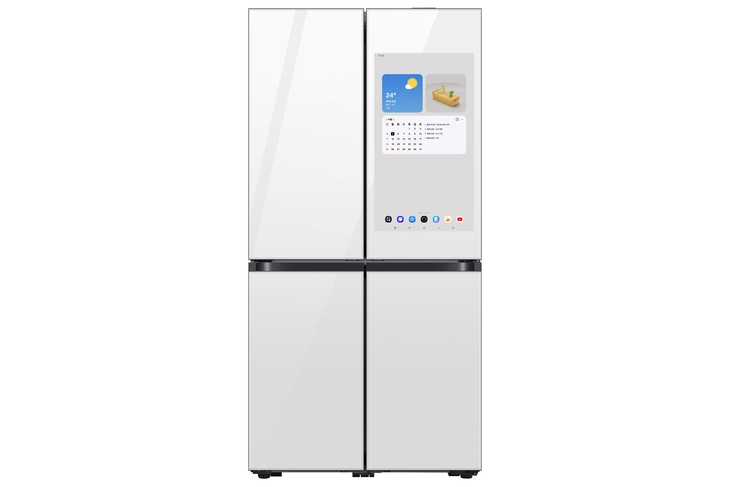
The AI Family Hub refrigerator — which took the Design Excellence award — mounts a 32-inch display on its front and turns it into a kitchen command center. Voice ID recognizes who’s standing in front of it. Now Brief surfaces calendar events, photos, and health data tailored to each user. Auto Door opens the fridge with a voice command or touch, no hands required.
Inside, cameras track ingredients as they go in and out. Samsung layered Google’s Gemini on top of that vision system to expand what the camera can identify — moving beyond barcodes and packaging labels into something closer to actual food recognition. The system then suggests recipes based on what’s actually in the fridge, not what you think you bought.
This is a subtle but significant upgrade from what Amazon’s Key features or LG’s ThinQ app offer. Those systems track purchases you’ve already made. Samsung is trying to understand what you already have.
The 4-Door Kitchen Fit Max took the other Home Appliance Excellence Award for an engineering reason that sounds small but carries real weight for urban buyers: it opens fully with just a 4mm gap on each side. Most refrigerators need 50–100mm for full door swing. The Hybrid Cooling system uses additional semiconductor elements when the door opens frequently or stores large volumes of food, maintaining efficiency without requiring a built-in cabinet modification.
In dense Asian apartments where every centimeter counts, that 4mm gap is a genuine design breakthrough. In Western kitchens, it’s a nice-to-have. That geographic asymmetry is worth noting.
Why This Matters Beyond Berlin
Samsung’s IFA strategy reveals a competitive bet that most Western observers are underweighting. The company isn’t competing on compressor power or freezer capacity anymore. It’s competing on behavioral prediction — how well the appliance understands the person using it.
The radar-sensor AC, the watch-linked sleep cooling, the voice-identified fridge, the Gemini-powered food recognition: these aren’t incremental feature updates. They’re a coherent philosophy that appliances should read the room, read the resident, and adapt accordingly.
Western competitors — Whirlpool, Bosch, even GE Appliances — are still largely in the telemetry business. Their smart features connect appliances to phones. Samsung is connecting appliances to lifestyles. The difference matters because it changes the purchase decision from “which fridge cools best” to “which appliance gets me.”
There’s also a data advantage hidden in this strategy. Every interaction between the radar sensor and your sleeping pattern, every food item the camera identifies, every voice command that triggers a different interface — these are training signals that make the system better over time. Western appliances that rely on manual input or periodic app checks don’t accumulate that same depth of behavioral data.
The Korean Playbook
This isn’t the first time Korean manufacturers have shifted the competitive frame at major trade shows. LG pushed “smart diagnosis” at CES years ago, framing repairs around predictive maintenance rather than break-fix cycles. Samsung’s current pivot feels like the next evolution of that instinct — move from reactive intelligence to anticipatory intelligence.
What makes the IFA 2026 run notable is the consistency across product categories. Both refrigerators and the air conditioner share the same design language: minimal visual clutter, surfaces that recede rather than announce themselves, and AI layers that operate invisibly. Samsung is building a portfolio, not just a product line.
The company plans to continue showcasing these AI home products through September 8 at a special installation at Berlin’s Humboldt Carré. That’s a deliberate choice — instead of disappearing into convention halls, Samsung is turning a public space into a living showroom.
Who Loses If This Frame Sticks
The competitors most exposed to Samsung’s pivot are the ones whose brand identity is built on hardware supremacy. If the market starts valuing behavioral prediction over cooling capacity, then decades of engineering credibility around compressors and insulation becomes background noise rather than the headline.
American and European brands have deep distribution networks and brand loyalty in the West. But Samsung’s IFA strategy suggests it’s willing to compete on a different plane entirely — one where the metric isn’t how well the machine works, but how well it knows you.
That’s a harder competition for incumbents to enter, because it requires a fundamentally different engineering culture. You can’t bolt radar sensors and Gemini onto an existing product tree overnight. The architecture has to be built from the inside out.
Samsung clearly spent years building that architecture. The four IFA awards are just the first public proof that it’s ready to compete on it.