Sara Duterte's Bail Is Just the Opening Move in a Political War That Will Reshape the Philippines
The arrest of a sitting vice president is unprecedented in the Philippines. But the real story isn't the legal maneuvering—it's what this power struggle between the Marcos and Duterte dynasties means for a nation torn between Washington and Beijing.
The Philippines Has Never Arrested a Sitting Vice President. Until Now.
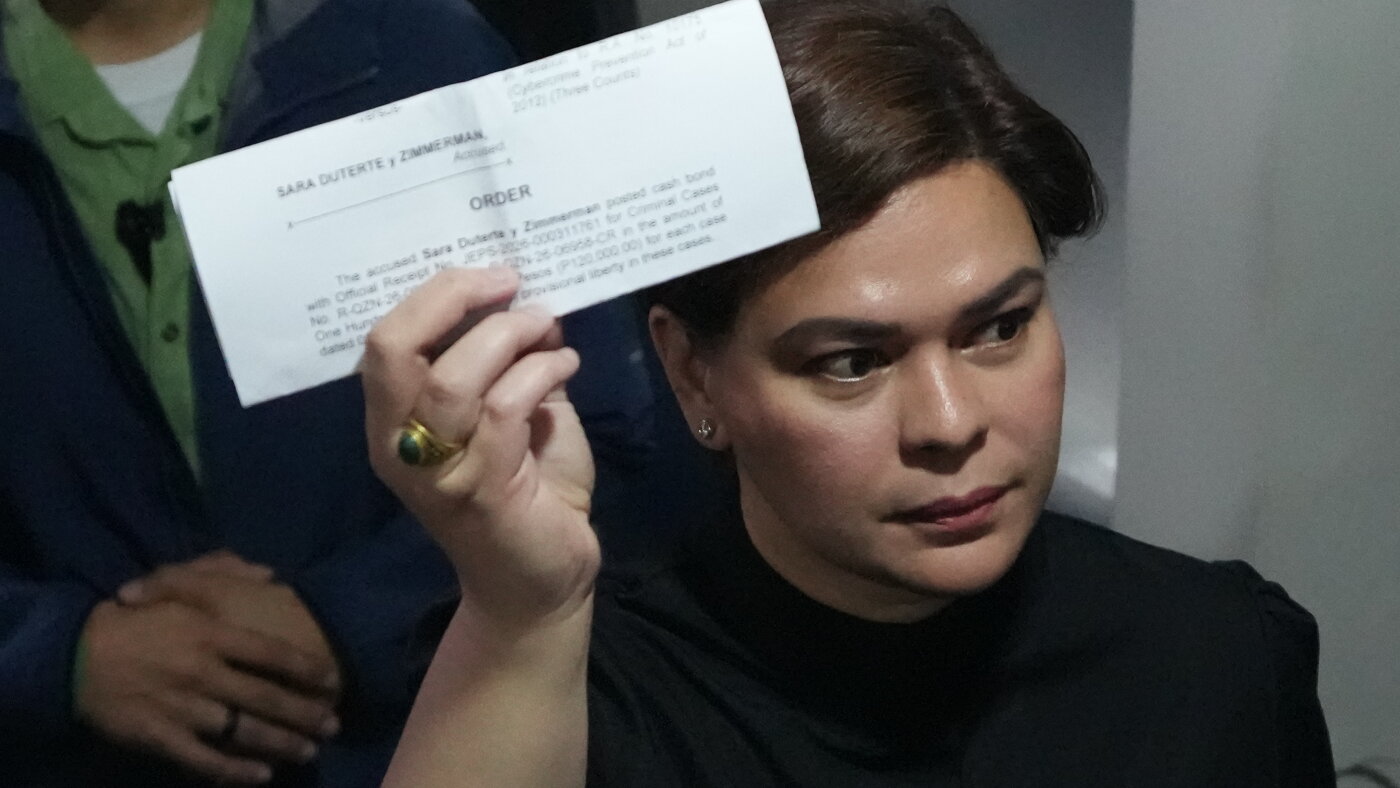
Sara Duterte stood outside a Manila courthouse Saturday, dressed in black, flanked by journalists she asked to walk beside her because she said she no longer felt safe from police. The image of a sitting vice president requiring media bodyguards is stark in a country where political violence has always been more verbal than physical.
What happened Friday night in Quezon City wasn’t just a legal development. It was a rupture. Duterte became the first sitting vice president in Philippine history to be arrested and held on criminal charges, setting off a political crisis that extends far beyond the courtroom and into the heart of America’s most important alliance in Southeast Asia.
The Charges Rest on Words Spoken Over a Year Ago
The case against Duterte traces back to a June 2024 online news conference, long after the romantic illusion of the Marcos-Duterte alliance had faded. During the broadcast, Duterte said she would have President Ferdinand Marcos Jr., his wife, and then-House Speaker Martin Romualdez killed by an assassin if she herself was murdered. She later insisted she was expressing concern for her own safety, not making threats. The court显然 saw it differently.
Three counts of grave threats. 360,000 pesos—roughly $5,740—for bail. A conviction would permanently disqualify her from public office and, crucially, eliminate her from the 2028 presidential race. That single detail transforms this from a routine criminal prosecution into an existential political battle with the next election as its stakes.
The House, packed with Marcos allies, impeached her in May on allegations of unexplained wealth and misuse of confidential funds. The Senate impeachment trial opened in July. The arrest warrant issued Friday represents a parallel legal track, one that bypasses the slower impeachment process and could reach a verdict before the Senate ever delivers its own.
A Rivalry That Was Always Going to Explode
Marcos and Duterte ran together in 2022, combining two of the Philippines’ most powerful political dynasties into a coalition that looked unbeatable on paper. Rodrigo Duterte, the populist strongman who presided over a brutal anti-drug campaign, handed the presidency to his younger political partner while keeping his daughter in the vice presidency. It was an arrangement designed to guarantee continuity.
It didn’t last two years.
The breakdown began with geography as much as policy. Rodrigo Duterte’s 2025 arrest by the International Criminal Court—and his subsequent detention in The Hague to face trial on charges of crimes against humanity—was the breaking point. Sara Duterte publicly condemned the Marcos administration for allowing her father to be surrendered to a foreign court that has no jurisdiction over the Philippines. Marcos stood by the decision. The alliance was mortally wounded.
The Foreign Policy Fault Line No One Is Talking About Enough
Here’s what most English-language coverage of this story is missing: the Duterte-Marcos split isn’t just a domestic power struggle. It maps directly onto a geopolitical fault line that defines the entire Indo-Pacific.
Marcos has rebuilt the Philippines’ defense partnership with the United States—the cornerstone of American strategy in Southeast Asia for seven decades. He has expanded access to US bases, increased joint military exercises, and publicly stood with Washington against China’s increasingly aggressive maneuvers in the South China Sea. The Philippines has become one of America’s most active treaty allies in the region, hosting rotating deployments of American forces and deepening intelligence sharing.
Sara Duterte has offered none of this. She has refused to condemn China’s use of water cannons and other coercive tactics against Filipino fishermen and coast guard vessels in disputed waters. Her father’s legacy—close ties to Beijing, rhetorical hostility toward Washington—remains her instinctive orientation. Where Marcos sees a China that must be countered, Duterte sees a partner that shouldn’t be provoked.
This isn’t abstract. The South China Sea is the single most dangerous flashpoint in the Western Pacific. Every encounter between Filipino and Chinese vessels there carries the risk of miscalculation. The person sitting second in line to the Philippine presidency shapes how aggressively or passively Manila responds.
Who Wins and Who Loses From This Arrest
If Duterte is convicted—and conviction is far from guaranteed at this stage—the immediate winner is Marcos. He removes the most powerful political rival in his orbit from the 2028 field, potentially clearing the path for a successor he can actually control. A Duterte-free ticket would look very different from the one he’s been forced to navigate for the past two years.
But the longer-term picture is messier. The Duterte political machine—built on Rodrigo Duterte’s personality cult and Sara Duterte’s own grassroots credibility in Mindanao—isn’t going to dissolve because of a bail hearing. If the arrest is perceived as politically motivated, as Duterte’s camp is already framing it, it could galvanize rather than weaken her position. The 2028 race could become even more polarized, with the Duterte base viewing any conviction as proof of Marcos’s authoritarian instincts.
And then there is the question that looms over everything: what happens to Rodrigo Duterte in The Hague? His trial begins in late November 2026. A conviction—or even the spectacle of it—would redraw the political landscape again. His children, Sara in particular, would face enormous pressure to position themselves, either by leaning harder into nationalist rhetoric that antagonizes Washington or by distancing themselves in a way that could fracture their base.
What This Means for the United States
Washington should be watching this closely. The Philippines is America’s Treaty Ally under the 1951 Mutual Defense Treaty, and recent years have seen that alliance hardened into something far more operational. American Bataan and Edwards combat zones are now front-line positions in the strategy to contain Chinese expansion.
A destabilized Philippine government—with a vice president locked in legal battle against the president, both commanding loyalist factions across government institutions—is a vulnerability China will notice and likely exploit. Beijing has every incentive to quietly amplify narratives of American puppetry and Philippine chaos, especially if the Duterte faction frames the arrest as Washington’s handiwork through Marcos.
The opposite outcome carries risks too. A Duterte presidency in 2028 could pull the Philippines away from its current pro-American trajectory, reversing base access agreements and weakening the alliance at exactly the moment the region needs it most. Neither scenario is comfortable for American strategists.
What Happens Next
The immediate timeline is legal, not political. Duterte’s lawyers have signaled they will fight the charges through every available remedy. The court process will drag through late 2026 and possibly into 2027. Meanwhile, the Senate impeachment trial continues on its own track, creating the possibility of conflicting rulings from two separate judicial bodies—a constitutional ambiguity the Philippines has never tested.
By early 2028, the country will be deep in election season. Whatever the courts have decided by then, the Duterte name will still carry enormous weight, particularly in the southern islands where her father’s legacy remains untarnished among her base. If she is barred from running, the dynasty will simply install another candidate and keep fighting. If she is free to run, the election becomes a referendum on whether Marcos’s legal offensive was justice or persecution.
The arrest of a sitting vice president is a seismic event in any democracy. In the Philippines, a country with a long history of oligarchical politics, martial law memory, and great-power vulnerability, it is also a symptom of something deeper: a nation that has not yet decided whether it wants to be an American ally or a Chinese neighbor. The courts will deliver a verdict on Sara Duterte. But the bigger question—what kind of country the Philippines becomes—remains unanswered.