Scandium Adds Life to Sodium-Ion Batteries
A Tokyo University of Science team has shown that doping sodium-ion battery cathodes with scandium stabilizes their crystal structure and extends cycle life. The catch: scandium is rare and expensive — and researchers are already searching for cheaper substitutes.
The scandium loophole
A research group at Tokyo University of Science has found a way to slow down one of the oldest problems in sodium-ion battery chemistry: the cathode crumbles after repeated charging. The fix is subtle but important — swap a small amount of the cathode material with scandium, and the crystal structure resists the expansion and contraction that normally degrade performance over time.
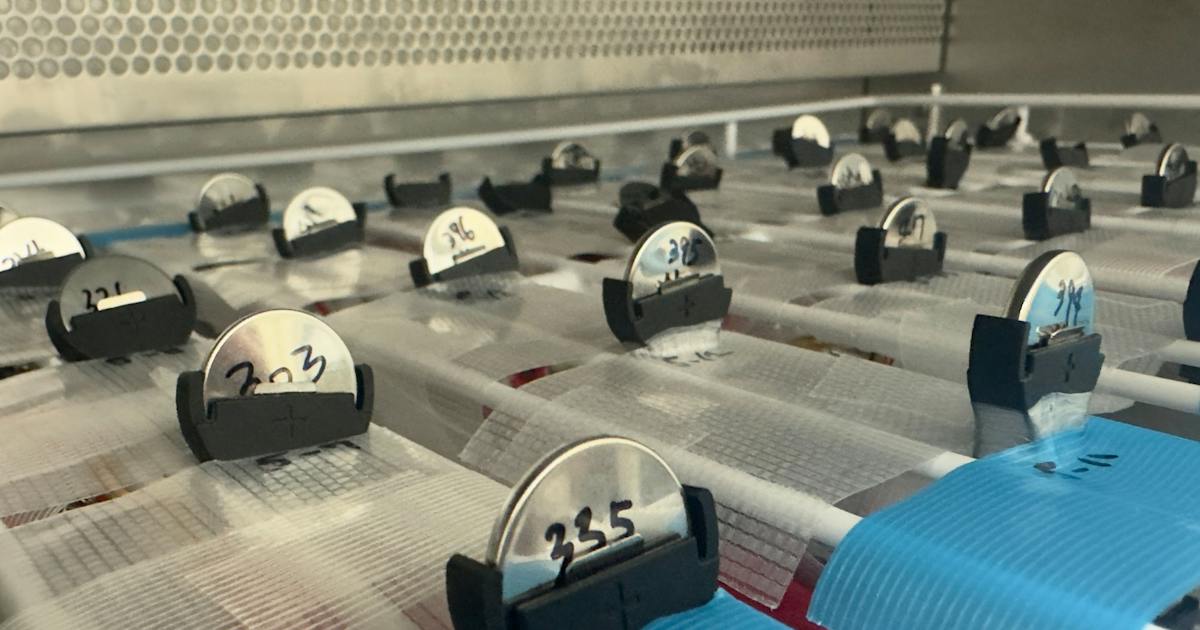
The work, reported in late August 2026, confirms that scandium-doped layered oxide cathodes maintained their capacity through 300 full charge-discharge cycles in coin-cell tests. That is not a commercial scale result, but it is a clear proof that the right dopant can change the degradation math.
Why this matters beyond the lab
Sodium-ion batteries sit at the center of a strategic bet in global energy storage. The active material — sodium — comes from seawater and salt deposits. It is cheap, abundant, and free from the supply-chain concentration that makes lithium and cobalt politically volatile. The trade-off has always been energy density: sodium-ion cells store less energy per kilogram than lithium-ion, which is why they have struggled to compete in electric vehicles.
For grid storage, however, energy density is secondary. What matters is cost per kilowatt-hour over thousands of cycles, safety, and the ability to manufacture at scale without depending on a handful of mining countries. Sodium-ion batteries check those boxes better than any alternative besides lead-acid — and they carry a far lower fire risk.
The problem has been cycle life. Layered oxide cathodes, especially those doped with nickel and manganese to push energy density higher, suffer from structural rearrangement during cycling. The lattice expands and contracts as sodium ions move in and out, and over hundreds of cycles that repeated motion fractures the crystal. Particles crack, electrical contact is lost, and the cell’s capacity fades. Researchers have tried various stabilization approaches — protective coatings, alternative dopants, gradient structures that vary composition through the particle — but the gains have been incremental. Most reported improvements add only a few dozen cycles before the same degradation mechanisms reassert themselves.
The scandium result is different because it attacks two failure modes at once. Swapping scandium into the crystal lattice suppresses volume change during ion insertion and extraction. Coating the particle surface with scandium limits parasitic reactions between the electrolyte and the cathode. Both mechanisms work together, which is why the 300-cycle retention looks robust rather than lucky. The layered oxide structure — a series of metal-oxide planes separated by sodium-filled gaps — tends to collapse slightly each time a sodium ion leaves and returns. Scandium ions, which are smaller and more rigid than the sodium they replace, act as structural pillars that hold the planes apart and reduce the mechanical strain that leads to cracking.
The cost trap
Here is the problem that everyone at the university is already facing: scandium is a rare-earth metal and it is expensive. The team’s lead researcher, Associate Professor Shinichi Kumakura, stated openly that the next step is to find cheaper elements that deliver the same stabilization.
That is the honest part of the story. The longer version is that scandium-doped sodium-ion batteries are unlikely to reach the market on scandium alone. If the doping level is high enough to make a difference, the cost advantage over lithium-ion evaporates. The technology only becomes attractive if the dopant can be reduced to trace amounts — or replaced entirely.
This is not the first time Japanese battery research has hit this wall. The broader push for sodium-ion development in Japan involves a consortium that includes Tokyo University of Science, GS Yuasa, and ELECOM, among others. The government has signaled strong support through grants and demonstration-project funding. CATL, the Chinese battery giant, announced plans to mass-produce sodium-ion cells for electric vehicles in 2026. The pressure on Japanese researchers is to find a path that does not depend on imported rare metals — which would simply recreate the same supply-chain vulnerabilities that sodium-ion was supposed to solve.
Who wins if this works
If the team finds a substitute for scandium — and there is reason to think they will — the implications extend well past Japan. Sodium-ion batteries with long cycle life would unlock utility-scale storage projects that are currently too expensive or too risky. Grid operators in Europe and North America are already testing sodium-ion prototypes from companies such as Fluence and Natron Energy. A reliable, low-cost cathode chemistry would accelerate adoption across all of them, particularly for projects that require 10,000 or more cycles — the kind of installations that make or break the economics of renewable energy storage.
It would also shift the geopolitical calculus around battery supply chains. Lithium prices have been volatile, and the concentrate is dominated by Australia, Chile, and China. Sodium is everywhere. The bottleneck for sodium-ion batteries is not the raw material — it is the manufacturing know-how and the cathode formulation. Japan has both, if it can solve the scandium question. A Japanese-made sodium-ion cell that outlasts lithium-ion on cycle count would give the country a foothold in the next generation of storage technology, independent of either Chinese or Australian supply chains.
What happens next
The immediate next step is material screening. Kumakura’s team will test other elements for the same doping effect. Yttrium, lanthanum, and cerium are plausible candidates — they sit near scandium on the periodic table and share similar ionic radii, which is what matters for lattice stabilization. If one of those works at comparable doping levels, the cost profile improves dramatically. Lanthanum, for instance, is roughly ten times more abundant than scandium and significantly cheaper on the open market. The team will also explore combinations — mixing two or more elements in sub-stoichiometric ratios to achieve stabilization without any single dopant dominating the cost.
On the commercial side, GS Yuasa has been building sodium-ion cells in partnership with the university group. The timeline for a production-ready cathode is likely two to three years, assuming the dopant replacement succeeds. CATL’s move into sodium-ion mass production this year raises the stakes — Japanese researchers are now racing against a competitor that already has gigafactory scale and Chinese state backing. The window for Japan to establish a differentiated position in sodium-ion is narrowing.
The scandium result is not a product. It is a signal. Japanese academia is taking another swing at the battery question, and this time the target is not energy density but cycle life — the metric that actually matters for storage. Whether scandium becomes a footnote or a breakthrough depends on what comes next.