Seoul's Mine Investigation Crisis Reveals Deeper Fractures
South Korea's sluggish response to a DMZ landmine blast that wounded three soldiers has ignited a political firestorm, exposing tensions between procedural caution and urgent accountability in an era of escalating North Korean provocations.
The Delay That Looks Like Cover-Up
Three South Korean soldiers were maimed by a landmine in the western DMZ on the 21st. The military did not form an on-site investigative task force until the 24th — three days later. By the 27th, joint inspections with the United Nations Command had only just begun. Opposition lawmakers call the pace a delay strategy that let inconvenient facts expire.
The timing is damning. President Yoon Suk Yeol delivered a landmark address to the UN General Assembly on September 22, in which he floated conditional relaxations of sanctions against North Korea as part of a confidence-building framework. Within 48 hours of the explosion, no official attribution had been issued. The military’s first substantive finding — that the blast originated from a North Korean planted mine — only emerged after the UN speech, after the Chuseok holiday, and only after opposition pressure mounted.
In 2015, after a similar mine incident killed two soldiers, South Korea launched its investigation within two days and concluded within ten that North Korea was responsible. The contrast with the current response is stark and deliberate-seeming.
But the delay carries consequences beyond optics. Military sources confirmed that the original forensic evidence at the blast site — soil samples, shrapnel patterns, and mine fragment placement — began degrading during those critical 72-hour window. North Korean patrols have been known to conduct sweep operations along border zones within days of any provocation. The longer the waiting period, the greater the chance that physical evidence was compromised or removed entirely. Joint UN Command inspections underway as of the 27th are racing against that clock.
The Correction That Undermines Credibility
The most damaging detail emerged on the 28th. The military initially reported the explosion occurred “tens of meters” from the Military Demarcation Line (MDL). The Joint Chiefs of Staff then corrected that figure to “approximately ten meters” from the MDL. A spokesperson attributed the discrepancy to poor communications in a mountainous area.
Ten meters inside South Korean territory — not beyond the MDL, not in a no-man’s-land zone, but within the contested border area itself — changes the entire calculus. It suggests North Korean forces crossed the MDL to plant the mine, or at minimum operated within South Korea’s sovereign defensive perimeter. This is not a border skirmish. It is a violation of the 1953 armistice line and potentially a premeditated act of sabotage.
Soldiers on the ground reported seeing what they described as North Korean wooden-cased anti-personnel mines. Brown-colored devices matching the design used in previous incidents. The military required “detailed identification” before acknowledging the possibility, leaving a window where testimony was recorded but not acted upon.
The correction itself triggered a secondary crisis. Multiple reporters noted that the initial “tens of meters” phrasing could have been intentionally vague — distancing the blast from the MDL to avoid triggering automatic escalation protocols. Whether that was deliberate strategic ambiguity or mere imprecision remains unresolved, but the damage to institutional credibility is immediate. Civilian oversight bodies are now demanding to see the original classified briefing documents released before the correction was issued.
The Politics of Caution
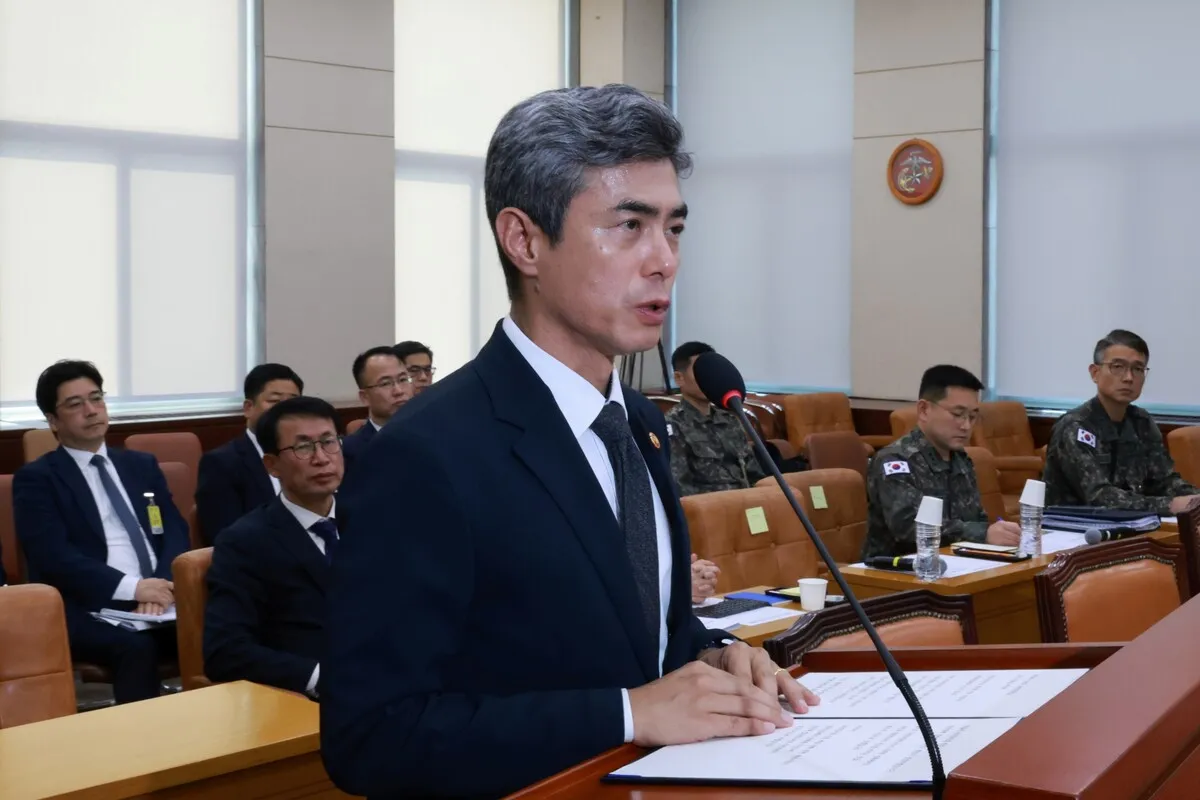
Defense Minister Kang Sin-cheol appeared before the National Assembly’s Defense Committee on the 29th, presenting maps and timelines under intense questioning. Lawmaker Na Kyung-won alleged that the original military report contained the phrase “North Korean wooden-cased mine estimated” — and that the phrase was subsequently removed. The military denied tampering; it said the language was refined as the investigation progressed.
Blue House press secretary Park Min-hee pushed back hard against claims that the president’s UN schedule influenced the delay. “The investigation timeline was determined purely on military judgment,” she stated. Joint Chiefs Chairman Jin Young-seong reinforced that security considerations dictated when information could be shared publicly.
But security and political strategy are not the same thing. The perception that a sitting president’s diplomatic calendar took priority over the welfare of wounded soldiers — and over transparency about an act of war — will outlast any denial. It reshapes how domestic audiences assess civilian control of the military, and how regional allies assess South Korea’s crisis management instincts.
The defense minister’s committee appearance revealed a third layer of complication. When pressed on whether any soldiers had been disciplined for leaking initial blast details to media outlets before official confirmation, Kang refused to confirm or deny whether such inquiries were underway. That refusal, far from protecting operational security, suggested the possibility that whistleblowing among rank-and-file personnel had already forced the military’s hand on attribution. If true, it represents an internal fracture — soldiers bypassing chain-of-command to ensure the truth about the mine’s origin was not buried.
What Happens Next
The explosive location — ten meters south of the MDL — is a fact the opposition will not let go. It transforms this from a routine border incident into a potential breach of the armistice. If confirmed through further forensic analysis, it justifies a harder line from Seoul, including possible suspension of the cross-border liaison channels that have provided a fragile communication path since 2018.
Pyongyang, for its part, has not yet commented. Its silence is itself a signal: the regime is testing whether South Korea will escalate or contain. A measured response — full investigation, attribution, proportional deterrence — would reinforce the credibility of the ROK forces and the US-ROK alliance. A restrained response risks appearing weak at a moment when Kim Jong Un has been consolidating authority and reasserting hardline postures toward the South.
The three wounded soldiers are recovering. Their injuries are serious but not life-threatening. The political injury to the administration may be harder to heal.
Second-Order Effects
The incident is already reverberating beyond immediate politics. South Korea’s defense budget review, currently stalled in legislative committee, has been accelerated. Opposition parties that previously opposed increases in defense spending are now arguing that the mine incident proves the military was under-resourced for border defense. Meanwhile, defense contractors are seeing their stocks rise on expectations of accelerated procurement.
Within the military itself, morale among frontline DMZ units has reportedly deteriorated. Soldiers posted to the western sector report feeling exposed — not just by the mine threat but by the perception that their commands prioritize diplomatic optics over their safety. Veteran NCOs familiar with border operations have begun speaking anonymously to journalists, describing a pattern of deferred maintenance on mine-detection equipment and understaffed observation posts in the western sector.
The United States has not publicly commented on the incident, which analysts interpret as deliberate caution. Washington is unlikely to escalate rhetoric independently but may quietly pressure Seoul to avoid actions that could trigger unintended conflict. That dynamic adds another layer of constraint on President Yoon’s options — he must demonstrate resolve to domestic audiences while managing American expectations for de-escalation.
The Bigger Picture
This incident sits inside a broader pattern. North Korea has steadily escalated military pressure along the DMZ over the past year — reinforcing border fortifications, conducting live-fire drills near the MDL, and testing South Korea’s red lines with calibrated provocations designed to probe for weaknesses. Landmines in this context are not merely weapons. They are signals. The question is whether Seoul reads them correctly, and whether its response matches the threat level.
The delay, the correction, the silenced testimony — these are not small things. They are the details that determine whether an administration looks competent or compromised when the next crisis arrives. And in a region where the margin between controlled tension and open conflict continues to narrow, the difference between competence and compromise may well be measured in meters from the Military Demarcation Line.