Seoul Stands Between Washington and Tehran at the Strait of Hormuz
Iran has directly summoned South Korea's foreign minister over fears of a Hormuz deployment. Seoul must navigate between American alliance demands and its own energy survival.
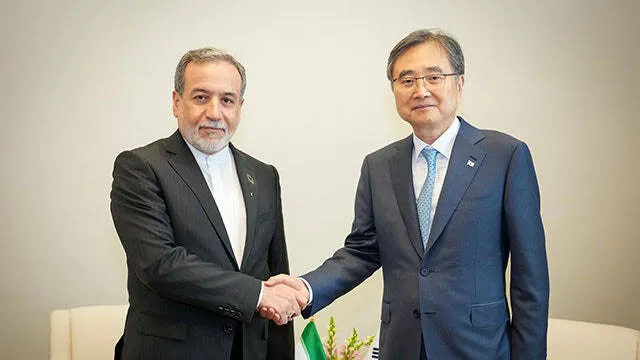
The Call That Changes Everything
When Iran’s foreign minister requested a phone call with his South Korean counterpart on September 11, the timing was itself a message. Washington has been pressing Seoul to commit forces to the Strait of Hormuz — a narrow waterway through which roughly 20 percent of global oil flows. Iran did not wait for South Korea to announce anything. It called first.
The conversation, confirmed by South Korea’s Ministry of Foreign Affairs, covered the Middle East situation, bilateral relations, and the protection of Korean nationals abroad. But the subtext was unmistakable. Jo Hyeon, South Korea’s foreign minister, conveyed that no deployment decision has been made. He also stressed the importance of restoring free navigation through the strait and reiterated South Korea’s consistent position on maritime freedom.
Araghchi, in turn, explained Iran’s position. What followed was not a routine diplomatic exchange. It was a warning delivered at the ministerial level, and then amplified hours later on social media in Korean.
A Statement in Korean Is Not Normal
Esmaeel Baghai, a spokesperson for Iran’s foreign ministry, posted a statement directly on X in Korean, not Persian and not English. The choice of language was deliberate. It meant the message was aimed at Seoul and its citizens, not at an international audience.
“Any country that militarily stations itself in the Strait of Hormuz or participates in operations there will inevitably be seen as directly supporting the aggressor,” Baghai wrote.
The word “aggressor” is the key. Iran is framing whatever conflict is unfolding in the region through a specific lens — one that casts a particular side as the unlawful party. By asking South Korea to choose sides now, before any decision is even made, Iran is attempting to shape the terms of the debate. It is also signaling that Seoul’s calculus should not be limited to its alliance with Washington.
For a country that imports the vast majority of its oil through the Hormuz corridor, the threat carries weight beyond abstract geopolitics. This is not a dispute about principles. It is a dispute about whether fuel will reach refineries.
The Fact-Finding Mission as Signal
South Korea’s response so far has been deliberately ambiguous. Since last weekend, Seoul has dispatched fact-finding missions to the United Arab Emirates and other Middle Eastern locations to assess conditions on the ground. Defense Vice Minister Lee Doo-hee stated in a National Assembly session that no decision has been made and that the government is in a review phase, weighing national safety and economic interests.
Chung Sye-kyun’s office took the analysis further. Senior presidential spokesperson Sung Gi-hong told a broadcaster that if troop deployment is off the table, technical support could be an option.
Interpreted plainly, this means South Korea is keeping every door open. No deployment decision has been made. But neither has it been ruled out. The fact-finding missions serve a dual purpose: they gather intelligence on logistics and risk, and they signal to Washington that Seoul is taking the request seriously even as it buys time.
The distinction between deploying combat troops and providing technical support matters enormously. One draws Korean soldiers into a potential shooting match. The other keeps them in a support role — logistics, medical, communications — while still fulfilling the kind of burden-sharing that alliance politics demands.
Domestic Opposition Sets the Boundaries
The real constraint on Seoul is not Tehran or Washington. It is the South Korean public.
Opinion polls consistently show strong opposition to another overseas military deployment, especially one that would place South Korean forces in an active conflict zone. The memories are fresh — Afghanistan, Iraq, the Red Sea mission — and the political cost of another deployment is clear. South Korean troops have faced threats in the past, and the public has not responded with enthusiasm.
This is why the technical support option keeps appearing in official statements. It is the path of least domestic resistance that still allows Seoul to demonstrate cooperation with Washington. But it is also a narrow path. Iran may view technical support as functionally equivalent to deployment, regardless of the label.
What Happens Next
Three scenarios are plausible, and none of them are comfortable for Seoul.
The first is that Washington escalates its pressure. The US has made clear it wants allies to contribute to security in the Gulf, and South Korea’s hesitation does not go unnoticed. If the US threatens to question Seoul’s alliance commitment — explicitly or implicitly — the calculus shifts dramatically. The US alliance is the cornerstone of South Korea’s security architecture, particularly given the ongoing threat from North Korea. Washington holds leverage that Tehran does not.
The second is that Iran makes good on its implicit threat. South Korean commercial vessels transit the Hormuz corridor regularly. If Tehran decides to target ships associated with countries it considers complicit, the human and economic costs would be immediate. The request to protect Korean nationals abroad takes on a darker meaning in this context.
The third — and perhaps most likely — is that Seoul stretches ambiguity to its limit. It sends technical support, not combat troops. It frames the deployment as a non-combat maritime security contribution. It hopes Iran accepts the distinction and that Washington finds it acceptable. Neither side will be fully satisfied.
The Bigger Picture
South Korea’s dilemma reveals a deeper structural tension in the region. For decades, Seoul treated the Middle East as a secondary theater — important for energy, manageable through economic diplomacy. That approach assumed the region would stay peripheral to great power competition. The current crisis has shattered that assumption.
South Korea is now being asked to take a position in a conflict it did not start, in a region where it has limited strategic leverage, at a time when its most pressing security concern remains the Korean Peninsula. Every option carries risk. Every risk carries a different kind of cost.
The phone call between Jo and Araghchi was not a breakthrough. It was a boundary-setting exercise. Iran drew a line. South Korea has not crossed it — yet. The question is whether Washington’s demands will force it to, and whether Seoul will have enough political cover to do so without risking the lives of its personnel or the flow of energy that keeps the country running.