Serbia's Student Revolution Is a Geopolitical Earthquake
Serbia's student-led uprising just toppled a 14-year strongman — the first pro-democracy victory inside Putin's orbit, and a template Eastern Europe can't ignore.
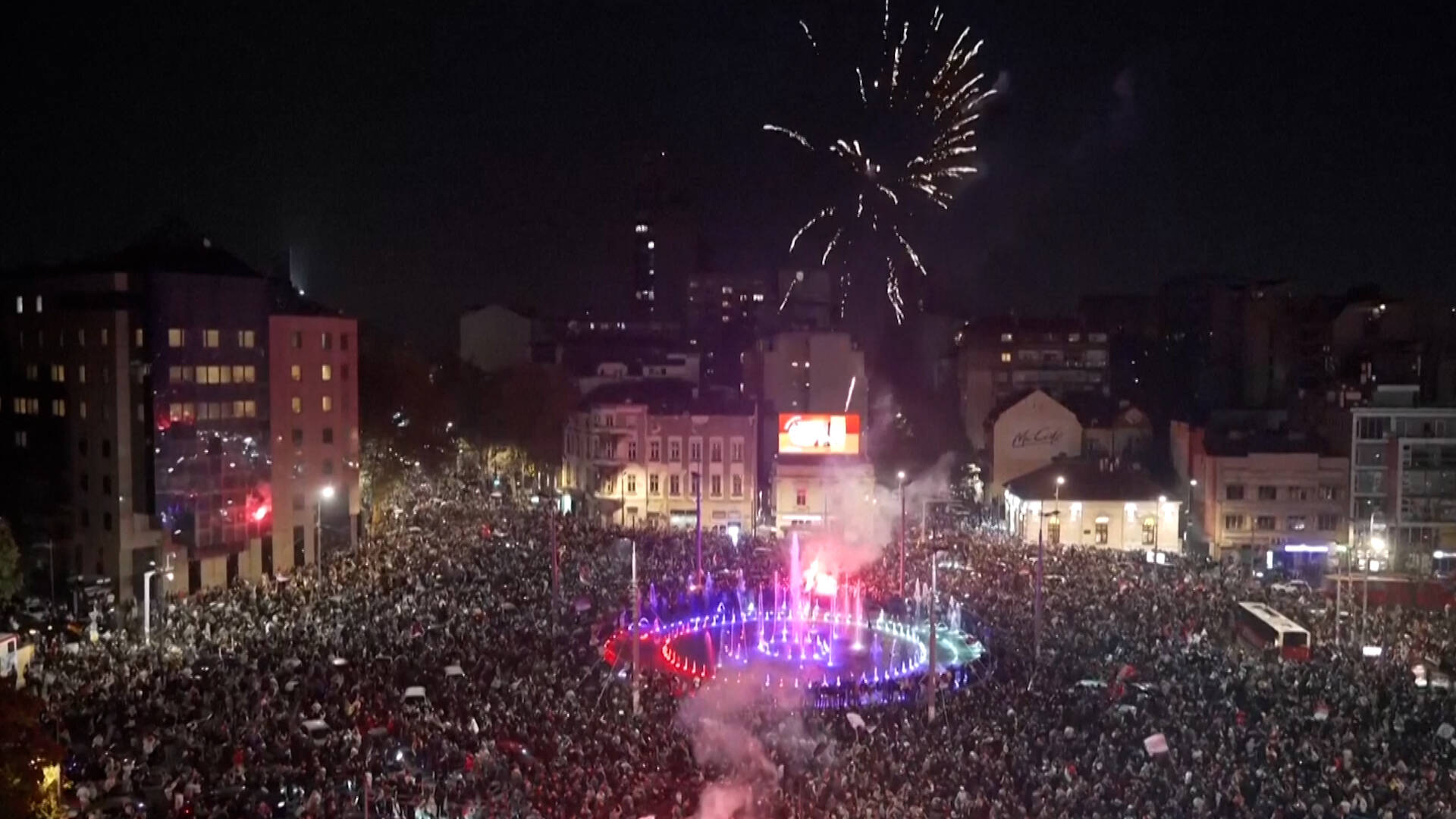
The canopy that fell — and a regime that followed
On a Tuesday in November 2024, a reconstructed steel-and-glass canopy collapsed at the Novi Sad railway station in northern Serbia. Sixteen people died. Within days, students occupied every faculty building across Serbia’s four university centers. They did not disband after the grief cycle passed. They organized. And two years later, they swept Aleksandar Vučić out of power.
The Student List won 52 percent of the vote in Sunday’s parliamentary election — more than 135 of 250 seats. Vučić’s Serbian Progressive Party (SNS), which has ruled for fourteen years, won roughly 105. The former president, long the most consequential political figure in the Western Balkans and a Kremlin-friendly strongman, conceded defeat by 10 p.m. Serbia’s political establishment had braced for rigged results or a declaration of emergency. Instead, it accepted them.
The victory is remarkable not only for what it accomplishes but for how it was achieved. The candidates on the Student List are not university students. They are farmers, athletes, artists, and little-known technical experts selected through popular assemblies in neighborhoods and municipalities across the country. Students walked and cycled into rural districts — traditional SNS strongholds — to campaign door to door.
A leaderless movement, structurally radical
The movement’s horizontality is its defining institutional feature. Serbian journalists and analysts describe it as “leaderless,” but that undercuts what is actually a deliberate democratic architecture. Decisions are made through plenums — assemblies that practice direct deliberation. The model spread from university campuses to residential blocks and municipal councils. Those popular assemblies remain active today, not as protest vehicles but as governing frameworks.
This matters for translation into policy. A movement that builds its own institutions outside the party system can govern without immediately recreating the patronage networks it opposed. It also means the Student List does not depend on a single charismatic figure — a vulnerability that has toppled many uprisings elsewhere. Lose one face, and the structure remains.
Why Vučić mattered — and why losing him shifts the board
Aleksandar Vučić governed Serbia from the premiership and then the presidency with a toolkit familiar across the post-Soviet authoritarian landscape: capture of the judiciary, weaponization of state media, co-optation of opposition parties, and selective persecution of critics. He maintained Serbia’s formal path toward European Union membership — a candidate country for twelve years — while avoiding EU-mandated sanctions on Russia after its 2022 invasion of Ukraine.
That balancing act was not accidental. Serbia’s historical ties to Russia are deep, rooted in religious affiliation, cultural solidarity, and the memory of NATO’s 1999 bombing campaign, which Democracy Now! reported on nearly three decades ago. For Vučić, neutrality toward Moscow was both a domestic rallying point and a geopolitical lever. It gave him room to trade on anti-Western sentiment while collecting EU investment promises.
The Student List has signaled a different posture. It opposes sanctions on Russia, citing Serbia’s own history under international sanctions and the desire to avoid economic self-harm. It will continue EU accession negotiations. It will preserve strategic partnerships with China. And it has declared that Serbia will not participate in what it describes as the systemic erasure of the Palestinian people — a clear reference to Israel’s war in Gaza and broader regional policy.
In practice, the new government will likely pursue a multi-vector foreign policy rather than a dramatic realignment. But the directional shift is already visible: Vučić’s era ended with Serbia as a semi-authoritarian state maintaining calibrated proximity to Moscow; the Student List’s Serbia is moving toward democratic consolidation and an EU trajectory, even if unevenly and without hostile posture toward Russia.
The domino question — and why it is not automatic
The headline implication, and the one that should attract global attention, is this: Serbia is the first country inside Russia’s post-Soviet sphere of influence where a pro-democracy movement has won power through elections. If a student-led assembly movement can unseat a fourteen-year strongman who maintained friendly relations with the Kremlin, the template exists for other authoritarian holdouts in the region — Hungary, Belarus, Moldova, parts of the South Caucasus.
But templates do not equal contagion. The conditions in Serbia were specific. The train station canopy was a concrete, emotionally legible failure that could not be blamed on abstraction. The government had already lost credibility through years of corruption allegations and democratic backsliding. Rural voters, who form the SNS base, were reached through physical campaigning rather than algorithmic mobilization. None of these conditions are automatically transferable.
Hungary’s Viktor Orbán, for instance, faces no comparable infrastructure collapse and commands a media apparatus far more sophisticated than Vučić’s. Belarus lacks the institutional pathways that Serbia’s civil society has used. Moldova’s pro-European orientation already distinguishes it. The Serbian case is instructive, not infectious.
Second-order consequences: NATO, the EU, and the Balkans
Three structural effects deserve scrutiny.
NATO dynamics. Serbia is not a NATO member. Its security posture remains non-aligned in formal terms, though the country participates in Partnership for Peace programs. A more democratic Serbia will likely accelerate discussions about closer Euro-Atlantic integration, but accession is not imminent. The immediate effect is reduced Russian military influence in a country that has served as Moscow’s diplomatic foothold in the Balkans.
EU enlargement. The European Parliament has already called for freezing Serbia’s accession negotiations, citing rule-of-law concerns. A Student List government will face intense scrutiny on judicial independence, media freedom, and anti-corruption enforcement. Passing those benchmarks would be politically costly but strategically transformative. Failure would reinforce the narrative that change is cosmetic.
Regional stability. The Balkans have a habit of converting internal crises into international ones. Kosovo’s status, Bosnian partition rhetoric, and historical grievances make the region sensitive to political shocks. A peaceful transfer of power in Belgrade is a stabilizing event — but the Student List will need to manage ethnic politics carefully, particularly in areas with significant Serb populations outside Serbia proper and in Kosovo, where relations with Pristina remain unresolved.
What happens next — in Serbia and beyond
The Student List’s first test will be governing. Winning an election is a movement accomplishment; building a functioning administration is a different discipline. The party system was deliberately bypassed, which means the new government must construct institutions from scratch rather than inherit them. That is empowering and fragile at once.
Vučić’s party will remain the largest opposition force. It controls significant local machine capacity and still commands loyal segments of the media and bureaucracy. Expect a campaign to delegitimize the new government as “student amateurs” — a line that succeeded in other post-communist transitions when opposition elites retained institutional leverage.
For the rest of Eastern Europe, the Serbian case offers a more useful lesson than most commentators realize. The movement did not rely on street protests alone. It built parallel democratic structures — assemblies, deliberation processes, candidate-selection mechanisms — that translated directly into electoral victory. The canvas collapse was the spark. The assemblies were the engine.
Serbia’s students proved that a strongman does not need to be overthrown to be defeated. He can be outorganized. That is a finding with consequences far beyond the Balkans.