The Shuttle's Toughest Move Was Its Last 12 Miles
The Space Shuttle Endeavour traveled 122 million miles in orbit before its final 12-mile journey through Los Angeles took three days at 2 mph, revealing the gap between aerospace engineering and civil logistics.
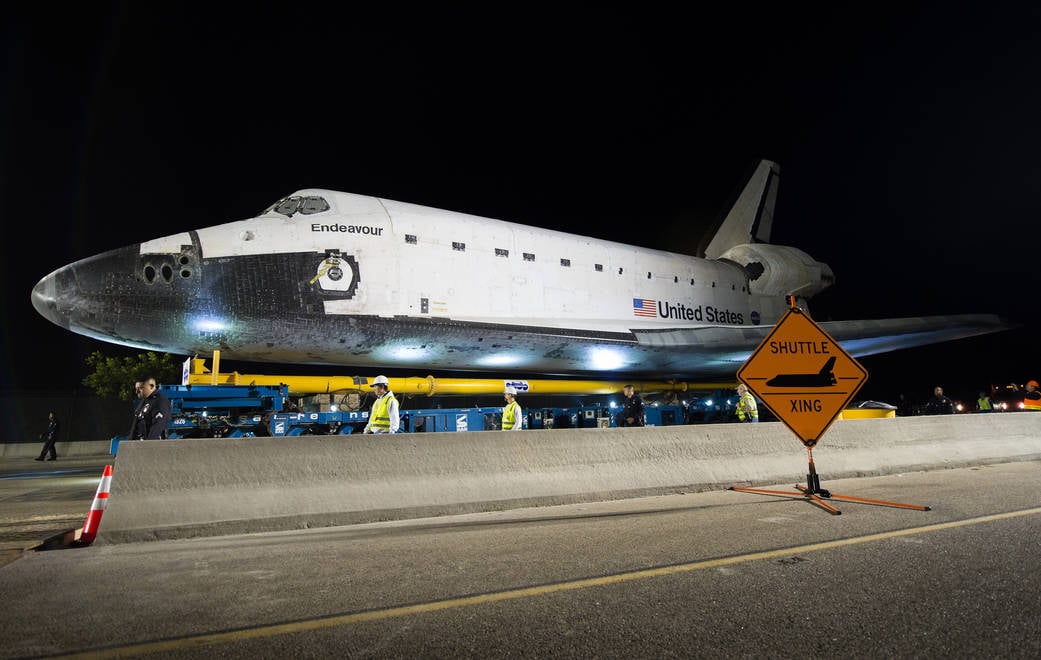
The Last Mission Was the Hardest
Endeavour logged 122,883,151 miles in orbit across 25 missions. It endured launches, re-entries, zero-G handling, and repairs mid-flight. Then, in October 2012, it had to travel twelve miles through central Los Angeles in roughly sixty-eight hours.
The average speed was 0.176 miles per hour. That covers one city block in an hour. The top speed was two miles per hour. The rest was stopping, assessing, adjusting, and sometimes waiting for crew to resolve whatever clearance problem sat ahead.
The journey from Los Angeles International Airport to the California Science Center was planned as a two-day operation. It became three. The orbiter reached its museum home on October 14 instead of October 13.
That delay tells the real story. Twelve miles through urban infrastructure is harder than a spaceflight when the cargo cannot flex, compress, or be redesigned on the fly.
Geometry Was the Problem, Not Weight
At 170,000 pounds, Endeavour was heavy. But weight was solvable. The transport system distributed the load across multiple axles. You can build a road to hold a given tonnage.
Shape could not be negotiated. The orbiter was 122 feet long, 78 feet wide, and 57 feet tall on its own. On the Over Land Transporter, the tail stood even higher. A road vehicle is built to be narrow. Endeavour was not.
Turning the nose changed where both wingtips swept. Lowering one side of the transporter to clear a power line on the left meant something else on the right suddenly had less room. Every adjustment created a new problem downstream.
This is not a problem astronauts face. In space, objects float. On a Los Angeles street, they collide with telephone poles, street signs, and branches that swing in the wind.
The City Had to Be Rewritten
Route planners did not pick the shortest path and hope for the best. They surveyed turns, bridges, overhead lines, traffic hardware, and underground infrastructure. The selected route was the one that could be made workable, not the one that would appear first in a navigation app.
Crews removed approximately 220 traffic signals and more than 400 trees. The distinction matters. Some removals happened months before the move. Others happened during it. Arborists continued trimming branches as Endeavour progressed, resolving conflicts that models had not fully captured.
Overhead utilities were raised, disconnected, or worked around. Steel plates protected vulnerable surfaces. Police officers—roughly 1,000 of them—lined the route, separating a rolling worksite from crowds that gathered along the sidewalks.
The operation was part engineering convoy, part civic procession. That mix created its own tension. You wanted public engagement with a national artifact. You also needed the working envelope to remain uncontaminated. Pauses gave crews room to complete each task and gave the transporter team time to confirm every group was ready.
The Final Miles Were the Tightest
As Endeavour entered denser streets near Exposition Park, progress slowed further. Wingtips passed apartment buildings, poles, and other obstructions with inches to spare. Workers trimmed more foliage and checked clearances while the transporter advanced in deliberate, measured increments.
“Inches to spare” does not mean improvisation. Surveys and digital models had identified the difficult locations in advance. But real streets contain flexing branches, sagging cables, parked infrastructure, and surfaces that do not behave as perfectly as a model predicts. The final authority remained the people watching the physical gap from the ground.
A fraction of a degree at the transporter moved a wingtip noticeably by the time that angle reached the end of the 78-foot span. Small inputs, large consequences.
What This Reveals About Engineering Culture
There is a tendency to treat spacecraft as if they exist in a separate category from ordinary engineering problems. They do not. When an orbiter leaves the runway environment, it encounters a world it was never designed for: narrow streets, fixed obstacles, and a public that expects miracles without understanding the labor behind them.
The Over Land Transporter itself is instructive. Its strongback frame had carried shuttle orbiters on a 37-mile route from Palmdale to Edwards Air Force Base for decades. After twenty-seven years in storage, it was refurbished for this journey. It is not a tractor-trailer. The multi-axle arrangement allowed operators to steer and position the load with exceptional control, stopping and correcting at the command of spotters who monitored nose, belly, tail, and both wingtips simultaneously.
The physics are the same as orbital mechanics—forces, moments, clearance envelopes. The scale is simply inverted. Where an astronaut manages thrust vectors to avoid collision with debris, a ground crew manages wheel angles to avoid collision with oak trees.
The Display Was Never the End
Endeavour arrived at the California Science Center in a horizontal display configuration. The longer plan called for a vertical presentation with a real external tank and authentic solid rocket booster components, recreating a launch-ready stack. Donations of flight-worthy shuttle booster hardware followed.
Moving and supporting a complete vertical stack in earthquake country created a different set of structural problems. The principle was identical: a familiar-looking spacecraft becomes an extraordinary civil-engineering load the moment it leaves the pad.
The contrast between the two regimes—the open sky versus the urban street—remains the most striking feature of this operation. Endeavour survived atmospheric re-entry at orbital velocity. It landed as an unpowered glider. Its final twelve miles required three days, hundreds of temporary changes to city infrastructure, and human spotters protecting clearances measured in inches.
Speed was never the measure of success. The slow pace was evidence that the operation was working as designed: turning an orbiter built for the void into a safe object on a public street, one carefully checked movement at a time.
Mission 26 had no astronauts, no launch stack, and no orbital velocity. It still required route analysis, hardware preparation, rehearsals, operating rules, contingency planning, and a large team. Its success criterion was simple to state and hard to achieve: place Endeavour in the museum without damaging the orbiter, the transporter, the city, or the public.
They did it. The shuttle rested on a pad where children could walk up to it. The streets reopened. The trees, some of them, were replaced. The engineers went home.