Solar Superstorm Crash Test Exposes Self-Driving Cars' Fatal Flaw
A November 2025 solar superstorm caused GPS errors over 30 feet across the U.S., enough to destabilize self-driving cars. The event lays bare the autonomous vehicle industry's dangerous reliance on a single navigation system vulnerable to space weather.
The Sun Just Crashed a Self-Driving Car
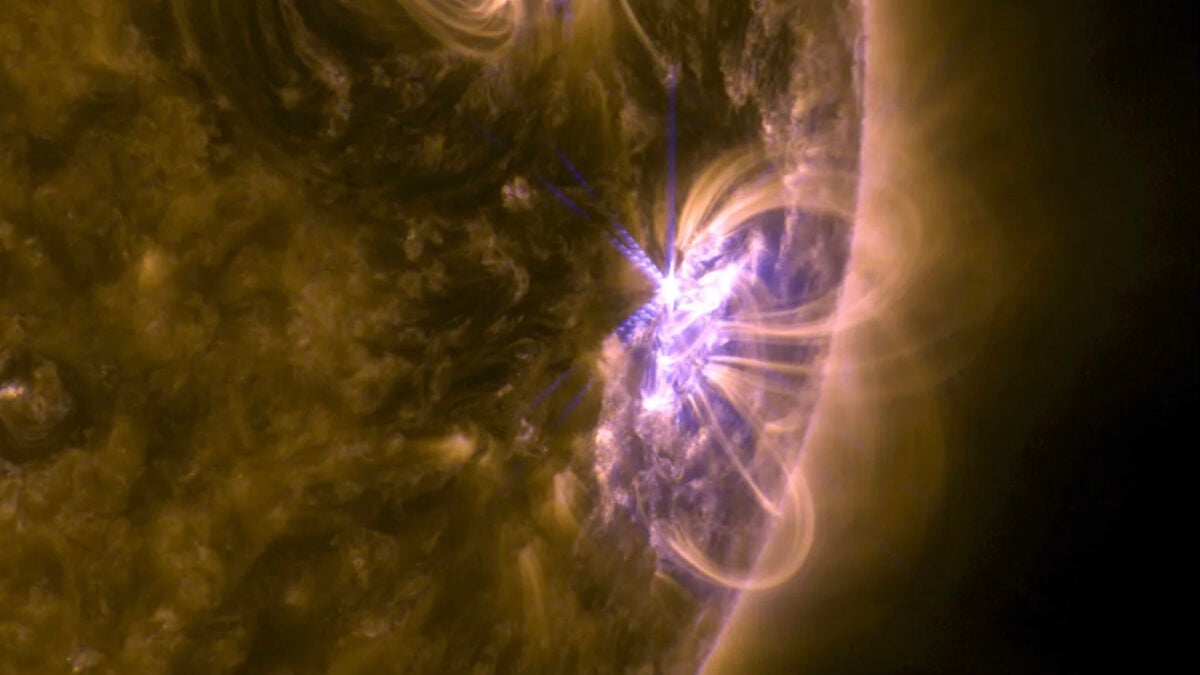
On November 11, 2025, the Sun sneezed. A coronal mass ejection slammed into Earth’s magnetosphere, painting the northern skies with auroras and simultaneously blinding the global positioning systems that underpin modern life. For six hours, GPS accuracy across the continental United States degraded by more than 30 feet—a margin wide enough to throw a precision‑agriculture tractor off its row or, as a new study in Geophysical Research Letters warns, to destabilize a self‑driving car.
The paper’s authors mapped electron density and signal fluctuations using ground‑based GPS receivers and all‑sky cameras from Canada to Florida. What they found was not a localized hiccup but a coast‑to‑coast disruption, with ionospheric turbulence spreading errors far from the polar regions where such effects are typically expected. The storm was a stress test—a real‑world crash course for an industry that has bet its future on a single, fragile thread.
GPS Is the Invisible Scaffolding
Modern autonomous vehicles don’t just use GPS; they depend on it as their primary source of absolute positioning. LiDAR, radar, and cameras provide relative location and object detection, but they must be anchored to a fixed coordinate frame. That frame is supplied by satellites orbiting 20,200 km above Earth, their signals passing through the ionosphere on the way down. During a geomagnetic storm, the ionosphere becomes a turbulent lens, bending and delaying radio waves. The result is a positional error that can exceed 10 meters—enough to shift a vehicle’s perceived location from the center of its lane to the shoulder, or worse.
Self‑driving systems are designed to handle sensor noise and momentary dropouts. They are not, however, built to cope with a sudden, widespread loss of accuracy across an entire region. The November storm revealed a stark vulnerability: when GPS goes bad, the car’s confidence in its own position evaporates. Without a reliable backup, the vehicle must either take a minimal‑risk maneuver (pull over and stop) or continue blindly, hoping its other sensors can compensate. Neither outcome is desirable at highway speeds.
Who Pays When the Sky Falls?
The financial implications extend far beyond any single incident. In May 2024, a less intense geomagnetic storm struck during peak farming season and cost U.S. Midwest farmers more than $500 million in crop damage and equipment misalignment. The November study noted that if the superstorm had hit during the same agricultural window, losses could have been even steeper. Now imagine those costs multiplied across logistics fleets, ride‑hailing networks, and delivery services—all of which rely on GPS for routing and timing.
For the autonomous‑vehicle industry, the risk is twofold. First, there is direct liability: a self‑driving car that swerves or stops unexpectedly because of a GPS glitch could cause a collision, property damage, or personal injury. Insurers are already pricing in weather‑related risks for conventional vehicles; space‑weather exposure is a new line item that has yet to be adequately modeled. Second, there is systemic risk: if a major storm were to knock out GPS across a metropolitan area, every autonomous vehicle operating there would face the same uncertainty simultaneously, potentially creating a cascade of failures.
The Single Point of Failure
The autonomous‑vehicle community has long touted sensor fusion—the idea that combining multiple data sources creates redundancy. In practice, however, the fusion algorithms often treat GPS as the ground truth against which other sensors are calibrated. When GPS degrades, the whole architecture wobbles. Companies like Tesla and Waymo have invested heavily in visual‑odometry and HD maps, but these are not foolproof substitutes. Visual odometry accumulates drift over time; HD maps require frequent updates and may not exist for every road. Neither can instantly provide a meter‑level absolute position without satellite correction.
The November storm underscores that until an autonomous system can maintain safe operation with degraded or absent GPS, it remains vulnerable to a hazard that is both predictable in its inevitability and unpredictable in its timing. Solar activity follows an 11‑year cycle, and we are currently approaching solar maximum. The next major geomagnetic storm is not a matter of if, but when.
A Weather‑Resilient Backup
The fix is not to abandon GPS but to build a navigation stack that does not collapse when its signals fade. Several approaches are under development. One is to augment GPS with ground‑based augmentation systems (GBAS) or low‑earth‑orbit satellite constellations that can provide more resilient positioning. Another is to improve inertial measurement units (IMUs) and develop tighter coupling between IMU and vision‑based localization, so that a vehicle can “dead reckon” its position for extended periods without external references. A third is to leverage cellular or V2X (vehicle‑to‑everything) signals for coarse positioning, though those too can be disrupted.
The key is to treat space weather as a known hazard, like rain or fog, and design around it. Autonomous‑vehicle manufacturers need to publish resilience standards and certify that their systems can safely degrade under ionospheric disturbance. Regulatory bodies such as the NHTSA and the European Union’s type‑approval agencies should consider requiring proof of GPS‑fallback capability before granting unconditional deployment permits.
The Timeline Is Tight
Several automakers have announced plans to roll out next‑generation ADAS features—level‑3 conditional autonomy, remote‑monitoring valet parking, and eventual level‑4 robotaxis—over the next two to three years. These systems will operate in increasingly complex environments and at higher speeds, making them even more dependent on precise positioning. If the hardware and software are not hardened against space‑weather events, the industry could face a public‑relations and legal crisis the moment the next superstorm hits.
Scientists are working on better prediction tools. The National Oceanic and Atmospheric Administration’s Space Weather Prediction Center already issues alerts, but the lead time is limited to hours, not days. Physics‑based models that can forecast the exact magnitude and timing of a coronal mass ejection are still in development. Until those models mature, the autonomous‑vehicle industry must assume that a disabling storm can strike with little warning.
What Happens Next
The November 2025 superstorm was a wake‑up call. It demonstrated that a natural phenomenon can produce errors large enough to threaten autonomous vehicles, and it provided a quantifiable benchmark: 30‑foot positioning errors spanning thousands of miles. The research community now has a clear mandate to refine measurement techniques and improve models. But the technology industry has an equally urgent mandate to adapt.
Insurers will begin to factor space‑weather risk into premiums for autonomous‑vehicle fleets. Fleet operators may start requiring drivers to manually override when GPS integrity is compromised. Consumers might become wary of relying on self‑driving features during periods of high solar activity—though that awareness could itself affect adoption rates. Meanwhile, policymakers could push for mandatory testing under simulated ionospheric disturbance, creating a new compliance layer similar to crash‑test ratings.
The Sun’s activity is cyclical, but its impact is not. As we move toward solar maximum, the probability of another disruptive storm rises. The autonomous‑vehicle industry’s reliance on GPS is a strategic choice that prioritizes simplicity and cost over resilience. The November storm shows that choice is a liability. Until the industry builds a navigation system that can shrug off a solar superstorm, every self‑driving car on the road is riding on a thread that can be severed by a flare on the Sun’s surface.
That’s not just a technical problem. It’s a test of whether we’ve learned to engineer for the cosmos as well as for the road.