South Korea Builds Its Own Battlefield AI — Without the US or China
Seoul is moving beyond relying on American AI for military use, building a sovereign battlefield model from scratch. The effort signals a shift in how middle powers approach defense AI — and what it means for regional security.
Seoul Doesn’t Trust American AI With Its Battlefield Anymore
South Korea’s defense ministry is doing something quietly significant: it is building its own sovereign military AI from scratch, trained entirely on Korean military data, terminology, and operational environments. No OpenAI. No Anthropic. No American foundation model, fine-tuned and repurposed.
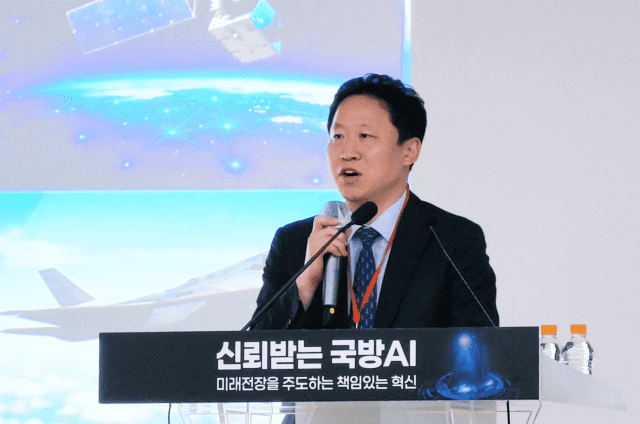
The project, announced at a Seoul defense AI seminar on September 2, represents a decisive break from the assumption that Korea can simply adopt American commercial AI and adapt it for military use. Instead, the defense ministry plans to develop specialized models starting from a domestic foundation model created by the Ministry of Science and ICT — and then layer Korean battlefield-specific training data on top.
The roadmap has three stages, each escalating in sensitivity. First, a general model trained on publicly available defense data. Second, an administrative model using non-classified military records. Third — and this is the critical one — a battlefield model trained on classified data for command decision support, weapons systems integration, and real-time tactical applications.
Who Benefits and Who Doesn’t
The immediate winner is the defense AI ecosystem within South Korea itself. The ministry explicitly framed this as an effort to nurture a Korean Palantir — a domestic defense data company that can operate with the same kind of data-integration capability that Palantir has built in the United States. The logic is straightforward: if you depend on an American company for your command-and-control AI, you have outsourced a core layer of military sovereignty.
The defense ministry is also creating what it calls a “defense AI common operating system” — a shared infrastructure that connects GPU clusters, secure networks, research spaces, and military data into a single platform. Five such hubs will be established across South Korea, starting with one in Pangyo opening September 17. Private companies and research institutions will be able to access military datasets in a controlled environment, developing and testing AI applications that can eventually feed into active military systems.
But the story isn’t purely domestic. The strategic implication reaches far beyond Seoul’s borders.
The Unspoken Shift: A Middle Power Claims Its Own AI Sovereignty
For years, the dominant assumption in defense AI has been that smaller or mid-tier powers would either integrate with American systems or, in some cases, lean toward Chinese technology. South Korea’s move rejects both premises. It is asserting that military AI sovereignty is a legitimate and achievable goal — even for a country that currently relies on American alliance structures for conventional defense.
This matters because South Korea is not an isolated case. It is a signal. If a technologically advanced mid-tier power like South Korea can build a classified, battlefield-grade AI model using its own data, the assumption that only superpowers can afford sovereign military AI begins to crack. Japan, Taiwan, Australia, and NATO members in Europe are all watching closely.
The timing amplifies the significance. The United States has been moving in the opposite direction — the Pentagon has recently approved the adoption of ChatGPT and Grok for military use, with heightened scrutiny around sensitive data handling. While Washington is experimenting with integrating commercial AI into military workflows, Seoul is deliberately rejecting that model for its most classified operations.
What This Looks Like in Practice
The specifics of South Korea’s approach reveal a careful calibration between ambition and constraint. The ministry identified 150 high-value military datasets covering combat command training, naval and coastal surveillance, and other high-impact applications. A defense data catalog will make these datasets discoverable for private-sector developers, but access will be tiered: only companies meeting strict information security standards will receive direct military data, while others will work through the secure proof-of-concept hubs.
The ministry also selected 20 rapid-demonstration projects across four domains — combat support, manpower reduction, defense operations efficiency, and cybersecurity. Successful projects move toward actual deployment; unsuccessful ones do not. The DARPA-style pressure-test model is visible here.
Beyond software, South Korea is also investing in physical AI. The DAS project, launching next year, will introduce robots and unmanned ground vehicles into military test environments, collecting real-world data that feeds back into simulation and world-model training. This closes a loop that pure software AI cannot achieve: the integration of physical military platforms with AI decision-support systems.
The Calculus Behind the Decision
The stated rationale is straightforward: national security data demands national security AI. General-purpose American models, no matter how capable, were not trained on Korean military doctrine, terrain, threat profiles, or operational protocols. Using them for classified applications introduces both capability gaps and security risks — the risk of data leakage, the risk of adversarial manipulation, and the risk of strategic dependence on a technology provider that may face its own domestic regulatory constraints.
But the deeper calculus is geopolitical. South Korea sits at the center of East Asia’s most dangerous flashpoint. North Korea’s accelerating nuclear and missile programs, China’s growing military presence in the region, and the unpredictable nature of American strategic commitments all factor into Seoul’s calculation. Building sovereign AI capability is insurance against a future where alliance-based technology access becomes uncertain.
What Happens Next
The next 18 to 24 months will be telling. If South Korea delivers a functional battlefield AI model, it proves that a middle power can build sovereign military AI without becoming a great power. That outcome reshapes assumptions across the Indo-Pacific.
If the project stalls — due to data quality issues, capability gaps in the domestic AI sector, or the inherent difficulty of training classified models without access to the most advanced general-purpose AI research — it will still send a message: the desire for military AI sovereignty is real, even if the path is harder than advertised.
Either way, South Korea has drawn a line. It will not outsource its most sensitive military decisions to a system it does not control. In an era where AI is becoming the central technology of warfare, that decision is as strategically consequential as any weapons procurement program.
The question now is whether other countries will follow — or whether South Korea’s approach reveals the limits of what a mid-tier power can achieve when it goes it alone.