South Korea's DMZ Mine Resolution Fails Amid Partisan Divide
South Korea's National Assembly defense committee couldn't agree on a condemnation of North Korea's DMZ mine blast. The fight over aid language reveals a sharper rift than the incident itself.
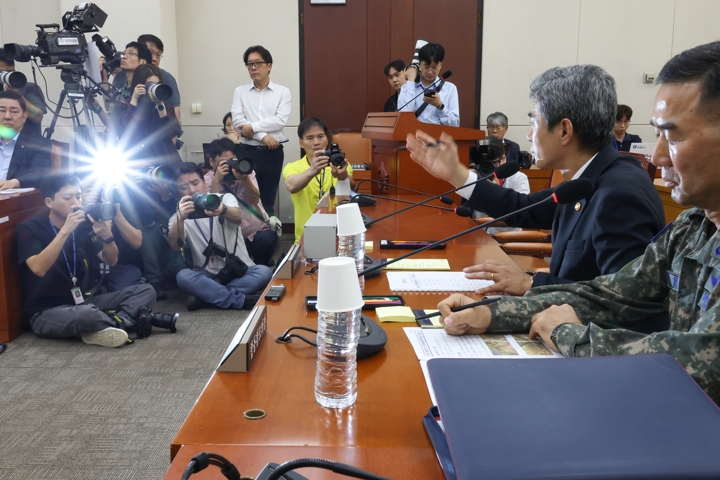
The Resolution That Wasn’t
South Korea’s National Assembly National Defense Committee sat down on September 29 intending to issue a unified condemnation of North Korea’s mine explosion in the Demilitarized Zone. What emerged instead was a public disagreement over words on a page — and a signal that Seoul’s political class is far from aligned on what comes next.
The resolution failed not because lawmakers disputed that a mine blast occurred or that it warranted condemnation. It failed because the opposition People Power Party insisted the document include language tying any future humanitarian aid to Pyongyang’s apology and guarantees against recurrence. The ruling Democratic Party refused.
The result is an unresolved tension that will shape South Korea’s response regardless of what happens next.
The Language That Broke It
PPP lawmaker Lim Jong-deuk, the committee’s opposition coordinator, said the parties agreed on direction but diverged on specifics. The gap was narrow and oddly specific: whether the resolution should state that humanitarian assistance to North Korea must be reconsidered if Pyongyang offers no apology and no assurance of non-repetition.
Lim made the PPP position blunt. “If there’s no apology and no promise of prevention, then humanitarian support at the government level cannot continue,” he said. PPP colleague Han Ki-ho sharpened it further, calling the posture contradictory — condemning North Korea while simultaneously sending roughly 10 billion won worth of pharmaceutical aid. “Our soldiers are being killed like this, and they’re receiving humanitarian support?” Han asked.
The Democratic Party’s response was equally direct. Committee coordinator Kim Byeong-joo pushed back on both the premise and the timing. There is no active humanitarian aid program to North Korea right now, he argued, because communication lines have been severed. Asking to “review” a program that doesn’t exist was, in his view, bad faith obstruction.
“They included language demanding proportional measures if North Korea doesn’t apologize,” Kim said. “But then they want to add a clause about reviewing current aid. That’s not substance — it’s picking a fight.”
Committee Chair Jin Seong-jun called for further consultation rather than force a vote, saying a revised draft could come up at a later session if consensus emerges.
What This Split Actually Means
The immediate aftermath is simple — no resolution, no unified parliamentary statement, and North Korea facing no fresh diplomatic pressure from Seoul’s legislature. But the subtext matters more.
The PPP is treating the mine blast as leverage to press a harder line on North Korea across the board. By attaching aid conditions to a condemnation resolution, they’re trying to anchor the government’s posture to a principle it has been reluctant to embrace: that engagement with Pyongyang should be transactional, not structural. The argument is straightforward in theory — if you condemn an act, don’t fund the regime responsible for it. The political read is less charitable: the opposition is using a military incident to constrain the executive branch’s options.
The Democratic Party’s position reflects a different calculus. Severing communication lines with North Korea makes the aid question somewhat theoretical, but the principle at stake is real. Humanitarian assistance, even at minimal levels, operates on a different track than diplomatic or economic engagement. Collapsing the two into a single conditional framework raises the question of what happens when Pyongyang does something genuinely provocative — does South Korea suspend food or medicine as punishment, or does it maintain a floor regardless?
The more consequential question is timing. South Korea is living through a period of unusually high tension on the peninsula. North Korea has reinforced its eastern and western military posts, conducted repeated reconnaissance satellite launches, and openly discussed the possibility of deploying troops to Russia’s war in Ukraine. The DMZ mine incident — whether intentional or accidental — adds another volatile element to an already frayed security environment.
In this context, a divided parliamentary response is not neutral. It signals to Pyongyang that Seoul lacks a consolidated political front. It also creates room for the executive branch to define the response unilaterally, which benefits the current administration but raises questions about democratic oversight on peninsula policy.
Who Wins and Who Loses
North Korea wins by default. Whether the mine blast was deliberate or an accident, a fractured response from Seoul is a victory for the regime’s broader strategy: demonstrate capability, invite division, and walk away with the initiative.
The PPP gains a talking point — it can argue that the government is soft on North Korea while refusing to take responsibility for an actual policy shift. The Democratic Party avoids a premature binding commitment but loses the opportunity to present a united front at a moment when unity would matter most.
South Korean soldiers at the DMZ lose in the quietest way. The mine explosion killed or wounded troops. A resolution would have been a statement that the state sees their sacrifice as nationally significant rather than operationally routine. Without it, the message is ambiguous.
What Comes Next
Committee Chair Jin said a revised resolution could be taken up at a future session if consensus emerges. That outcome is uncertain. The same language that failed on September 29 will likely face the same obstacles — the PPP wants a policy commitment attached to the condemnation, and the Democratic Party is unwilling to give it without extracting something in return.
The government’s response will likely unfold outside the legislature. Presidential directives, military posturing, and statements from the Ministry of Unification will fill the gap left by the failed resolution. But a parliamentary condemnation carries weight that executive actions alone do not — it signals institutional consensus and makes future reversals politically costly.
Without that consensus, South Korea’s next move on the peninsula will be shaped more by the administration’s calculations than by a coherent national position. That is not a new problem in Korean politics. It is a problem that just became more visible.
The mine in the DMZ is a physical reminder of what is at stake. The unresolved resolution is a political one.