South Korea's Silence on North Binance Hack Sanctions
North Korea's heist of $6.3 billion from Binance has exposed a policy rift within South Korea's government — one that could weaken regional pressure on Pyongyang's cyber operations.
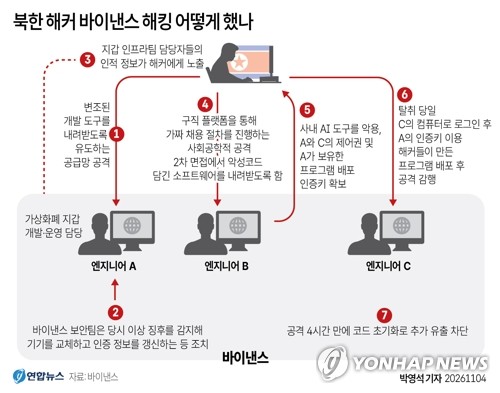
The Heist That Nobody in Seoul Is Punishing
The numbers alone are staggering. Sixty-three billion dollars — roughly four times the entire GDP of North Korea — siphoned off over five months by a team of hackers operating out of Pyongyang. But the real story isn’t what happened at Binance. It is what is not happening inside the South Korean government right now.
On November 3, Binance released its initial investigation report confirming that North Korean state-sponsored hackers from the Reconnaissance General Bureau unit known as TraderTraitor carried out a meticulous, multi-layered attack beginning in June. The FBI backed the assessment days later, releasing its own intelligence assessment detailing command-and-control infrastructure traced to North Korean military addresses. Kim Yo-jong, the powerful younger sister of Kim Jong-un, dismissed the findings as “American political provocation” over two consecutive public statements. And in Seoul? Nearly silence.
The Ministry of Unification confirmed on November 5 that no inter-ministerial discussion on additional sanctions has even begun. When pressed by reporters, an unification ministry official said the government “does not have accurate information” about the incident and that no debate has started on how to respond. Evidence exists. Dialogue has not.
That gap matters more than most international outlets covering this story realize. It signals something broader about where South Korea stands on one of the defining security challenges of the decade.
A Cabinet Divided Over What Counts as War
The deeper problem is not bureaucratic inertia. It is ideological tension between two wings of the Yoon administration.
Last month, during a National Assembly audit, Unification Minister Jeong Dong-young explicitly opposed expanding unilateral sanctions targeting North Korean cyber operations. The proposal linked the hack to the late September landmine explosion in the Demilitarized Zone that wounded South Korean soldiers. Jeong rejected the connection, saying the link was “weak,” and argued against treating cybercrime the way traditional acts of war would be treated under sanctions law. His remarks drew sharp criticism from opposition lawmakers but were never rebutted by his own cabinet colleagues.
Foreign Minister Kang Kyung-wha represents a different camp. She has repeatedly called for tighter multilateral coordination with Washington and Tokyo on North Korean financial crimes, framing cyber-theft as a direct national security threat requiring the same tools traditionally reserved for terrorism financing. Her office did not publicly counter Jeong’s position after his comments, which speaks volumes about where the balance of power sits inside the Blue House.
The result is a situation where South Korea’s primary ally in the region has no coherent position on one of the largest single acts of cyber-theft in history. That is unusual. It is also dangerous — particularly because the vacuum invites other actors to set the terms.
Why Seoul Stalls
Three forces explain the paralysis, and each compounds the others.
First, South Korea faces domestic political fragility. President Yoon’s approval ratings have hovered near crisis levels since the winter, dragged down by economic stagnation and a series of governance missteps. Any move perceived as provocative toward North Korea risks energizing conservative backlash ahead of mid-term elections. Jeong’s caution reflects party calculations, not just policy judgment. Sources inside the Unification Ministry say internal memos advising a tougher stance were quietly shelved in October before any formal inter-agency meeting could take place.
Second, the legal framework itself is ambiguous. North Korean hacking operations have historically occupied a gray zone between crime and warfare. The Trump administration took the extraordinary step in 2022 of indicting three North Korean generals for the $6.3 billion Ronin Bridge heist on Ethereum, setting a precedent for criminal prosecution rather than mere sanctions. But South Korea lacks equivalent prosecutorial tools, and its sanctions regime applies differently to cyber activities than to kinetic ones. Legal scholars within the justice ministry have debated for years whether existing statutes can cover an operation of this scale without legislative overhaul — an exercise that would take months, if not years.
Third, Beijing complicates enforcement at every turn. China continues to serve as North Korea’s primary economic lifeline, absorbing the vast majority of Pyongyang’s sanctioned trade through informal channels. Any aggressive South Korean sanctions push risks triggering diplomatic friction with Seoul’s other critical partner, which has already signaled discomfort with what it views as Washington-led escalation. The math is uncomfortable: punish Pyongyang too harshly and Beijing wavers; punish it too gently and alliance credibility erodes. Every option carries cost. Doing nothing carries the lowest immediate price, which is precisely why it is the most likely path.
The Real Cost: Everything Goes Unpriced
North Korea generates an estimated $4 billion annually through cyber operations, according to South Korean intelligence estimates published earlier this year. The Binance hack, if successful, would nearly double that figure overnight. Most of those funds flow into weapons development programs that directly threaten South Korea, Japan, and US forces across the Pacific. Satellite imagery analyzed by independent think tanks shows increased construction activity at missile test facilities in recent months, consistent with what analysts describe as accelerated funding cycles tied to cryptocurrency proceeds.
Every month that passes without coordinated sanctions sends a message more damaging than any press release: that the theft is acceptable so long as it stays below the threshold of conventional conflict. That threshold, currently drawn around kinetic attacks and nuclear tests, was never designed to encompass digital expropriation on this scale. As Pyongyang recalibrates its calculus accordingly, the gap becomes a structural liability.
Japan has moved faster than South Korea. Prime Minister Fumio Kishida’s cabinet has pushed for stronger financial tracking measures targeting North Korean cryptocurrency laundering networks, working closely with the Financial Action Task Force to designate specific exchange accounts. The United States continues to impose targeted sanctions through Treasury Department executive orders, freezing assets and prosecuting operatives. South Korea remains absent from those frameworks despite bearing the greatest strategic exposure. Defense contractors in Seoul have quietly raised concerns with industry associations, warning that the funding gap will widen further as Pyongyang reinvests stolen capital into next-generation cyber capabilities.
Second-Order Effects Already Emerge
The consequences are not hypothetical. Crypto security firms operating in South Korea report a measurable uptick in phishing attempts targeting exchange employees since the Binance announcement — a pattern consistent with TraderTraitor’s operational tempo. Black-market brokers in Busan and Incheon have begun advertising North Korean-origin wallet keys at premium prices, indicating that some proceeds may already be circulating through shadow networks. Interpol has received three formal requests from Asian exchanges seeking South Korean cooperation in tracing transaction paths, all still pending review.
Meanwhile, allied defense planners are quietly adjusting force posture assumptions. USFK briefings referenced in leaked documents note that North Korea’s expanded cyber budget enables simultaneous investment in both offensive digital operations and hypersonic missile development — two tracks that compound each other strategically. The absence of a South Korean response removes a key pillar from the trilateral deterrence architecture.
What Comes Next
A trilateral sanction package aligned with US and Japanese positions would send a clear signal. It would require Jeong’s ministry to reverse course, which means pressure from the presidential office or from coalition partners willing to make it a public issue. Opposition parties have already introduced a private member’s bill calling for emergency session of the National Security Council, though its passage remains uncertain given the ruling party’s slim majority.
Alternatively, Seoul could pursue independent designation of specific TRD units involved in the hack — similar to the US INDICT designations — though legal constraints may limit scope. Even partial action would establish precedent and create operational headaches for Pyongyang’s financial apparatus. The finance ministry has draft regulations ready for review; they have simply not been forwarded.
Without either path, North Korea will continue treating South Korea as the soft target in Northeast Asia: closest geographically, weakest politically, and most hesitant to escalate. That calculus benefits Pyongyang today and will compound next year when the stolen funds have already been laundered through multiple jurisdictions and converted into ballistic missile components. The window for a credible response is narrowing with each day of silence.
The Binance hack should have triggered immediate action. Instead it revealed something worse — a government that cannot agree on what kind of threat it faces.