South Korea's Nuri Rocket Proves It Can Carry Satellite Swarms
South Korea's Nuri rocket has achieved four consecutive orbital insertions and demonstrated the ability to deploy multiple satellites in formation — a capability that reshapes both its commercial launch prospects and regional defense posture.
Four in a row, and something new
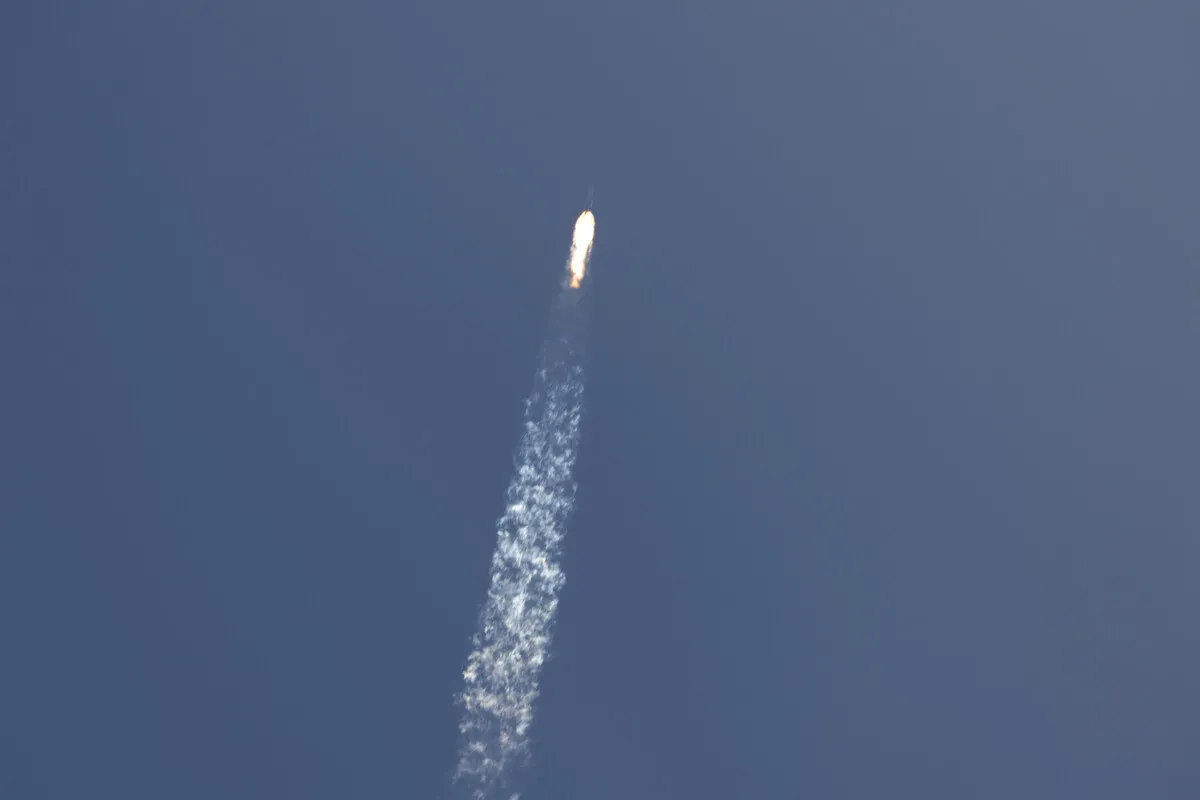
South Korea’s Nuri rocket didn’t just reach orbit again. On the afternoon of the 7th, launching from the Naro Space Center in Goheung, it carried ten small satellites into space — not as a single payload, but as a coordinated cluster of five 100-kilogram mini-satellites deployed 35 to 40 seconds apart, followed by nine CubeSats released in sequence. The maneuver worked almost exactly to plan.
That may sound incremental. It isn’t.
Previous Nuri launches carried one or two large satellites. This time, the payload was a swarm — satellites designed to operate together, forming what experts are calling a mission-type space transportation capability. The Korea Aerospace Research Institute developed a new low-shock separation device specifically for this flight. The implication is that South Korea can now deliver multiple coordinated payloads on schedule, without relying on foreign launchers to share their rides.
What made this flight distinctive was the precision of the deployment window. Each of the five cluster satellites — built under the NeOnS (Next-generation Optical nano-satellite) program — separated within a two-second tolerance of its scheduled release time. That kind of timing precision matters when you’re trying to establish formation flying patterns, because even small errors in deployment velocity compound rapidly in orbit. The low-shock separation mechanism, which KARI engineers designed to minimize the mechanical stress imparted to each satellite during release, appears to have performed within specification. Ground telemetry confirmed that all five cluster satellites powered up and transmitted their first signals within minutes of separation, a sign that the deployment sequence hadn’t disrupted their internal systems.
Who wins when a country builds launch-repeat capability
The math is blunt. Before this flight, Nuri’s cumulative success rate sat at 75 percent. With the fourth consecutive orbital insertion confirmed, it climbed to 80 percent. That crosses a threshold — the Space Agency says 90 percent is the benchmark that commercial buyers will actually trust. South Korea is five percentage points away from being taken seriously in the global commercial launch market, which is currently defined by SpaceX and, to a lesser extent, India’s ISRO.
The immediate winner is the domestic launch industry. For years, South Korea’s medium-sized next-generation satellites were launched on foreign rockets — a pattern that left Seoul dependent on scheduling determined by other nations. The Space Agency has already stated that future public satellites will fly on Nuri whenever possible. That changes the economics: no more bidding for a slot on a Falcon 9, no more waiting for someone else’s manifest to clear.
But the second-order effects ripple further than scheduling independence. When a nation controls its own launch cadence, it also controls its own intelligence cycle. Defense and reconnaissance satellites no longer need to wait for a commercial launcher’s open window, which can shift by months depending on payload priorities elsewhere. This flight demonstrated that Nuri can serve as a dedicated platform for time-sensitive national missions — something that matters enormously when you’re monitoring a neighbor that tests missiles and launches its own satellites on its own schedule.
The second winner is Hanwha Aerospace. Since the third Nuri launch, the company has been embedded in the operation — this flight saw 23 Hanwha personnel manning 20 of the 22 consoles at the launch control center. Starting with the sixth launch in 2026, Hanwha takes over final assembly and sea transport. By 2030, the government expects a commercial launch cadence of two to three flights per year, run entirely by private industry. Hanwha isn’t just a contractor anymore. It’s becoming the operator.
That transition carries risk. Hanwha’s core business is defense manufacturing — artillery, armored vehicles, ammunition — and aerospace launch operations require a different kind of discipline, one measured in milliseconds and thermal cycles rather than ballistics and metallurgy. But the company has been methodical about the handoff. The government has structured the transition so that KARI retains oversight of flight operations while Hanwha absorbs integration and logistics. If the model holds, it could become a template for how South Korea industrializes space access the way it industrialized shipbuilding and semiconductors decades earlier.
The cluster-satellite question: why it matters for defense
The real story isn’t just the number of satellites launched. It’s what flying a cluster enables.
A single large satellite is a high-value target. It’s also a single point of failure. A cluster of five coordinated mini-satellites — each capable of carrying sensors, cameras, or communications equipment — provides redundancy, multi-angle observation, and the ability to remap coverage faster than any monolithic platform. In defense terms, that means a South Korean constellation that can re-image a target area in hours instead of days, survive the loss of one node, and potentially operate across multiple orbital planes simultaneously.
This matters in a region where North Korea is rapidly expanding its own satellite and missile capabilities. Pyongyang has launched its own reconnaissance satellites in recent years and continues to test longer-range missiles. China’s BeiDou navigation constellation and its growing commercial mega-constellation ambitions are reshaping the infrastructure landscape across East Asia. South Korea doesn’t need to match those programs dollar for dollar. It needs the kind of resilient, distributed space architecture that cluster satellites provide — at a fraction of the cost.
The NeOnS dataset satellites this flight carried — five of them in a coordinated formation — are a proof of concept. Each satellite carries optical imaging sensors designed to capture data at resolutions useful for both civilian and defense applications. The cluster concept, if proven out over subsequent flights, could lead to a dedicated reconnaissance constellation that operates continuously over the Korean Peninsula and surrounding waters. That capability would fundamentally change Seoul’s surveillance posture, giving it persistent coverage that a single satellite could never achieve.
There’s also a commercial angle. The global demand for Earth observation data is growing — agriculture monitoring, disaster response, insurance risk assessment, and maritime tracking all depend on frequent, high-quality imagery. A cluster of mini-satellites can provide revisit times measured in hours rather than days, which is the difference between actionable intelligence and outdated information. South Korea’s launch industry could position itself as the provider of last resort for customers who need responsive, frequent coverage without the premium pricing associated with Western launch services.
The reusable gap
Here’s where South Korea lags. No Nuri flight has demonstrated reusability. No Korean launcher has landed a booster, turned it around, and flown it again. That capability is what drives costs down in the commercial market — SpaceX’s Falcon 9 primary driver is reuse, not raw performance. A refurbished first stage can cut launch costs by roughly 30 percent, and that gap is where the commercial market splits: players who can afford reuse and players who can’t.
Korea’s next launch vehicle, a 2.3 trillion won, two-stage methalox design, is supposed to incorporate reuse technology. It’s targeting a test flight in 2031. The design calls for a landing leg system and engine throttle-down capability on the first stage, both of which are standard on modern reusable rockets but untested on any Korean vehicle. If the program stays on schedule, South Korea will have demonstrated a reusable launcher within a decade of its first successful orbital flight — an aggressive timeline by historical standards.
But the alternative — staying permanently dependent on foreign launchers for critical national payloads — isn’t an option the government is willing to accept. The strategic logic of indigenous launch capability outweighs the economic logic of buying cheaper rides abroad. That’s a calculation many countries have made, and South Korea is making it with full awareness of the costs involved.
What happens next
The Nuri program runs through 2028, with five more launches planned through flight seven. Flight eight and beyond belong to Hanwha. The government plans a private-sector collaboration mini-lunar lander on Nuri in 2030, followed by a national lunar lander on the next-generation vehicle in 2032. Both missions signal that South Korea is thinking beyond Earth orbit — that the launch industry it’s building is meant to serve deep space exploration, not just orbital insertion.
The timeline is aggressive but coherent. The question isn’t whether South Korea can build a satellite launcher — it can, and it has, four times in a row. The question is whether it can industrialize the process fast enough to make reuse economically viable before the global launch market hardens around the players who already have it. Every year without reuse is a year of paying a premium. Every year with a working cluster-satellite deployment capability is a year of pulling ahead of competitors who still rely on monolithic platforms.
South Korea just proved it can do both. The next four flights will determine whether it can sustain the pace.