South Korea's Nuriro 5th Launch Signals Space Ambition
South Korea's Nuriro rocket launched its fifth mission carrying 15 satellites in a complex deployment sequence. The mission tests orbital precision and reveals Seoul's growing ambitions in commercial space and regional security.
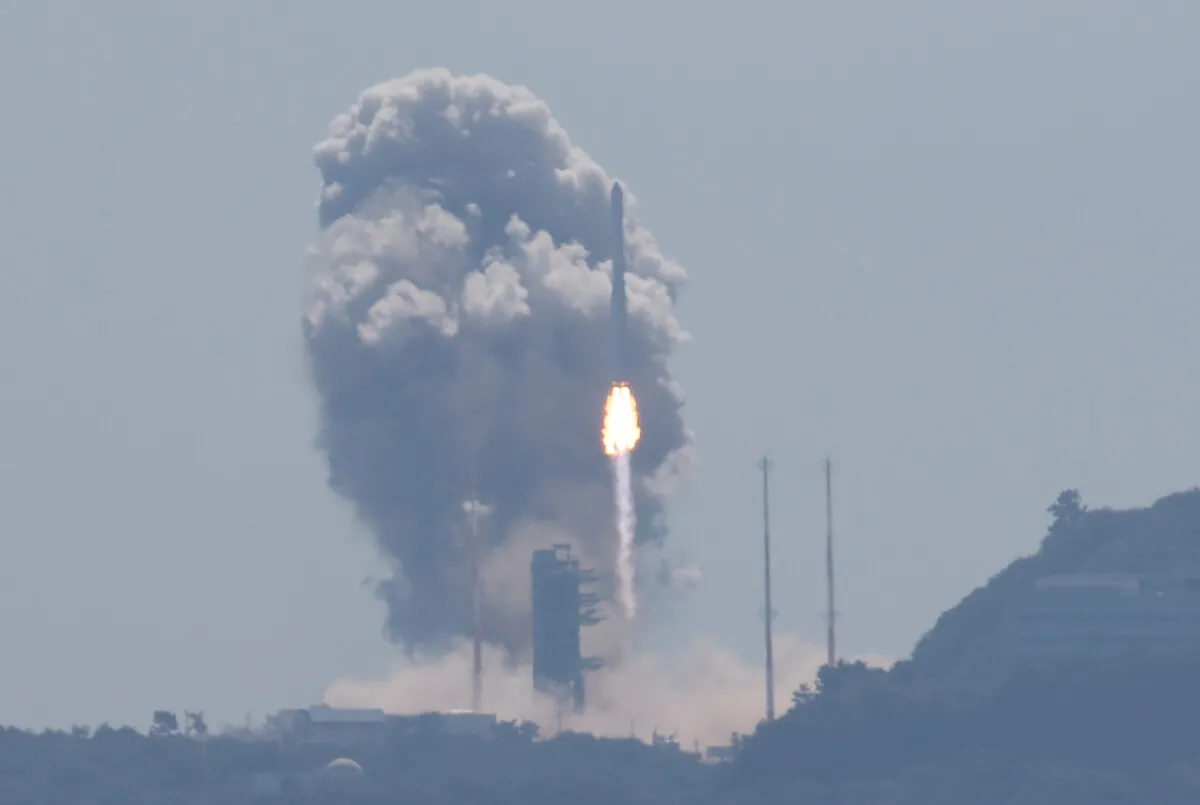
A Rocket That Carries a Fleet
South Korea’s Nuriro rocket lifted off at 12:25 p.m. on July 7 from the Naro Space Center in Goheung, South Jeolla Province, marking a pivotal moment in the nation’s rapidly evolving space program. The launch carried 15 satellites — the largest payload in the vehicle’s history — and required a precision deployment sequence that few in the region can claim to master with consistent reliability.
The mission diverged sharply from every previous Nuriro flight. It was the first daytime launch, demanding enhanced tracking and telemetry during peak solar interference conditions. More critically, it carried not one primary satellite but a constellation of microsatellites that had to separate from each other in a carefully choreographed sequence without colliding — a test of orbital control precision that has divided the capable from the competent in East Asia.
The Technical Challenge
Nuriro stands 47.2 meters tall with a 3.5-meter diameter and weighs roughly 200 tons. It runs on liquid oxygen and kerosene — a straightforward propulsion choice that has nonetheless proven reliable across five attempts, a track record that now puts South Korea among the small club of nations operating successful orbital launch vehicles independently.
The flight profile demanded extraordinary precision at every stage. Two minutes and three seconds after liftoff, the first stage separated at an altitude of 67 kilometers. The payload fairing jettisoned at 224 kilometers. The second stage dropped away at 268 kilometers.
Then came the hard part.
Starting at 13 minutes and 30 seconds into the flight, Nuriro began releasing five Neon-Sharp microsatellites in 35-to-40-second intervals. Each satellite had to deploy cleanly while the rocket adjusted its orientation to avoid collisions between the departing vehicles — a process requiring real-time adjustments to the third stage’s attitude control system.
After those five separated, the third stage climbed to 577 kilometers before shutting down its engine and entering the target orbit. It then performed an avoidance maneuver to distance itself from the already-deployed satellites, vented all remaining fuel and oxidizer into space, and set itself on a reentry path for natural disintegration 19 to 20 minutes after launch.
Ten CubeSats from various Korean research institutions — designed for disaster monitoring, agricultural survey, and pharmaceutical crystallization experiments — were released sequentially after the primary payloads. The final separation occurred at roughly 17 minutes and 15 seconds into the flight, completing one of the most demanding deployment sequences in the program’s history.
First-stage boosters were predicted to impact the ocean approximately 400 kilometers from the launch site. The fairing fell about 1,590 kilometers away. The second stage traveled even farther, landing some 26,704 kilometers downrange. Tracking data came from facilities in Naro, Jeju, and Palau in the south Pacific — an infrastructure network that has grown more sophisticated with each successive flight.
Why This Matters Beyond Korea
South Korea’s space program has advanced rapidly but incrementally. The first successful Nuriro launch came in June 2022, ending years of setbacks that began with the 2013 failure of the earlier Naro-1 vehicle. Each subsequent mission has refined the vehicle and expanded its capabilities — from proving orbital insertion capability to increasing payload mass to mastering multi-satellite deployment. This fifth flight represents the most complex deployment yet, and success or failure carries consequences that extend well beyond the Korean Peninsula.
Japan holds a dominant position in regional space launch capabilities through its H-IIA and H3 programs, which have delivered heavy payloads to geostationary orbit with regularity. China’s Long March fleet launches with frequency and payloads that dwarf everything else in East Asia, operating dozens of launches annually. North Korea has demonstrated its own ballistic missile technology through repeated test flights, though its orbital capability remains unproven. South Korea’s ability to reach orbit reliably and with increasing sophistication matters for the balance of power in a region where space assets underpin both commercial infrastructure and military capability.
The constellation deployment pattern tested here — releasing multiple small satellites in rapid succession — mirrors a growing commercial trend transforming the global space economy. Small satellite constellations provide communications, earth observation, and intelligence-gathering services at a fraction of the cost of single large satellites. Companies like SpaceX with Starlink and Amazon with Project Kuiper have proven the model commercially. Nations that can deploy and manage these fleets efficiently gain advantages that are both economic and strategic, creating a new tier of space-faring capability distinct from the Cold War-era model of single mission satellites.
The Geopolitical Calculus
The United States has closely watched South Korea’s space progress, viewing a capable Korean launch vehicle as a strategic asset in the Indo-Pacific. American policy has generally supported Korean civilian space development as part of broader regional security architecture, though Washington maintains export controls on certain dual-use technologies. But the implications of a Korean launch vehicle that can deliver 15 satellites to orbit are not limited to commercial considerations.
Satellite data feeds into missile targeting, maritime surveillance, and early-warning systems — the same systems that underpin extended deterrence arrangements with the United States. A country that can reliably place multiple observation satellites into solar-synchronous orbits controls information flows that matter for regional stability. South Korea’s growing independent capability reduces reliance on allied intelligence sharing and provides Seoul with direct situational awareness of North Korean activities and Chinese naval movements.
Japan and South Korea have discussed trilateral cooperation on space and missile defense with the United States, though historical grievances and domestic politics have repeatedly slowed integration. A dependable Korean launch capability strengthens the case for deeper integration by adding practical value to theoretical frameworks. Failure would not be catastrophic to the alliance structure, but it would reinforce skepticism among partners about Seoul’s ability to match Japanese and Chinese progress — a narrative that could slow cooperation on other security dimensions.
The commercial dimension adds further complexity. South Korea’s space sector is attracting significant private investment, with companies like SpaceK and DynaPort developing their own launch concepts. A successful Nuriro mission signals to international investors that South Korea offers a stable environment for space entrepreneurship, potentially drawing capital that might otherwise flow to Tokyo or Singapore.
Second-Order Effects
The implications of this mission extend beyond orbital mechanics. Success establishes a template for commercial satellite operators seeking reliable access to sun-synchronous and low-earth orbits — markets currently dominated by SpaceX, Axiom Space, and increasingly Chinese operators. South Korea’s emergence as a dependable launch provider could shift contracting patterns for East Asian commercial operators who have historically relied on European or American launch services.
The deployment technique tested here — precise sequencing of multiple small satellites — is directly applicable to commercial constellation operations. Operators deploying their own fleets need exactly this kind of capability: the ability to place multiple satellites into slightly different orbital planes without human intervention beyond the initial command sequence. Nations and companies that master this technique gain a competitive edge in an era when satellite bandwidth and orbital slots are becoming scarce resources.
Domestically, the mission reinforces the political case for continued space spending in a country where budget priorities are fiercely contested. The Korean Aviation and Space Administration operates under annual legislative review, and each successful mission provides ammunition for advocates of expanded space investment. Conversely, repeated failures would embolden critics who argue that Korea’s space ambitions outstrip its technological readiness or fiscal capacity.
What Happens Next
Launch results were expected around 2 p.m. on July 7, with communications from the primary satellites beginning at approximately 4:30 p.m. The Korean Aviation and Space Administration and the Korea Aerospace Research Institute will determine whether all 15 satellites achieved their target orbits and began normal operations — a process that may take several hours as ground stations establish contact with each payload individually.
Success would mark a milestone: the most complex Nuriro mission, the largest payload, and the first daylight launch all in one attempt. It would also demonstrate a deployment technique — precision sequencing of multiple small satellites — that the region’s other space-capable nations have their own approaches to mastering. Japan’s H3 program has shown similar multi-satellite deployment capability. China’s Long March range handles far larger constellations routinely. But South Korea’s achievement on its fifth attempt signals a maturation curve steeper than any peer in the region.
Failure would not end South Korea’s space ambitions. The program has absorbed setbacks before — notably the 2018 and 2021 Nuriro failures that grounded the program for months. But each unsuccessful launch raises the cost of going to orbit and gives rivals time to widen their lead in an arena where first-mover advantages compound quickly.
The world watches these launches with varying levels of attention. In East Asia, where space capability increasingly defines technological and strategic standing, South Korea’s fifth attempt was never just a test flight. It was a statement about where the country intends to be in the next decade of space competition — and whether it can transition from capable participant to influential operator in a region where the轨道 (orbit) of power is shifting upward.