South Korea's Hormuz gambit and the end of strategic autonomy
Seoul's quiet deliberation over sending troops to the Hormuz Strait is the most consequential overseas military decision since Vietnam. The debate exposes how far South Korea has drifted from independent foreign policy and what that means for the Indo-Pacific.
The line no government should cross
South Korea is quietly weighing the most dangerous military decision it has faced since the Vietnam War: sending troops to the Hormuz Strait. The revelation that the Blue House is in a “review phase” — not a decision phase — has already triggered a firestorm in Seoul’s political class. Opposition parties are calling it a red line crossed before a line was even drawn.
The Innovation Party’s floor leader, Kim Joon-hyung, did not mince words. He called the deliberation itself evidence of a government helping an “illegal aggressive state” — a clear reference to the United States — and demanded that President Lee Jae-myung answer directly whether troops would or would not be sent. Constitution scholar Cho Kuk cited Article 5 of the South Korean constitution, which rejects aggressive war, as if the text itself might still bind a government drifting toward another continent’s conflicts.
The Progressive Party’s leader, Kim Jong-hoon, went further, demanding transparency on who was even broaching the idea and demanding accountability. His framing — “who is pushing this?” — is the question no technocratic answer can satisfy.
The ruling Democratic Party has remained conspicuously silent, with party spokesperson Lee Ju-hee deferring to the National Defense Committee. But one member, legislator Lee Ki-heon, broke ranks to state publicly that he would oppose any troop deployment request, calling the mere discussion of sending reconnaissance assets or logistics support “deeply concerning.”
What makes this moment significant is not the policy outcome — which remains unresolved — but the fact that the question is even being asked in a country that spent decades building a foreign policy doctrine around strategic autonomy.
The ghost of Vietnam
South Korea’s experience in Vietnam, where it deployed up to 50,000 troops between 1965 and 1973, remains the reference point for every debate about overseas military commitment. The war generated enormous economic benefit through American payments, but it also left a bitter legacy of civilian casualties, moral reckoning, and long-term diplomatic complications with Vietnam itself.
Since then, South Korea has been remarkably careful about deploying combat forces beyond its immediate region. Its contributions to coalition operations in Iraq and Afghanistan were limited to medical and reconstruction units, never frontline combat troops. The Korean Campaign to Stop Troop Deployment to Iraq in 2003 mobilized hundreds of thousands of citizens.
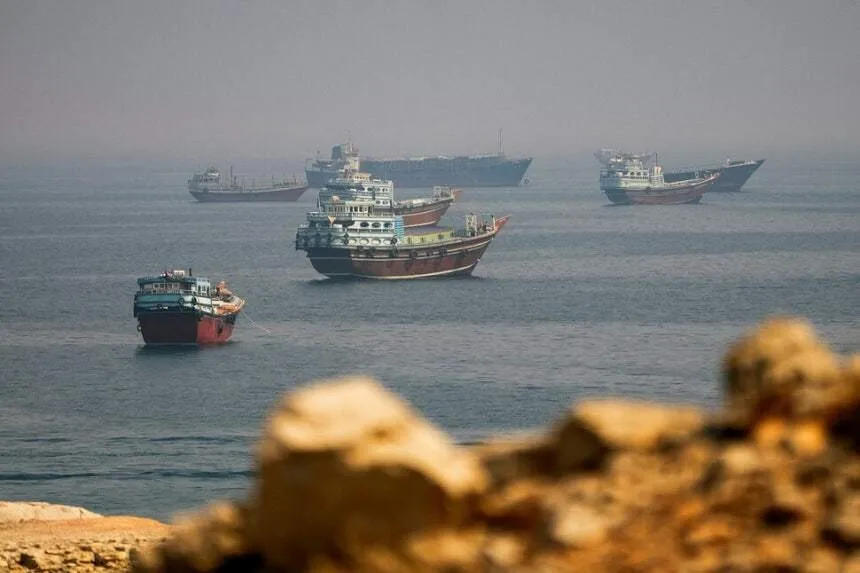
The Hormuz deliberation represents a qualitative break from that tradition. This would not be a humanitarian mission or a reconstruction effort. The Strait of Hormuz is one of the most militarized chokepoints in the world, through which roughly 20 percent of global oil consumption passes. Any South Korean naval presence there would place troops in the vicinity of active military confrontation, not disaster relief zones.
Kim Joon-hyung’s comparison to the Yoon Suk Yeol administration’s handling of the Ukraine war is telling. Even a government widely considered pro-American and pro-NATO did not propose sending troops to support Ukraine’s defense against Russia. The Hormuz proposal, by contrast, would place Korean forces potentially adjacent to Iranian military positions — a scenario with consequences far more immediate and volatile than the European theater.
The Trump variable
Legislator Lee Ki-heon’s statement contained a phrase that deserves to be taken seriously: he expressed “deep regret” at what he described as President Donald Trump’s treatment of alliances as “tools of coercion.”
This is not typical diplomatic language coming from a member of the ruling party. It signals that even within the political camp that has long pursued closer alignment with Washington, there is recognition that the American commitment to South Korea is becoming transactional rather than intrinsic.
The Trump administration’s approach to alliances has consistently emphasized burden-sharing measured in dollar terms and troop contributions, rather than shared democratic values or mutual defense guarantees. For South Korea, which has long positioned itself as a middle power with independent diplomatic capabilities, this creates an uncomfortable calculation: alignment with the United States now carries the risk of being dragged into conflicts that serve American interests but offer little strategic benefit to the Korean Peninsula.
The irony is sharp. South Korea’s own security depends critically on American commitment to the peninsula’s defense. Yet the same alliance that guarantees Seoul’s safety is increasingly asking it to project power in regions where American interests, not Korean ones, are at stake.
What’s at stake for the peninsula
The Hormuz deliberation cannot be understood in isolation from the broader security architecture of Northeast Asia. North Korea has accelerated its missile and nuclear programs with increasing regularity, and China’s military modernization continues to outpace South Korea’s defense budget growth. In this environment, every decision about where Korean troops are stationed matters.
Deploying naval assets and personnel to the Persian Gulf would require resources — ships, crew rotation, intelligence support, logistics chains — that could otherwise reinforce deterrence on the Korean Peninsula or in the East China Sea. It would also signal to Beijing and Pyongyang that South Korea is willing to extend its military footprint far beyond its regional neighborhood, potentially complicating any future diplomatic openings with neighbors who have their own concerns about American power projection.
There is also a domestic dimension. South Korean public opinion has grown increasingly skeptical of overseas military deployments. The opposition parties’ forceful rejection of the Hormuz idea reflects not just ideological positioning but a genuine current in the electorate that resents the country being pulled into conflicts that have nothing to do with its security.
The constitutional question
Cho Kuk’s citation of Article 5 of the constitution — which states that South Korea “rejects war as a sovereign right of the nation” — may seem like political theater, but it points to a real tension. The Korean constitution was drafted in a context deeply shaped by the trauma of Japanese colonialism and the Korean War. Its framers explicitly sought to constrain the executive branch’s ability to commit the nation to overseas military action without robust legislative and public scrutiny.
The current deliberation is occurring without any formal request to the National Assembly for approval, which would be required under South Korean law for the deployment of armed forces overseas. This procedural gap is precisely what critics like Kim Joon-hyung are challenging when they accuse the government of “double play” — testing the waters through media leaks before committing to a position, then retreating when criticism mounts.
What happens next
The Blue House’s clarification that no decision has been made is both accurate and evasive. A review phase is, by definition, a period of information gathering and internal debate. But the fact that such a review is happening at all — and that it became public through what appears to be deliberate journalistic exposure rather than official announcement — suggests the issue is moving faster through bureaucratic channels than the political leadership is willing to acknowledge publicly.
The most likely near-term outcome is continued ambiguity: the government will neither confirm nor deny specific plans while keeping its options open. But ambiguity is a luxury that will not last. If the United States formally requests Korean participation in Hormuz operations — whether for convoy protection, maritime security, or something more ambitious — Seoul will face a choice that will define its strategic identity for decades.
The opposition parties have drawn a line. The question is whether the government respects it, or whether the drift toward greater military integration with American operations in the Middle East continues until the line is crossed without anyone noticing until it is too late.
For a country that has built its postwar identity on the proposition that Korean security must be decided by Koreans, the Hormuz deliberation is not just a policy question. It is an existential one.