SpaceX Catches Starship in Orbit—But the Real Prize Is Still Ahead
SpaceX made history by catching its Starship upper stage with mechanical arms after a record 22-hour orbital flight. The lower booster exploded—but one half of full reusability is now proven.
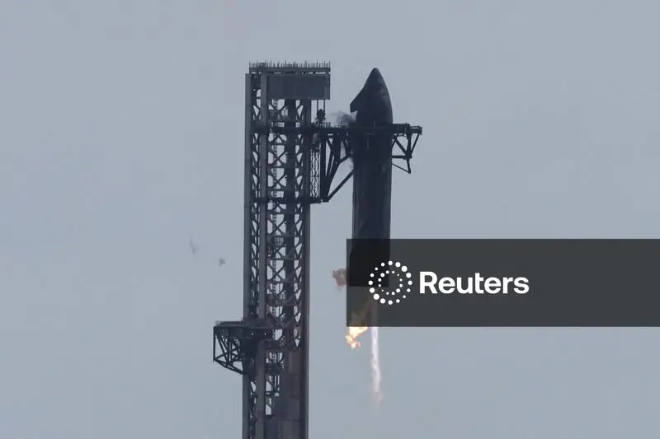
The Upper Stage Came Home. The Booster Did Not.
On November 14, SpaceX did something no one has ever done before: it flew a rocket upper stage into orbit, kept it there for 22 hours, and caught it on the way back down using two massive mechanical arms at its Texas launch tower.
The Starship 42 vehicle completed 14 laps around Earth before descending vertically into the V-shaped gap between what engineers call MechaZilla—the launch tower’s capture system. The upper stage landed cleanly inside those arms. The Super Heavy booster below it, however, exploded over the Gulf of Mexico roughly five minutes after liftoff when its catch attempt was aborted.
One half of full reusability is now proven. The other half is still a question mark.
Why This Moment Matters More Than It Sounds
Catching a 52-meter-tall spacecraft in flight is not a minor engineering achievement. It is the single hardest thing SpaceX has attempted in the Starship program so far. The upper stage had to perform a powered flip maneuver near the ground, hover momentarily, then thread itself between two steel arms moving at terminal velocity. Miss the alignment by meters and the structure tears apart.
It worked. That validation unlocks the next phase of the program faster than anyone outside SpaceX likely expected.
For context, Starship was never designed to land vertically on a platform at sea or on barge. The entire architecture assumes the upper stage returns to the launch site and gets caught by the tower. Without that capability, you lose the most expensive part of the vehicle every flight—and the whole cost argument collapses.
The Real Cost Argument
SpaceX’s case for Starship rests on a single number: how cheaply it can put mass into orbit when fully reused. Falcon 9 already recovers its first stage and lands it on droneships. That slashed prices and dominated the commercial launch market. But Falcon 9 only recovers half the rocket.
Starship aims to recover both stages and turn them around quickly enough to fly multiple times per day—essentially treating a launch vehicle like an airliner. If that works, the marginal cost per kilogram drops from roughly $2,000–$3,000 today to somewhere closer to $100 or less, assuming reflight rates climb high enough.
That changes everything about who can afford to go to space.
The current upper-stage catch proves the return-and-capture loop works. What it does not prove is turnaround speed. A vehicle that lands intact but takes six months to refurbish is not meaningfully cheaper than a disposable rocket dressed up as reusable.
Who Wins, Who Loses
The immediate winner is SpaceX. Every successful test narrows the gap between Starship’s promise and reality while eating up time that competitors need to close their own gaps.
United Launch Alliance and Rocket Lab face direct pressure. ULA’s Vulcan center faces obsolescence on heavy-lift pricing. Rocket Lab’s Neutron program competes in the mid-to-heavy market where Starship will eventually undercut everyone. Neither has a path to orbital upper-stage recovery yet, let alone a dual-stage system.
China’s state-run programs are the more consequential competitor. China has been testing its own large reusable launch vehicle concepts for years, including shuttle-style designs and vertical-landing boosters. But the visible, public, incremental demonstration cadence that defines SpaceX’s approach has no Chinese equivalent. When Beijing finally shows something comparable, it will carry political weight far beyond the engineering milestone.
Blue Origin remains the ghost at the table. New Glenn has sat on the launching pad for years. Jeff Bezos’s company has not yet demonstrated orbital upper-stage recovery either, and its timeline keeps slipping. That silence matters less each quarter.
What Comes Next
SpaceX needs to land both stages in the same flight. That has happened three times before on separate occasions—but never simultaneously. The next test flights will focus on closing that gap.
Then comes turnaround. Can Starship 42 be refueled, rechecked, and flying again within days? Weeks? Months?
Elon Musk flagged plans to increase launch frequency next year, alongside development of a second site in Louisiana. He posted 126 launches so far this year, mostly on Falcon 9, which suggests infrastructure is scaling even as Starship itself matures.
NASA is watching closely. The agency’s Artemis program depends on Starship as the lunar lander. Contract leverage flows to whoever proves reliability fastest. A fully reusable Starship would also unlock SpaceX’s other ambitions: orbital internet expansion, in-space manufacturing, and ultimately crewed Mars missions. All of those depend on the same underlying math—if you can’t bring the rocket home cheaply, none of it scales.
The Bigger Picture Nobody Is Talking About
There is a second implication buried in this test that deserves attention. The upper stage carried 26 Starlink satellites to orbit and deployed them during its 22-hour stay. SpaceX is turning its own launch vehicle into a satellite bus—a spaceplane that goes up, works for a while, comes home, and goes again.
That is not standard. Other operators buy satellite buses from manufacturers and load them onto rockets. SpaceX is building the bus, the launcher, and the retrieval system into one stack. If the model holds, each Starlink mission becomes cheaper than the last without external suppliers depending on the outcome.
That self-sufficiency is why Chinese and European regulators have raised alarms about SpaceX’s dominance. It is also why this upper-stage catch matters beyond aerospace circles—it reshapes the economics of access to orbit for every competitor worldwide.