SpaceX’s Starship Catch Changes the Math on Space
SpaceX caught its Starship booster midair for the first time, a milestone that reshapes economics for lunar landings and mega-constellation launches — and puts pressure on Blue Origin and China.
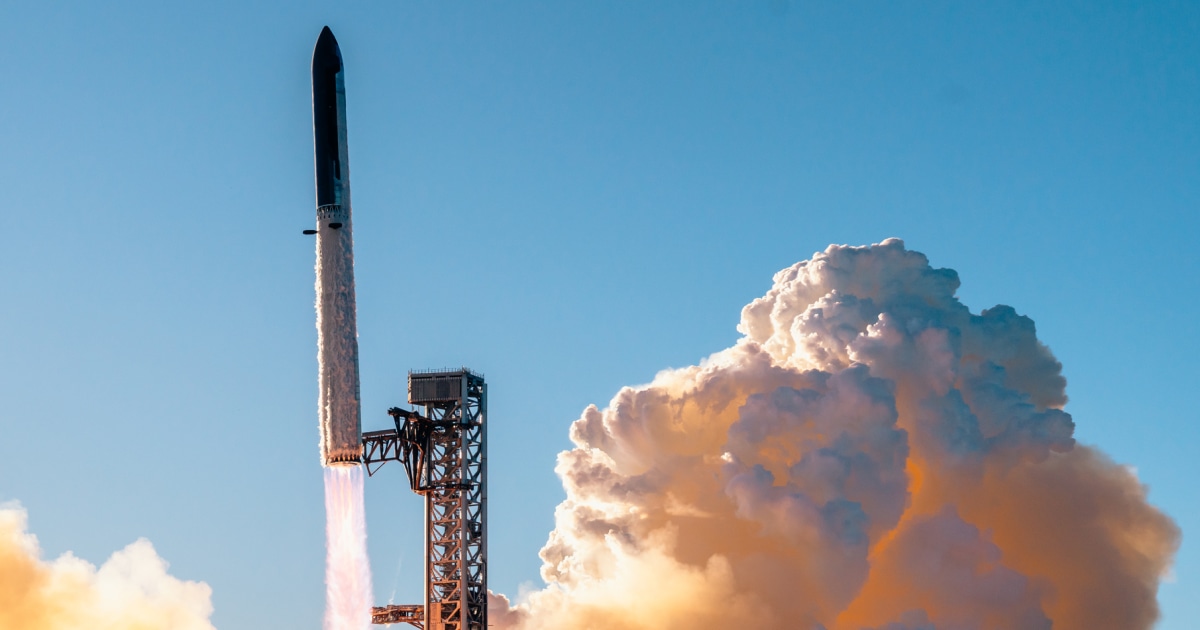
The Arms Closed Around Starship and Changed Everything
On Saturday night in Texas, two mechanical arms the size of a building grabbed a flying spacecraft out of orbit and brought it home upright. SpaceX did what no one else has done: return a heavy-lift rocket stage from orbital flight and recover it intact using launchpad infrastructure rather than a ship at sea.
The image looked like science fiction. The math behind it looks even more disruptive.
Starship Flight 15, launched Friday from Pad 2 at SpaceX’s Starbase, carried the upper-stage vehicle into orbit while the Super Heavy booster failed to make the return trip. The booster’s engines shut down prematurely during reentry, and its guidance system triggered the flight termination, sending wreckage into the Gulf of Mexico. But the upper stage completed fourteen laps around Earth at 165 miles altitude, released 26 Starlink satellites, and came back under control. It descended vertically and was caught by the tower arms — the first time this has ever happened with a vehicle of this size.
“Can you believe it?” SpaceX commentator Dan Huot said. Elon Musk congratulated his team. NASA Administrator Jared Isaacman called it “almost magic.”
What they were really seeing was a proof of concept that rewrites the cost structure for launching massive payloads into space.
Why the Catch Matters More Than the Landing
A rocket engine costs millions. A full Super Heavy booster has thirty-three Raptor engines. Every time you lose a booster, you lose a multi-million-dollar airframe and a significant chunk of that hardware. Catching it instead means the same hardware flies again without waiting weeks for a recovery vessel to drag it in from the ocean — or without scrapping it entirely.
Previous Starship booster recoveries used a barge approach: the booster fired its landing burn over the Gulf, splashed down, and was hauled back by crew. It worked sometimes. It also meant downtime, water exposure, and logistical overhead. The tower catch eliminates the marine recovery step and gets the booster turned around faster.
Speed is the point. Rapid reuse is what makes Starship different from every other rocket ever built. A launcher that lands and flips overnight can theoretically fly dozens of times per year instead of dozens per decade. That changes everything about how expensive space access is.
SpaceX already demonstrated three successful booster catches before Flight 15. What changed now is that the upper stage itself — the part carrying passengers, satellites, or lunar landers — returned from actual orbital velocity and was caught the same way. The heat shield held. The guidance worked. The vehicle touched down upright.
That combination had never been achieved at this scale before.
Who Wins, Who Loses, and How Fast
For satellite operators, the implications are direct. Starlink alone needs dozens of launches to fill its planned constellation of tens of thousands of satellites. Each successful rapid-flight cycle cuts the marginal cost of placing another payload in orbit. If Starship reaches even a fraction of its intended cadence, the price floor for mega-constellations drops significantly.
Other constellations face the same pressure. OneWeb, Amazon’s Kuiper project, and any operator planning to put large numbers of satellites into low Earth orbit suddenly have a competitor whose launch pricing could undercut theirs simply because reuse works better.
For Blue Origin, the pressure is sharper. NASA has awarded Blue Origin a contract to build the Blue Moon lander for Artemis III and beyond. The Artemis program plans to rotate between SpaceX’s Starship and Blue Origin’s lander for crewed moon missions starting no earlier than 2028. Blue Origin still has not flown its New Glenn rocket, which was supposed to be operational this year, and its lander program remains unproven in flight. Every day SpaceX refines Starship’s reliability makes Blue’s window narrower.
China faces a different kind of pressure. Its state-run space program is building toward a permanent lunar base and has made steady progress on crewed missions and space station operations. But China does not yet have a heavy-lift launch vehicle capable of matching Starship’s payload capacity to lunar transfer. No Chinese rocket has demonstrated orbital reuse. The gap between SpaceX’s cadence and China’s best available options is widening with each successful flight.
What’s Next — And What Could Go Wrong
SpaceX has confirmed it will begin launching Starships from Kennedy Space Center in Florida within months. That is the staging point for Artemis mission practice flights, including the upcoming Artemis campaign that will keep astronauts in lunar orbit as a precursor to landing.
Artemis IV, targeting at least 2028, will attempt humanity’s first moon landing since Apollo. Two landers are involved: SpaceX’s Starship and Blue Origin’s Blue Moon. Both must work simultaneously for that timeline to hold.
The booster explosion on Flight 15 was a setback, but not a structural one. SpaceX has four successful booster catches across previous flights. Engineers are investigating why the engines stopped early, but the upper-stage success proves the core architecture is sound.
What remains to be proven is rate. A single catch is a milestone. Twenty catches in a row is a business model.
Starship’s design calls for flights so frequent that the economics only work if the hardware survives repeated use. The tower catch makes that possible. The question now is whether SpaceX can sustain it fast enough to justify the billions invested, and whether competitors can respond before the economic center of gravity in space shifts decisively in SpaceX’s direction.