SpaceX catches Starship in orbit — what it means for space economics
SpaceX has successfully caught its Starship spacecraft mid-air after a record-breaking orbital test, marking the first time a full-size spaceship has been recovered intact from orbit. Here is why that changes everything.
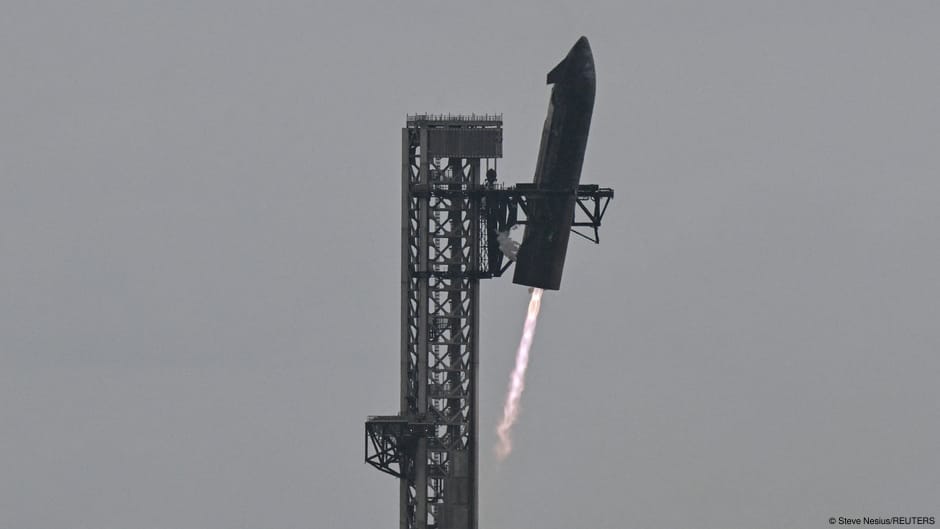
A spaceship, caught like a Frisbee
On Saturday, SpaceX did something that had never been attempted before in the history of aerospace. Its Starship spacecraft descended from orbit and slipped cleanly between two mechanical chopsticks mounted on a launch tower at Starbase in Texas. The vessel was recovered intact.
It sounds almost trivial when described plainly. But in practical terms, this is the moment the long-promised era of fully reusable orbital rockets moved from engineering fantasy into operational reality. No major launch provider has ever caught a full-size spaceship mid-flight since the Space Shuttle retired in 2011. This was not a splashdown recovery of a capsule with parachutes. This was a 50-metre-tall stainless steel ship, coming home from orbit at several kilometres per second, being stopped mid-air by two steel arms.
Dan Huot, SpaceX commentator, said it best: “Can you believe it? Look at her! Baby, she’s back!”
NASA administrator Jared Isaacman put it more formally: “It was almost magic.”
But magic, in this context, is just expensive engineering finally paying off.
What actually happened
This was Starship’s fifteenth test flight. The upper stage — the actual spacecraft designed to carry cargo and eventually crew — orbited the Earth fourteen times over roughly 22 hours before returning. During that time it deployed 26 Starlink internet satellites, proving the ship can work as a payload bus in addition to being a reusability demonstrator.
The landing itself was textbook. Starship came down vertical above Launch Pad 2, slowed from hypersonic speed using its own engines, and settled precisely between the tower’s catch arms. The chopsticks grabbed the vehicle and lifted it back onto the pad. That is the full cycle of reuse: launch, orbit, return, grab, refurbish, fly again.
The lower stage — the Super Heavy booster — told a different story. SpaceX had intended to catch that one too, but its engines shut down prematurely. The booster’s guidance system detected it was off trajectory and triggered the self-destruct protocol. It exploded over the Gulf of Mexico shortly after liftoff on Friday. Engineers are still investigating what went wrong. SpaceX has caught the Super Heavy booster on three previous test flights, so the technology works in principle. This failure is a setback, not a surprise, given how little testing has gone into the full stack to date.
Why the cost story matters more than the spectacle
The image of a giant robot arm catching a rocket from the sky will dominate headlines. The economics behind it matter far more.
Every kilogram sent to orbit currently costs anywhere from roughly $1,000 to $20,000 or more, depending on the launcher and destination. Reusable rockets have already driven prices down significantly — Falcon 9’s booster reuse cut launch costs by an order of magnitude compared to expendable vehicles. But Falcon 9 recovers only the first stage. The upper stage still falls into the ocean and is lost. Full reusability means recovering both stages, which is where the real economic disruption begins.
If SpaceX can reliably catch and reuse both the Super Heavy booster and the Starship spacecraft, the marginal cost of each launch drops toward single-digit thousands of dollars per kilogram. That number sounds abstract until you apply it to anything: a lunar lander, a Mars mission, a thousand new satellites, or the kind of infrastructure building that makes a permanent moon base economically plausible.
Elon Musk has built his entire company around this thesis. He sees Starship as the backbone of SpaceX’s satellite constellation business and the vehicle that will carry humans to the Moon under NASA’s Artemis programme and eventually to Mars. The chopstick catch validates the core assumption driving all of that planning.
Who wins, who loses, and what happens next
Winners. SpaceX, obviously. Every successful catch reduces its cost per launch and increases cadence. More cadence means more data, more iterations, faster progress. NASA is also a winner here — it is spending billions on Starship for the Artemis lunar lander contract. A reliable, low-cost heavy-lift vehicle gives NASA options it simply does not have today. Anyone deploying large satellite constellations benefits from cheaper access to orbit.
Losers. Established launch providers without a reusable heavy-lift strategy in flight testing. United Launch Alliance, Arianespace, ISRO, CNSA — they all operate existing fleets designed for partially or wholly expendable architecture. Their cost curves cannot compete with a fully reusable vehicle that lands itself on a launchpad. China’s state-sponsored programmes may eventually close the gap through sustained investment, but they face the same structural disadvantage right now.
What comes next. SpaceX will fly this again. The goal is rapid iteration — catch another Starship, then catch a Super Heavy booster alongside it, then do both in sequence within the same launch window. Each flight tests a different variable: thermal protection, engine reliability, propellant transfer in orbit, crew operations. The 26 Starlink satellites deployed during this flight suggest SpaceX is already flying operational missions on a vehicle still technically in development, which should tell anyone watching how confident the company is in the system’s readiness.
NASA expects Starship to carry astronauts to the lunar surface later this decade under the Artemis programme. That timeline depends entirely on Starship reaching operational reliability. Today’s catch moves that timeline closer. Whether it arrives on schedule remains uncertain — SpaceX has missed deadlines before, even while consistently delivering breakthroughs.
Rival programmes are watching closely. Blue Origin’s New Glenn is still in development and has not yet demonstrated any orbital recovery. China is testing its own heavy-lift reusable rockets but remains years behind. Europe’s Ariane 6 programme is focused on reliability, not reusability. India’s next-generation launch vehicle concepts remain on paper.
The broader signal
This catch is not just a technical milestone. It is a signal that the most ambitious launch vehicle ever built is approaching operability. For decades, the dream of affordable, frequent, fully reusable spaceflight belonged to science fiction and government roadmaps. SpaceX has turned it into engineering discipline — iterative testing, rapid failure, relentless improvement.
The fact that the Super Heavy booster was lost this time does not diminish the achievement. It confirms the pattern: SpaceX pushes boundaries, learns from failures, and keeps flying. The Starship upper stage came home. That means the core loop of reusability — launch, orbit, recover, repeat — is finally closed.
Everything after this point is about scale, cadence, and cost. The chopsticks worked. Now comes the hard part: doing it again next week, then next month, then cheaply enough to make the rest of the world rethink what spaceflight can be.