Spain's housing strike exposes Europe's affordable-crime revolt
Spain's first general strike in 14 years reveals how housing is becoming the defining fault line in European politics — and why Pedro Sanchez can no longer govern without it.
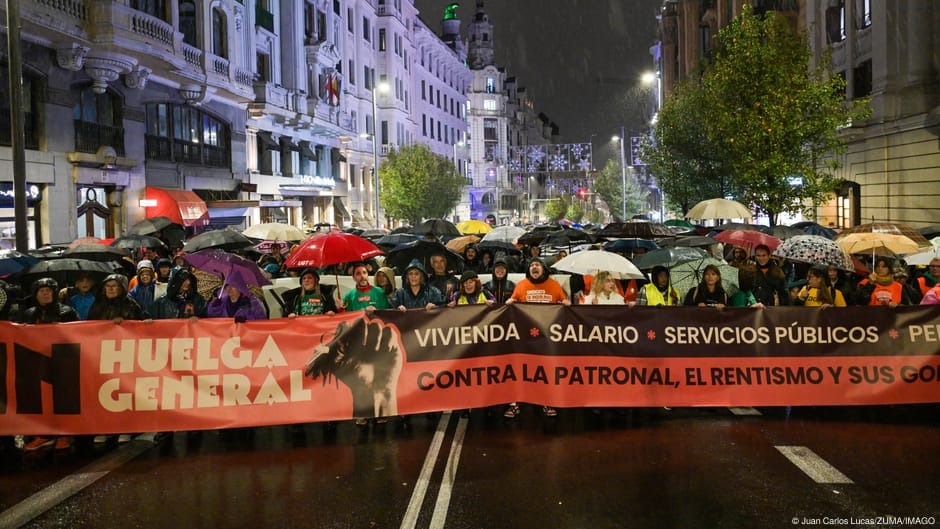
Spain’s general strike was never just about rent
The image from Wednesday night tells its own story. Rain fell hard across central Madrid, yet 120,000 people stood in the streets anyway. A week earlier, rail workers had walked out over two deadly train crashes; now they were joined by teachers, nurses, delivery drivers, and thousands of young people who cannot afford to live in the country where they work.
This was Spain’s first general strike since 2012. Fourteen years separate it from the last time the entire economy ground to a halt. The elapsed time matters less than what has filled the gap: a structural collapse in housing affordability that has quietly radicalized a generation across Southern Europe and beyond.
The numbers behind the banner
Avenue banners in Barcelona read “Live. Not just survive.” The statistics justify the slogan.
Spain’s central bank estimates a current shortfall of roughly 750,000 homes, a deficit projected to exceed one million by 2028. Young renters pay an average of €1,176 a month — nearly their entire salary. In Madrid and Barcelona, those figures climb still further.
Eighty-seven-year-old Maricarmen Abascal died after being evicted from her home earlier this year. Her death became the human face of a statistical disaster, and organizers made certain protesters knew it.
How the government turned crisis into strategy
Prime Minister Pedro Sanchez faces snap elections on November 29. His coalition lacks a parliamentary majority sufficient to pass the housing reforms he proposed. So instead of legislation, he issued two extraordinary decrees — emergency measures modeled on the very reforms parliament rejected.
Government sources close to Sanchez described the strike as organized “in favor of rights,” then went further, characterizing it implicitly as an attack on the opposition.
Alberto Núñez Feijoo, leader of the conservative People’s Party, called that framing absurd, claiming no other EU country witnessed such a politically aligned general strike.
The tension between state and labor unions runs deep but also runs thin. UGT, one of the strike’s principal organizers, shares a historic founding lineage with Sanchez’s socialist PSOE party through Pablo Iglesias Posse. Institutions are separate; genealogies overlap. That ambiguity will shape the aftermath.
Who benefits, who loses, who gets squeezed
Sanchez gains political cover if turnout exceeds expectations and the protest registers as legitimate popular demand rather than orchestrated electoral maneuvering. He loses credibility if voters interpret the decree measures as insufficient, or if turnout falls below thresholds that would demonstrate genuine mobilization.
Feijoo and the PP gain if the strike appears weaponized for partisan advantage, feeding a narrative of governmental manipulation. They lose if the underlying housing crisis remains the dominant issue on election day and their alternative platform offers nothing concrete to displace it.
Young Spaniards bear the sharpest cost either way. They confront rents that consume nearly all earnings, a housing deficit set to worsen, and a political system that treats emergency decrees as substitutes for structural reform. They walk because they have little left to lose, and they return to work when strikes end because wages remain the lifeline they cannot surrender.
Spain is not unique — and that is the point
What makes this moment consequential stretches far beyond Spain’s borders. Portugal, Ireland, Germany, and several Eastern European capitals all report surging rental burdens and shrinking affordability among younger cohorts. The protests that spilled into small-scale rioting in Barcelona — storefronts smashed, dumpsters ignited, fireworks thrown at police — echo similar scenes elsewhere in Europe, though Spanish authorities stress most demonstrations remained peaceful.
When housing becomes the central grievance binding disparate worker groups — railway employees, teachers, airport staff, healthcare workers — it ceases to be a sectoral policy question. It becomes a governing challenge. Governments that treat it as local zoning or municipal budgeting risk repeating the mistake of assuming incremental adjustment will satisfy populations priced out of their own cities.
What happens next
Three outcomes seem plausible before November 29.
First, Sanchez’s government may attempt to translate its emergency decrees into legislative language, using the strike’s momentum to pressure opposition parties into compromise. This would require political capital Sanchez does not currently command in sufficient quantity.
Second, the PP could exploit the union-government overlap to paint the strike as electoral theater, arguing that emergency decrees signal desperation rather than governance. That argument gains force if shop owners remain open and workers reported returning to post-strike routines without substantive concessions.
Third, and most likely to matter beyond the ballot box, the housing deficit itself will not shrink during a campaign season. The 750,000-home gap will persist. If any coalition takes power afterward without confronting supply constraints, investment incentives, and regulatory bottlenecks, the next wave of unrest will arrive when the next election cycle fades from memory.
Reuters and DW correspondent Nicole Ris noted that many Spaniards she spoke with refused to join the strike despite sharing its grievances, calling the action “nonsense” and suspecting it served electoral calculations more than everyday survival. That skepticism matters. A movement that depends on mobilization alone without addressing why participants eventually return to work risks exhausting its own energy.
The broader European signal
The Portuguese housing protests, German rent disputes, and Irish tenant advocacy campaigns share DNA with Spain’s Wednesday march. None of them exist in isolation. When Spain, Europe’s fourth-largest economy, invokes a general strike over housing affordability, Brussels should register the alarm. National governments can continue subsidizing homeownership programs while ignoring renters, but subsidies do not solve shortages.
European policymakers face a choice: treat Spain’s strike as a domestic disturbance or recognize it as evidence of a continental pattern. Rent controls without supply expansion punish landlords without helping tenants. Supply expansion without affordability safeguards produces gentrification. Both approaches have been tried; both fall short when demographics and migration pressures intensify demand faster than construction can respond.
The evening marches in Madrid and Barcelona demonstrated that frustration has crossed a threshold. Whether it translates into durable political change depends on whether Sanchez, Feijoo, and their competitors can convert street energy into housing construction, financing reform, and tenant protections that outlast the next headline.
Until then, Spaniards will keep choosing between surviving and living — and every general strike after this one will measure how much longer the balance tips.