St. Petersburg Car Bomb Marks a Dangerous New Phase in Russia's Home Front
A lieutenant colonel killed by car bomb in central St. Petersburg reveals that Russia's security bubble is shrinking. Kyiv has not claimed responsibility, but the attack follows a killing in Crimea and signals a possible expansion of Ukrainian sabotage operations into the Russian heartland.
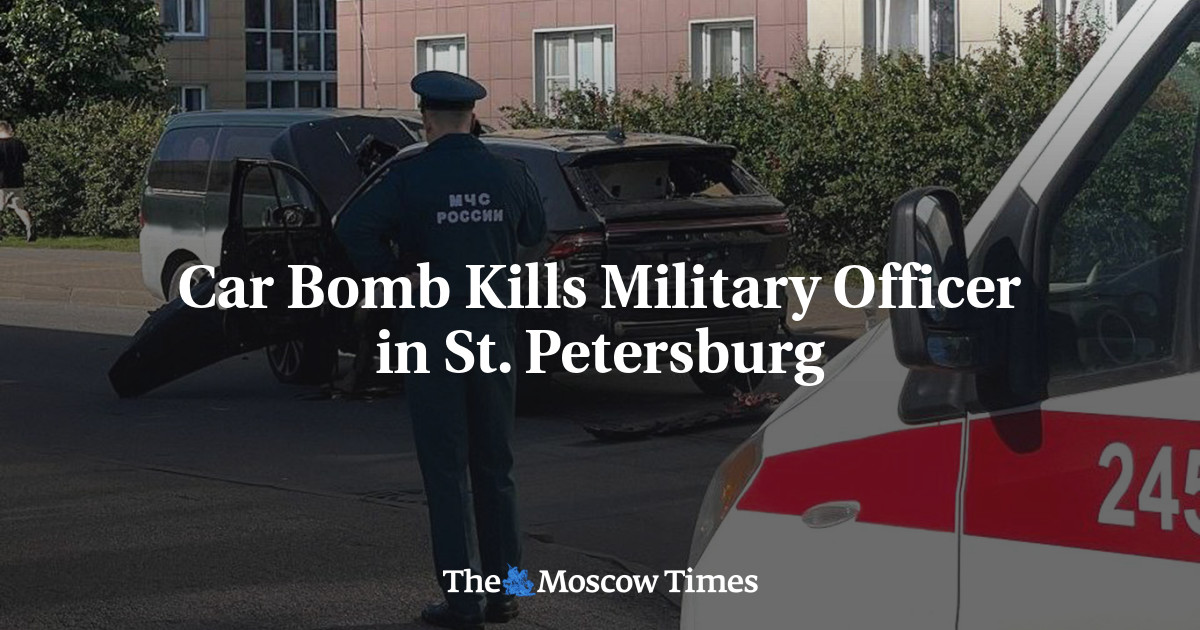
A Lieutenant Colonel Dies in St. Petersburg
The blast hit around 10 a.m. local time on Thursday near a supermarket in the Shushary neighborhood of St. Petersburg, a residential area not far from the city center. A Russian lieutenant colonel was killed. His wife, also in the vehicle, was hospitalized.
The Investigation Committee — Russia’s top prosecutorial body — confirmed the death but deliberately described the incident as a “vehicle fire,” not an explosion. That semantic choice matters. It mirrors a pattern seen across Russia when state investigators want to minimize the political implication of what happened: if it was a fire, it could have been an accident. If it was a car bomb, it was an act of war conducted on Russian soil.
No group has claimed responsibility. Kyiv has remained silent.
What Happened Before
This is not an isolated event. Earlier this month, a Russian military officer was killed in a bomb attack in annexed Crimea. Russian police arrested a woman and alleged she acted on behalf of Ukraine. That attack happened in occupied territory, where the risk profile for Russian personnel is already elevated. This one happened in St. Petersburg, a city that has enjoyed relative insulation from the violence of the war — until now.
Russia has accused Ukraine of carrying out several high-profile assassinations of military officials since the full-scale invasion began. Ukrainian sources have publicly claimed responsibility for some of those attacks and denied involvement in others. The pattern so far has been selective and calibrated: strikes against military logistics hubs, drone attacks on airfields deep inside Russia, and targeted killings in occupied Crimea and border regions.
St. Petersburg sits outside all of those categories.
The Shrinking Bubble
The Kremlin has spent two years projecting an image of normal life in Russia’s major cities. In Moscow and St. Petersburg, daily routines continue relatively uninterrupted. This assumption has been a cornerstone of Putin’s domestic messaging — that the war is being fought elsewhere, that Russians at home are safe, that Ukraine cannot reach them.
A car bomb in central St. Petersburg shatters that illusion. Whether the attack was planned and executed by Ukrainian intelligence, a Russian opposition cell, or an independent actor, the effect is the same: the psychological distance between the front and the home front has collapsed.
St. Petersburg is Russia’s second city. It is symbolic as well as strategic — a city of palaces, universities, and naval heritage. An attack there carries weight beyond the tactical. It tells Russian citizens that the war is no longer confined to distant regions. It tells the military establishment that no rank, no location, and no amount of security detail guarantees safety.
Why the Silence From Kyiv?
Ukraine’s decision not to claim this attack — if it was indeed orchestrated by Kyiv — follows a clear pattern. Ukraine has been selective about attribution. It claims operations that serve a strategic communication purpose and stays quiet on others. A killing in St. Petersburg is useful to Russia’s domestic narrative if left unclaimed. It sows fear without giving Kyiv the propaganda value of a public victory.
But the silence also raises questions. If Ukraine did not orchestrate this attack, who did? The Russian opposition inside Russia remains fractured and heavily suppressed. Independent sabotage cells are nearly impossible to sustain under current conditions. The most plausible alternative explanation — a rogue or semi-autonomous domestic actor — would make the attack even more alarming for the Kremlin, because it signals internal fracture rather than external aggression.
Either scenario is bad for Putin. External aggression can be blamed on a foreign enemy. Internal sabotage points to a population that may be turning against the war.
The “Vehicle Fire” Euphemism
The Investigation Committee’s choice to call it a “vehicle fire” is itself a signal. Russian authorities routinely downgrade the language around attacks that implicate the state’s security failures. Calling it a fire keeps the public from connecting the dots. It also prevents panic. But it does not hide the fact that a serving Russian military officer was killed in a targeted explosion in one of Russia’s most heavily policed cities.
The discrepancy between what investigators say and what local media like Fontanka reported — a car explosion, not a fire — has already created a small information war within Russia. Independent and semi-independent outlets are filling the gap that state media tries to close. That gap is where suspicion grows.
Who Wins, Who Loses
If Ukraine planned this attack, it wins a psychological blow. A senior Russian military officer is dead. The message is clear: no one is safe. Russia loses credibility on domestic security, which the Kremlin has staked much of its legitimacy on.
If Russia planned this attack — a false flag to justify further crackdowns — it wins short-term control and loses long-term trust. The pattern of fabricated or exaggerated threats has eroded public confidence in Russian institutions. Another false flag would accelerate that erosion.
If an independent Russian actor carried out the attack, both the Kremlin and Kyiv lose something. The Kremlin loses the narrative that the war is contained. Kyiv loses the ability to claim credit and deny responsibility simultaneously — a tool it has used with precision.
What Comes Next
Russia will respond. Expect tighter security around military personnel in St. Petersburg and possibly other major cities. More arrests. More rhetoric about Ukrainian terror. The Investigation Committee will likely release its official version — a vehicle fire, an accident, a lone individual — within days.
Ukraine will almost certainly continue its campaign of sabotage inside Russian territory, including strikes on military infrastructure deeper inside the country. The St. Petersburg attack, regardless of its origin, fits that broader strategy: making the war tangible for Russians who have tried to treat it as abstract.
The real question is whether this marks a scaling up or a sporadic escalation. A single attack is disturbing. A pattern of attacks in Russian cities would be transformative. We do not yet know which we are looking at.
What we do know is that the Kremlin’s claim — that Russia proper is immune to the violence of this war — no longer holds.