Starship's Catch Changes Everything — And Nothing
SpaceX caught its Starship upper stage with tower arms for the first time, validating full reusability. But the booster exploded on return, leaving the dream of double-catch recovery still unfinished.
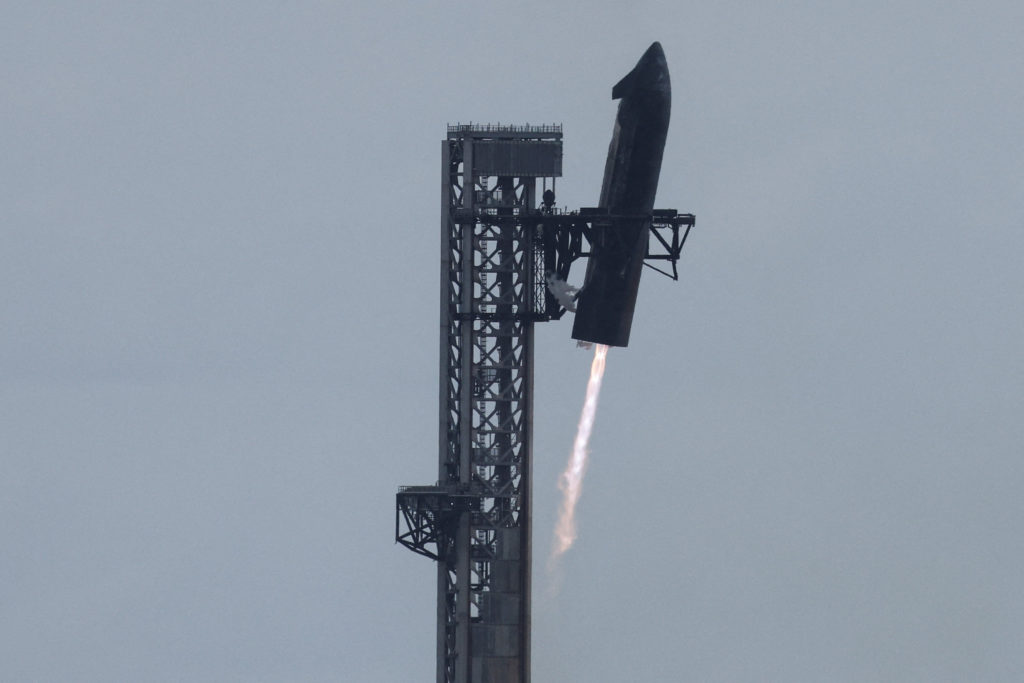
The Arms Caught It. The Booster Did Not.
On November 14, 2026, something historic happened above the Texas coastline: SpaceX’s Starship returned from orbit and was snatched midair by two giant mechanical arms attached to the launch tower. Cameras zoomed in. Dan Huot, the company’s commentator, practically lost his voice. Elon Musk thanked his team.
What nobody mentioned — or at least, what deserved more scrutiny — is that this was only half the story. The first-stage booster had already broken apart over the Gulf of Mexico after its engines shut down too early on reentry. Wreckage was cordoned off by buoys as the upper stage glided gracefully into the embrace of the catcher arms. It was poetic. It was also incomplete.
Why This Matters More Than the Headlines Suggest
Let’s be clear about what just happened. For the first time, SpaceX demonstrated that its massive orbital vehicle can return from space and be caught without landing on the ground or splashing down. That sounds like a technical footnote until you do the math on what it means for cost per kilogram to orbit.
Every time a vehicle lands vertically on a pad or floats away after water recovery, it pays a penalty — in repairs, in corrosion, in turnaround time. Catching a spacecraft midair with tower arms preserves the heat shield integrity far better than any landing gear approach. It reduces refurbishment. It speeds iteration. It turns Starship from an expensive test article into something approaching an airliner model.
The previous three attempts at booster capture during suborbital hops proved the mechanics worked in principle. Saturday’s flight proved it works with an actual orbital vehicle returning at real velocity — not a controlled drop from a helicopter, not a glide from a high-altitude balloon, but a metal tube coming home from 165 miles up after circling the Earth fourteen times.
That is the difference between a lab experiment and an operational system.
The Booster Problem Nobody Wants to Talk About
The booster failure was not subtle. According to SpaceX’s Kate Tice, the engines stopped firing prematurely on reentry. The guidance system detected it was out of position and triggered the self-destruct. Three successful booster catches came during earlier tests; Friday’s attempt was the fourth orbital-class descent, and it failed.
This matters because the entire architecture of rapid reflight depends on catching both stages — what Musk has called the “double catch.” One stage recovered means a 50 percent reduction in launch costs at best. Both stages mean something closer to 90 percent. Right now, SpaceX is flying at roughly half its intended efficiency.
Engineers are investigating. The timeline for the next attempt is unknown. What is known is that every day the booster fails to return, the arithmetic of Starship’s economic promise gets harder to defend to investors, to NASA, and to anyone betting that reusable heavy-lift rockets will fundamentally reshape the space industry.
NASA’s $Billions Are Now on the Line
Here is where the political economy enters. NASA is paying SpaceX billions of dollars under the Commercial Lunar Payload Services architecture and the Artemis program contract. Starship is supposed to land astronauts on the moon — specifically Artemis III and beyond. The agency welcomed the catch enthusiastically. Jared Isaacman called it “almost magic” on X.
But welcome it does not change the fact that NASA’s timeline is already fragile. Artemis IV is targeting no earlier than 2028 for humanity’s first crewed lunar landing since Apollo. Blue Origin’s Blue Moon lander will share duties with Starship on a rotational basis. Neither vehicle is ready.
If the booster problem persists, Starship becomes unreliable exactly when NASA needs it most. A single successful flight does not prove a pattern. Six successful flights in a row might. We are at approximately two.
Who Wins, Who Loses
SpaceX wins credibility and continues its dominance of global launch markets. Every successful Starship flight compresses the competitive window for United Launch Alliance, Arianespace, and China’s Long March fleet. If Starship achieves even partial reusability at scale, the cost curve for putting mass into low Earth orbit drops dramatically — and SpaceX captures nearly all of the surplus value.
Blue Origin loses time. The company has been building Blue Moon in parallel rather than chasing Starship’s pace. If Starship reaches operational reliability before Blue Origin, NASA’s scheduling leverage shifts entirely toward Texas.
China’s space program watches intently. Its own heavy-lift efforts — the Long March 9, which remains years from debut — were designed to compete precisely in the domain where Starship is now proving itself. A fully reusable super-heavy lift vehicle changes the strategic calculus of who controls cislunar space.
What Comes Next
The next critical data point is straightforward: how many consecutive flights can SpaceX execute with both stages recovered? One is an anomaly. Three is a trend. Five is a system.
Florida operations are expected within months. Kennedy Space Center will become Starship’s primary launch site, with Texas serving as a secondary or test facility. That transition will introduce new variables — different weather patterns, different launch azimuths, potentially different infrastructure constraints.
The 26 Starlink satellites deployed during this mission matter less than the 14 orbits completed. Previous Starship orbital missions managed one or two laps. Fourteen demonstrates thermal management capability that scales — and thermal management is the hardest engineering problem on reentry for any vehicle that big.
The heat shield held. That is the quiet victory in all the noise. The catch is theatrical. The thermal protection system is infrastructural. One makes good television. The other makes spaceflight possible.
The Bottom Line
SpaceX turned a half-failure into a headline triumph, and part of that is marketing strategy. The other part is genuine progress. Catching a returned Starship from orbit is genuinely hard and genuinely new. But the booster still fell into the ocean, and until both stages fly back intact, the full promise of the vehicle remains deferred.
What is certain is that the direction of travel has shifted. The question is no longer whether Starship can reach orbit — it can, repeatedly. The question is whether it can return intact enough times fast enough to justify the bets NASA, SpaceX shareholders, and the broader space industry have placed on it.
The arms caught it. Next week, we’ll know if they can catch the rest.