Starships first satellite deployment is the space industry’s new inflection point
SpaceX successfully deployed 26 next-gen Starlink satellites from orbit on Starship Flight 14, proving the vehicle can carry the heavy payloads that will define the next era of commercial spaceflight. The milestone quietly reshapes launch economics, telecom strategy, and the calculus for every competitor.
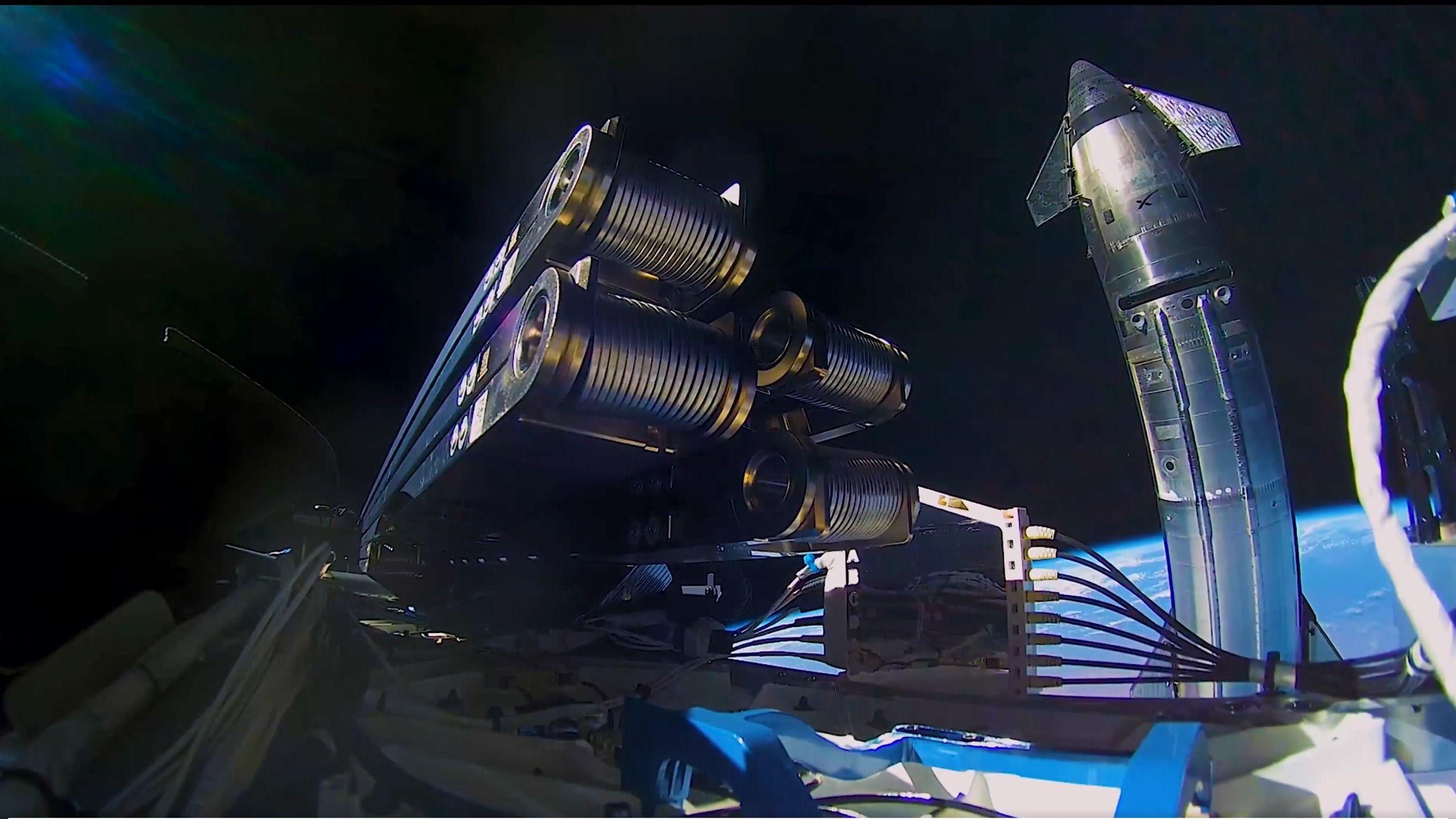
The moment SpaceX stopped talking and started deploying
On September 28, 2026, SpaceX did something that sounded like a press release bullet point until you actually watched the footage. During the 14th test flight of Starship, the company’s 407-foot megarocket reached orbit and — for the first time ever — released satellites into it. Twenty-six Starlink Version 3 craft peeled away from the upper stage, their cameras capturing a sequence that will look ordinary in ten years and revolutionary in retrospect.
The deployment itself is impressive engineering. The real significance is what it unlocks: the economic logic of an entirely new tier of commercial spaceflight, one that makes most existing launch vehicles look like horse-drawn wagons beside a freight train.
The weight problem that only Starship solves
The Starlink V3 satellite weighs roughly 4,400 pounds — about twice the mass of its predecessor. That is not a incremental upgrade. It is a different class of hardware, and it cannot fly efficiently on the Falcon 9, the workhorse that built the original Starlink constellation now numbering more than 11,000 satellites in low Earth orbit.
SpaceX’s own math is stark. A single Starship launch carries roughly 60 V3 satellites and delivers about 20 times the bandwidth capacity that a Falcon 9 mission could provide with V2 hardware. The V3 satellite supports 1 terabit per second of downlink and 160 gigabits per second of uplink — improvements of roughly 10x and 22x over V2, respectively. Its antenna system manages 2,048 beams in each direction, compared with V2’s 192 downlink and 144 uplink beams.
This is not optimization. It is a generational leap measured in powers of ten.
Who loses when Starship arrives
The immediate casualty list is short but brutal. Falcon 9 will not die tomorrow — it still flies with remarkable reliability and has years of remaining utility for lighter payloads. But for Starlink operations, which consume the majority of SpaceX’s launch cadence, Falcon 9’s relevance is now on a one-way slope.
Beyond SpaceX’s own fleet, every other commercial launch provider faces a new reference case. A vehicle that can deliver 60 heavy satellites per launch at a marginal cost driven toward zero by full reusability does not just underprice competitors. It makes their business models structurally uncompetitive for any payload Starship can carry.
Traditional satellite operators like Eutelsat, SES, and Intelsat already feel the pressure of Starlink’s expanding footprint. Starship accelerates that pressure by making it cheaper to launch replacement and capacity satellites than it is to build them on Earth and hope a ride-share slot opens up on a partially reusable rocket.
Defense contractors face a harder calculation. The U.S. Space Force and other government buyers have invested heavily in tailoring missions to Falcon 9, Atlas V, and Delta IV payloads. If Starship becomes the default launch system for national security architectures, the qualification pipeline shifts — and not everyone in the current ecosystem qualifies for the new one.
The 100,000-satellite math and the 10,000-launch/year target
SpaceX founder Elon Musk has said the V3 constellation will eventually contain roughly 100,000 satellites. At 60 satellites per Starship mission, that requires approximately 1,700 launches just to deploy the base layer. Add in the five-year replacement cycle — Starlink satellites do not last forever — and the number climbs steadily.
But that is only the visible half of the plan. Musk has also described a far more ambitious project dubbed Starmind: one million AI data centers in Earth orbit, all of them launched on Starship. The Starmind concept has drawn skepticism as science fiction, but treating it as pure fantasy misses the signal. Whether or not the final architecture looks exactly as described, the direction is clear — SpaceX is building launch capacity for a scale of orbital infrastructure that does not yet exist anywhere else.
The annual flight target Musk has floated is 10,000 Starship launches per year by 2030. To contextualize that number: Falcon 9 flew 165 times in 2025, a company record that represented roughly half of all orbital missions worldwide that year. Ten thousand Starship flights would mean a cadence more than 60 times the current global total. The physics of that claim are not the issue. The issue is whether the supply chain, the launch pads, the propulsion testing infrastructure, and the market demand can all scale in parallel without one of them becoming the constraint.
What remains unproven
Starship Flight 14 checked an important box. It did not check all of them. The mission profile tested was a relatively straightforward orbit and deployment — no refueling, no crew, no deep-space injection.
Orbital refueling remains the single most critical capability Starship has not yet demonstrated. Missions to the Moon, Mars, and any payload requiring energy beyond a simple LEO injection depend on propellant transfer in orbit. Until that works, Starship’s true payload potential stays theoretical.
Human rating is another gap. SpaceX has flown 20 astronaut missions on Crew Dragon, but Dragon carries four people and operates in a very different envelope than Starship. A life-support system, abort capability at scales Dragon never required, and crew certification all lie ahead. NASA’s contracts depend on this timeline.
Perhaps most importantly, SpaceX must prove it can sustain the flight rate the math demands. One successful deployment is a milestone. One hundred deployments a year is an industrial operation. One thousand a year is a reorganization of the global launch market. The company has never had to operate at that cadence before — and no other entity in history has launched orbital vehicles frequently enough to serve as a benchmark.
The second-order implications
The most interesting consequences of this milestone are not about satellites at all.
First, the cost curve. If Starship reaches its reusability target and sustains high flight rates, the price per kilogram to orbit could fall to a fraction of current levels. That does not just help SpaceX. It makes previously uneconomic concepts — orbital manufacturing, large-scale solar power stations, dedicated satellite servicing — financially plausible. The barrier stops being engineering. It becomes capital allocation.
Second, the data center argument. Starmind, however ultimately realized, reframes what orbit is for. Right now, the dominant narrative is internet access. A million orbital AI compute nodes would represent a fundamentally different industry — one where latency, power availability, and thermal management in vacuum become the primary design constraints rather than bandwidth. Whoever treats Starship primarily as a communications launch vehicle will miss the larger bet.
Third, the geopolitical dimension. A single company controlling the majority of launch capacity at this scale concentrates enormous leverage. Governments will respond — through regulation, through subsidized alternatives, through direct competition. The tension between SpaceX’s dominance and national industrial policy is not a future problem. It is already being fought in spectrum hearings, export control debates, and defense contract negotiations.
What happens next
The next 12 to 18 months will be decisive. Expect Starship to attempt orbital refueling tests, crewed orbital flights, and repeated deployments at increasing cadence. Each success narrows the gap between what the vehicle can do and what it is certified to do. Each failure at this scale — and failures at Starship’s size are expensive — will test whether the flight rate math can survive real-world friction.
Competitors will respond in kind. ULA’s Vulcan, Rocket Lab’s Neutron, and China’s Long March 9 and commercial equivalents are all designed with Starship’s shadow in mind. Some will find niches. Most will not compete on price for heavy payloads.
And Starlink itself will keep expanding. The V3 constellation is the infrastructure play. The Starmind vision is the option value. Both require Starship to work at the scale SpaceX is promising.
Flight 14 was the proof of concept. The proof of scale is the mission that has not happened yet.