Starship reaches orbit: the moment LEO broadband goes global
SpaceX's Starship Flight 14 achieved orbital velocity while deploying 26 next-gen Starlink satellites—a milestone that transforms LEO broadband from a promising network into a genuinely global-scale system. The implications ripple far beyond space industry, reshaping competitive dynamics for traditional satellite operators and emerging-market telecom.
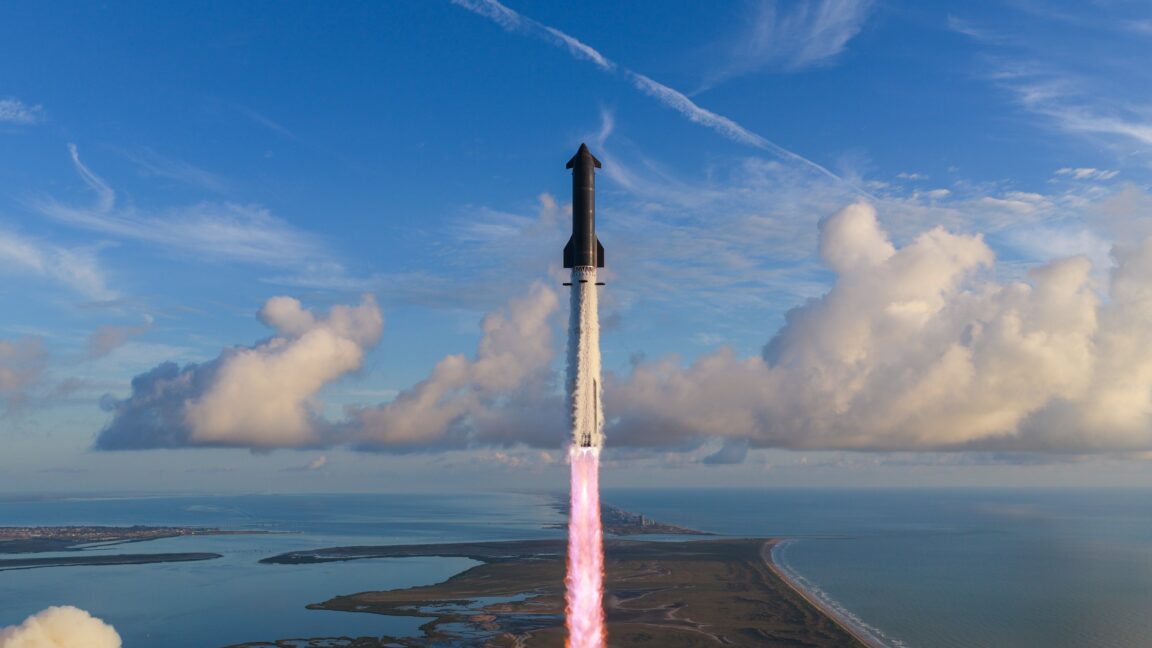
The moment LEO broadband became genuinely global
Monday’s Starship Flight 14 wasn’t merely a rocket reaching orbit. It was the moment when low-Earth orbit broadband infrastructure transitioned from theoretical promise to physical reality at planetary scale. When SpaceX deployed 26 Starlink V3 satellites from Starship’s payload bay—a system described by witnesses as resembling a Pez dispenser ejecting candy—the company didn’t just launch satellites. It demonstrated that the economic architecture for truly global broadband coverage now exists.
The Starlink V3 satellites represent a tenfold capacity increase over the older generation. Each one delivers approximately 1 Tbps—enough to serve entire nations, not just individual households. These satellites are too large for Falcon 9’s payload fairing, which is why SpaceX had to wait for Starship. When the first batch of V3 satellites attempted launch on a previous Starship flight in July, they burned up during reentry because that mission remained suborbital. Monday proved the vehicle could deliver them to stable orbit. The contrast between failure and success within weeks exposed how dramatically the economics of space launch are shifting.
What made Monday’s launch distinctive wasn’t just the orbital insertion—it was the precision. Starship’s heat shield held through reentry temperatures exceeding 1,400 degrees Celsius, and the vehicle executed a powered landing that required no parachute deployment or splashdown recovery. This precision matters because each Starlink V3 satellite costs roughly $5 million to build, and losing one to thermal damage during deployment isn’t an abstract risk—it’s a line item that determines whether the entire constellation economics work. When SpaceX got it right, the per-satellite delivery cost dropped below $10 million including launch, which is a fraction of what Eutelsat pays for geostationary launches that deliver a tenth of the capacity.
Why this matters beyond the space industry
Traditional satellite operators face an existential revaluation. Eutelsat, which operates geostationary satellites positioned 35,000 kilometers above Earth, can no longer claim exclusive access to global broadband markets. Their latency advantages against LEO constellations were always theoretical; their cost structures are now physically inferior. A geostationary signal travels 70,000 kilometers round-trip, producing latency that makes video calls feel sluggish and online gaming impossible. Starlink V3’s 550-kilometer orbit produces round-trip times under 50 milliseconds—comparable to terrestrial fiber in most cases.
The regulatory implications cut deeper than commercial competition. Emerging markets—Africa, Southeast Asia, parts of Latin America—were never well-served by terrestrial fiber or geostationary satellite broadband. Latency made real-time applications impossible. Starlink V3’s 1 Tbps capacity per satellite changes the calculus entirely. A single Starship deployment could theoretically serve an entire country’s connectivity needs. This isn’t hypothetical: SpaceX is already negotiating direct-to-device partnerships that would eliminate the need for specialized user terminals altogether.
The geopolitical dimension is equally significant. Nations that previously had no option but to accept Chinese or Russian satellite infrastructure as the price of connectivity now have a Western alternative that doesn’t come with political strings. For countries in the Pacific, the Indian Ocean, and the Arctic—regions where territorial disputes make infrastructure siting politically sensitive—having a commercial option that bypasses sovereign ground stations entirely changes the strategic equation. Starlink V3 satellites communicate via laser links that route data through space without touching any single nation’s territory.
The competitive ripples
Terrestrial ISPs in developed markets may not feel immediate pressure. Their fiber and cable infrastructure remains superior for density and reliability. But in regions where laying fiber is economically impossible—remote islands, mountain communities, vast agricultural zones—Starlink V3 represents a qualitative leap. The 30-degree inclination orbit from Monday’s launch covered most populated landmasses between equator and mid-latitudes. Future flights will reach higher inclinations as range safety rules relax and Florida launch sites come online.
Eutelsat’s response has been predictable: emphasis on high-throughput GEO satellites and partnerships with existing LEO operators. But the math doesn’t support their positioning. A single Starlink V3 satellite costs roughly what Eutelsat spends on an entire geostationary fleet when accounting for launch, insurance, and operations. The capacity differential is even more lopsided. Iridium’s strategy of focusing on mission-critical communications rather than consumer broadband remains sensible, but the line between ‘mission-critical’ and ’essential infrastructure’ keeps blurring.
The ripple effects extend to equipment manufacturers as well. Traditional satellite antenna makers—who built expensive phased-array systems for geostationary tracking—now face competition from cheap, mass-produced Starlink dishes that sell for a fraction of the cost. This isn’t speculation: early reports from sub-Saharan African installations show Starlink terminals deploying in days rather than months, with users reporting download speeds that exceed their existing copper-based broadband by an order of magnitude. The equipment supply chain is adapting faster than incumbent manufacturers anticipated.
What happens next
SpaceX is already planning Starship launches every few weeks through 2027. The company has 100-ton satellites waiting in Texas warehouses, built ahead of launch vehicle availability. When Starlink V3s integrate into the constellation over coming months, users will notice capacity improvements before speed improvements—until SpaceX hits enough orbital saturation that throughput per user climbs meaningfully.
The FAA’s decision not to require a formal mishap investigation despite engine failures on three Raptor engines across the flight is telling. Spaceflight safety culture is shifting from perfectionism to iterative improvement. SpaceX’s approach—fly fast, learn faster, return data regardless of outcome—is creating an informational moat that competitors cannot easily replicate. Even if Eutelsat matched Starship’s launch capability, they couldn’t match the operational tempo.
Musk’s comments about Raptor 3’s manufacturing complexity—reduced part count requiring highly modified 3D metal printing—signal where the industry is heading. Simplification through advanced manufacturing, not complication through incremental design. The engine failures are symptoms of pushing boundaries, not evidence of flawed methodology. Each failure teaches something that simulation cannot predict.
The next inflection point comes when Starlink achieves full orbital saturation—estimated at 4,000 to 5,000 V3 satellites distributed across multiple orbital shells. At that point, latency becomes consistent globally, capacity per cell exceeds most terrestrial mobile networks, and the economics of building new ground stations in remote areas become unfavorable compared to simply deploying a Starlink terminal. This saturation isn’t years away: with Monday’s deployment rate, SpaceX could reach it within 18 months if launch cadence holds.
The broader transformation
Starship reaching orbit while deploying commercial satellites marks a structural shift in how global infrastructure gets built. Before Monday, broadband coverage gaps existed because infrastructure couldn’t reach remote areas economically. After Monday, those gaps exist only because of regulatory friction, not physical impossibility. The technology to connect every human on Earth now exists. The question is whether policy and market structures adapt fast enough to make it happen.
For emerging markets, this represents a potential leapfrog moment. Countries that skipped landlines for mobile phones might skip terrestrial fiber entirely for broadband. The economics favor satellite in regions where laying cable costs more than launching satellites. Starlink V3’s 60-satellite deployment capacity means a single flight could serve multiple nations simultaneously—a capability that redistributes power away from incumbent telecom monopolies.
The environmental dimension deserves attention too. Building fiber networks across tropical rainforests, mountain ranges, or Arctic tundra damages ecosystems that take centuries to recover. Satellite broadband eliminates that physical footprint entirely—though it introduces a different environmental question around rocket emissions and orbital debris management that regulators are only beginning to address. The tradeoff isn’t obvious, and the public debate over which approach is truly more sustainable is still forming.
The inflection point is now. LEO broadband has graduated from experimental to operational. The question for Eutelsat, Iridium, and terrestrial ISPs isn’t whether they’ll be disrupted—it’s how quickly they can pivot before the disruption becomes irreversible.