Starship reached orbit. The real story is what comes next.
SpaceX's Starship Flight 14 finally sent the vehicle to orbit — a hard-fought milestone that unlocks NASA's moon plans and cements SpaceX's dominance in heavy-lift launches, while reshaping the economics of the entire space industry.
One Step Into Orbit, One Giant Implication
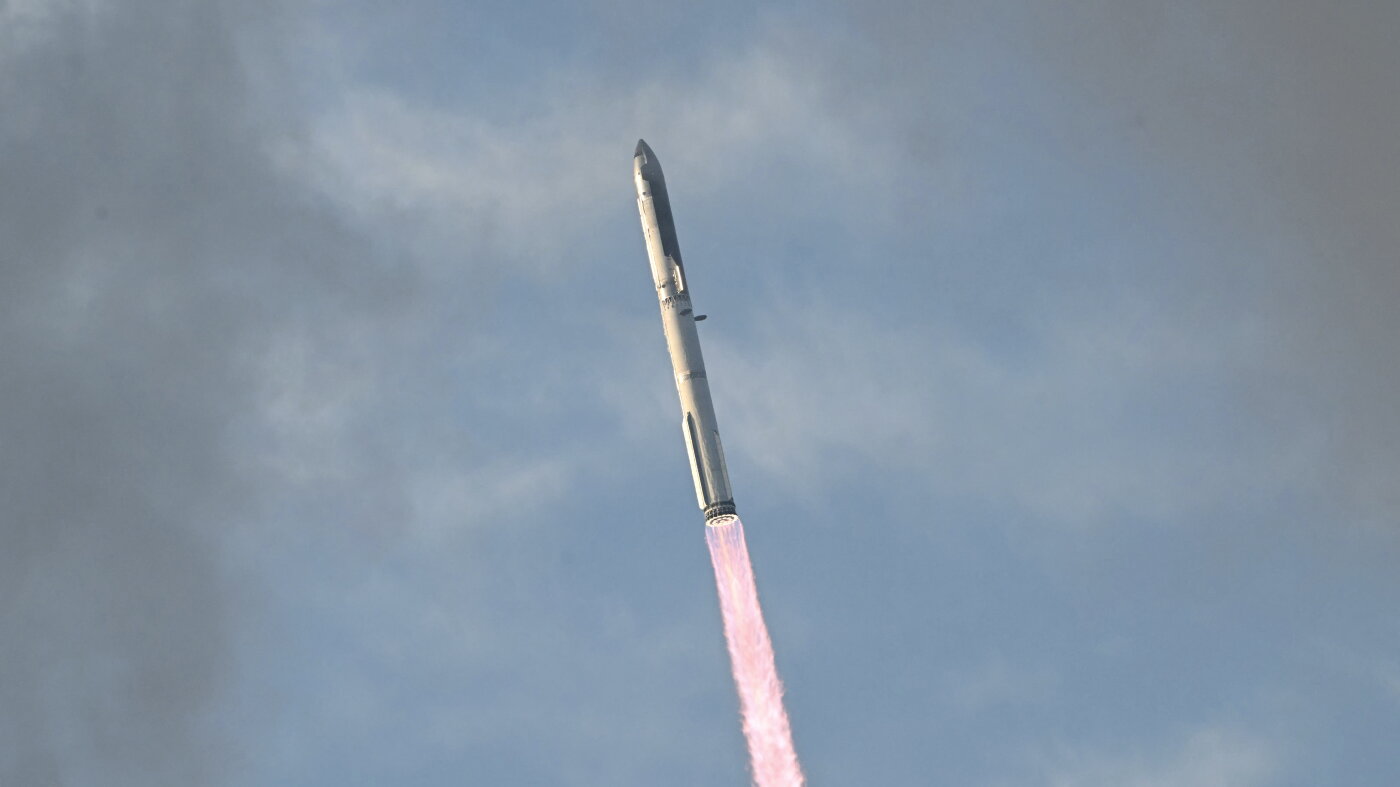
SpaceX’s Starship finally reached orbit. Flight 14, launched Monday morning from the company’s Starbase facility on the Texas coast, became the first mission to send the 171-foot vehicle at orbital velocity — roughly 17,500 miles per hour. The flight lasted three hours instead of the planned 10, ending with a splashdown north of Hawaii. But the date on the calendar matters less than what the milestone unlocks.
Starship’s arrival in orbit is the keystone for two of SpaceX’s most consequential programs: the expansion of its Starlink broadband constellation and NASA’s plan to return humans to the lunar surface. Get one right and the other follows. Get both wrong and the company’s growth thesis frays fast.
The Starlink Angle: Why V3 Needs Starship
During its ascent, Starship deployed 26 next-generation Starlink V3 satellites into orbit. This may look like routine operations, but it is a quiet proof of concept. Falcon 9, SpaceX’s current workhorse, cannot carry the larger V3 class of satellites. Starship can, and it can do so in numbers that change the bandwidth equation entirely.
SpaceX announced last month that it was ending Starlink launches from Cape Canaveral, signaling a decisive pivot toward Starship. The company is already laying out plans to build a major launch complex in Louisiana — a $100 billion project that aims for dozens of pads and its first Starship launches from that site by 2029. If those timelines hold, Starlink V3 will flow through Starship regularly within a few years, and Falcon 9 will cede its role as the company’s primary satellite deployer.
The shift carries second-order consequences for the broader satellite industry. V3 satellites are larger, heavier, and more capable than the Gen 2 fleet currently in orbit. That means fewer launches per constellation expansion cycle, but each launch carries exponentially more capacity. Operators using Falcon 9 or Delta IV Heavy for heavy payloads will face a widening cost gap that Starship undercuts simply by being reusable at this scale. The economics of deploying 12-ton satellite buses become uncompetitive when a single Starship flight can carry three times that mass to the same orbit.
This matters because Starlink is central to SpaceX’s financial story. In filings ahead of its planned IPO in June, the company explicitly flagged Starship’s development as a risk factor, warning that delays or failures would constrain its growth strategy. Reaching orbit reduces that risk — it does not eliminate it. The vehicle still needs to demonstrate controlled landing, thermal protection reliability, and in-orbit refueling before the Starlink revenue model hits its full stride.
NASA’s Moon Plan Depends on This Rocket Working
Starship is also the only vehicle NASA has chosen to land astronauts on the Moon under the Artemis program. The agency plans to test docking between its Orion capsule and Starship during Artemis III, currently targeted for late 2027. Another commercial lander, built by Blue Origin, will fly alongside it on a subsequent mission — a dual-lander architecture that was intended to provide redundancy but now raises questions about scheduling coordination between two independently developed vehicles.
Orbiting is step one. Landing, refueling, and returning from the lunar surface are steps two through four — and they are far harder. The heat shield testing on this flight was an important checkpoint. Three of the deployed Starlink satellites carry cameras designed to capture reentry data on Starship’s thermal protection system. Surviving the heat of atmospheric return intact is a prerequisite for reusing the vehicle, which is exactly what makes Starship economically viable compared to expendable rockets.
NASA is counting on a reusable lunar lander to keep Artemis costs down. The agency’s original budget projections assumed multiple flights per year, each landing and returning astronauts from the lunar surface without building a new descent stage for every mission. If Starship cannot demonstrate reliable heat shield performance and eventual recovery, the entire lunar logistics chain becomes more expensive and more fragile. That pressure could cascade into delays across the Artemis timeline, affecting not just human missions but the scientific payloads and infrastructure modules also planned for lunar orbit and surface.
The in-orbit refueling demonstration — still untested — is the linchpin. Starship must prove it can transfer cryogenic propellant between tanks in microgravity, a feat never accomplished at this scale by any nation. Success opens the door to lunar orbit rendezvous architectures that NASA has long envisioned. Failure forces a redesign that could push crewed lunar landings years further out.
What This Means for the Launch Market
The broader implication is straightforward: SpaceX now controls the only operational path to orbit for the heaviest payloads in the Western Hemisphere. No American competitor has a rocket in this class. No American competitor is close. European, Japanese, and Indian programs all fall short of Starship’s payload capacity. China is the only nation pursuing a rival heavy-lift vehicle at this scale, and its timeline remains unclear.
That gap creates leverage. NASA, the Pentagon, and commercial satellite operators looking for a ride to high orbits have one provider. That concentration of power is unlikely to shift quickly, and it gives SpaceX significant negotiating weight on price, schedule, and contract terms. Defense contracts, in particular, carry strategic implications — the U.S. government’s reliance on a single commercial provider for its heaviest national security payloads introduces a single point of failure that policymakers have yet to fully address.
Flight 14 also highlighted how much testing remains. A Super Heavy booster engine failed during ascent. Mission managers chose to continue toward orbit rather than abort, cutting the flight short from ten hours to three. The booster simulated a landing at sea rather than returning to the launch tower — a variation in the reusability test program. SpaceX is clearly running a disciplined, iterative flight-test campaign. Each mission gathers data the next one uses.
Who Wins, Who Loses, What Comes Next
SpaceX wins most obviously — orbital capability accelerates its path toward the ambitious cadence it has described. NASA wins if the data from this flight feeds cleanly into Artemis timelines. Starlink subscribers eventually win through expanded coverage and higher-bandwidth service from the V3 constellation.
Competitors lose on scheduling flexibility. Starship’s capacity dwarfs what current rockets can deliver, and SpaceX’s growing launch infrastructure means it can run flights more frequently without waiting for range slots at Cape Canaveral. Commercial satellite operators who need heavy-lift will have nowhere else to turn for the foreseeable future.
The next critical tests are heat shield validation across multiple reentry profiles and eventual booster recovery at the launch tower — both still pending. If Starship can demonstrate those milestones consistently, the economics of space access shift in ways that benefit everyone who depends on it. The cost-per-kilogram to orbit could drop by an order of magnitude, opening doors to large-scale orbital manufacturing, deep-space missions, and asteroid mining concepts that have lived only in study reports until now.
If not, the same growth narrative that SpaceX sold to investors begins to look like a longer climb. The orbital milestone is real. It is also the first chapter, not the conclusion.