Taiwan's Trillion-Dollar Bet at China's Doorstep
Taiwan just approved its first defense budget over 1 trillion new dollars — while its president stood on an island just 1.8 kilometers from Chinese guns. The strategy is clear: make invasion unbearably costly.
The Gunpoint Budget
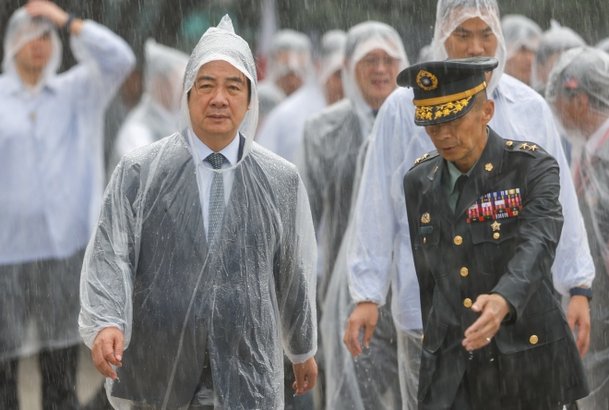
Taiwan has just approved its first defense budget exceeding one trillion new dollars — roughly $32 billion. That number would be notable on any ordinary day. It landed on the day President Lai Ching-te stood in the rain on Jinmen Island, a rock barely 1.8 kilometers from Chinese-controlled shores, where artillery shells rained down 68 years ago.
The coincidence is the point. Lai didn’t choose a ceremonial hall in Taipei. He chose the place where Taiwan’s survival was last tested with conventional firepower, and announced a strategy built around making any future attack financially unbearable for Beijing.
What Changed
The math is stark. Taiwan’s 2027 defense allocation of 1.1225 trillion TWD represents 3.1% of GDP — a commitment that would impress any NATO member. But Taiwan is not NATO. It has no mutual defense treaty. The 2022 CHIPS Act may guarantee American fabs in Taiwan, but it does not guarantee American ships.
The budget trajectory tells the real story. Taiwan spent approximately 365 billion TWD on defense in 2023. That doubled in under four years. The acceleration reflects a simple calculation: China’s military modernization is not slowing, and every year Taiwan delays investment costs more lives than money.
Chinese coast guard vessels have been conducting so-called “law enforcement patrols” around Jinmen since early 2024,常态化化izing gray-zone pressure that stops short of armed conflict. The PLA Air Force and Navy operate daily within Taiwan’s ADIZ. Beijing has not ruled out force, and has repeatedly moved the goalposts on what counts as “peaceful reunification.”
Lai’s message on Jinmen was calibrated for this moment: Taiwan will not cede territory, will not negotiate away sovereignty, and will pay whatever price is necessary to make aggression unprofitable.
The Asymmetric Shift
The spending priorities reveal the strategy.
Taiwan is funneling money into missile systems, unmanned drones, and domestically designed submarines — platforms that can punish an invading fleet before it reaches the shore. The recent Han Kuang exercises explicitly simulated Chinese naval blockade scenarios, forcing the military to practice fighting under conditions of severed sea lines of communication.
This is not a strategy designed to win a conventional war against the People’s Liberation Army. It is a strategy designed to make winning impossible.
Beijing understands this calculus. The gray-zone coercion around Jinmen and Matsu serves a dual purpose: it tests Taiwan’s response thresholds while keeping the island economically integrated enough to resist decoupling pressures. China wants Taiwan compromised but not triggered. Every patrol by a coast guard vessel is a probe. Every militarized photo op by PLA aircraft is a signal.
Taiwan’s response has been consistent: absorb the pressure, invest for the next escalation, and never concede. The trillion-dollar budget is the financial embodiment of that posture.
The Chip Factor
No analysis of Taiwan’s defense spending is complete without confronting what happens if the math fails.
Taiwan manufactures approximately 90% of the world’s most advanced semiconductors. A Chinese blockade or invasion would not just be a geopolitical catastrophe — it would be an economic one. The global economy depends on TSMC’s fabs in Xinbei and Hsinchu more than most observers acknowledge. Cars, smartphones, military systems, AI hardware — all flow through islands that now sit 1.8 kilometers from enemy artillery.
This dependence creates a strange symmetry. China holds the military advantage. The world holds the economic leverage. Taiwan holds the factories.
The United States has tried to resolve this triangle through the CHIPS Act, subsidizing TSMC’s expansion in Arizona. ButArizona fabs will not match Taiwan’1s output for years, and they will not replicate the ecosystem of suppliers, talent, and process refinement that makes Taiwan irreplaceable. The subsidy deal is real — $6.6 billion in American support for TSMC’s US operations — but it is not a substitute for Taiwan’s existing capacity.
Japan and South Korea are watching the budget numbers and recalibrating their own defense postures. Japan’s recent decision to double its defense spending to 2% of GDP was partly motivated by Taiwan scenarios. South Korea has quietly increased its own military procurement while positioning itself as a potential alternative semiconductor hub. The implications ripple far beyond East Asia.
Who Wins, Who Loses
Taiwan wins credibility. A trillion-dollar budget sends a signal to Washington that Taipei is investing in its own survival — precisely the message American policymakers need to hear before committing to defensive guarantees that carry enormous risk.
China loses credibility. The gray-zone strategy has not forced Taiwan into concessions. Instead, it has accelerated Taiwan’s military modernization and drawn the island closer to democratic partners who share its concern. Beijing’s coercion is producing the opposite of its intended effect.
The United States wins strategically — for now. Taiwan’s increased self-reliance reduces the immediate burden on American forces while maintaining the strategic status quo. But winning today does not solve tomorrow’s problem. If Taiwan’s investments buy another decade of deterrence, that is a success. If they buy ten years and then lose, the cost is existential.
Semiconductor companies are the quiet losers. They can diversify. They can build new fabs. But the next decade of investment decisions will be shadowed by the question of whether their primary manufacturing base remains underTaiwanese control.
What Comes Next
The next anniversary of the August 23 artillery barrage will arrive in 2027, exactly one year after this budget takes effect. By then, Taiwan will have begun fielding new missile batteries, expanded its drone programs, and likely launched its first domestically built submarine. The questions will be whether those systems are enough, and whether China has adapted its strategy to neutralize them.
Lai’s visit to Jinmen was not a coincidence. It was a statement: Taiwan will meet any threat at the water’s edge, and it will pay for that choice with its own money, not just American promises.
Whether that equation holds is the defining strategic question of the decade.
The budget has been approved. The money is spent. Now comes the harder part: making sure it matters when it is needed.