The Moon Just Grew Its Biggest New Crater Ever Found—Here's Why It Matters
A 222-metre crater appeared on the Moon in 2024, making it the largest newly formed impact crater discovered anywhere in the solar system. The find reshapes how we estimate impact risk for lunar missions and offers a rare window into how surfaces change after a strike.
A routine check that changed everything
Robert Wagner was doing the kind of work that almost never produces anything new. On 24 October 2025 he was running a quality check on a global map of the Moon, stacking hundreds of wide-angle frames taken years apart so that software could grey out everything unchanged and highlight only what had shifted. Most passes return hundreds of false alarms—tiny shifts in lighting, a shadow moving a few pixels. Then a bright spot appeared inside a dark halo, spanning hundreds of pixels on a camera whose individual pixels roughly equal the size of an American football field.
It marked a crater 222 metres wide on the Moon’s eastern near side that did not exist before spring 2024. It is the largest newly formed impact crater found anywhere in the solar system. Papers describing the discovery appeared in Science Advances on 16 September 2026. Wagner, an image-processing specialist at Intuitive Machines who works with the Lunar Reconnaissance Orbiter Camera system, said he stopped, dropped everything, and started digging into what that spot was.
The crater is now named McGetchin, after lunar scientist Tom McGetchin.
What hit the Moon, and when
The impact happened inside a 41-day window bracketed by before-and-after images—sometime between 11 April and 22 May 2024. No one saw a flash. The date comes entirely from the gap between two photographs. A comet or asteroid fragment struck at roughly 15 kilometres per second, and the discovery paper estimates the energy at 6.5 times 10 to the 10th kilojoules. That is more than 27 times the energy of the previous record holder, a 70-metre crater formed in 2012, and more than four orders of magnitude beyond a 10-metre impact.
NASA describes the object as roughly the size of a three- to six-storey building. A firmer estimate of its mass and composition is expected in a later paper. None of the three primary sources reports an observed flash or definitive identification of whether the projectile was cometary or asteroidal.
The ground that used to be there
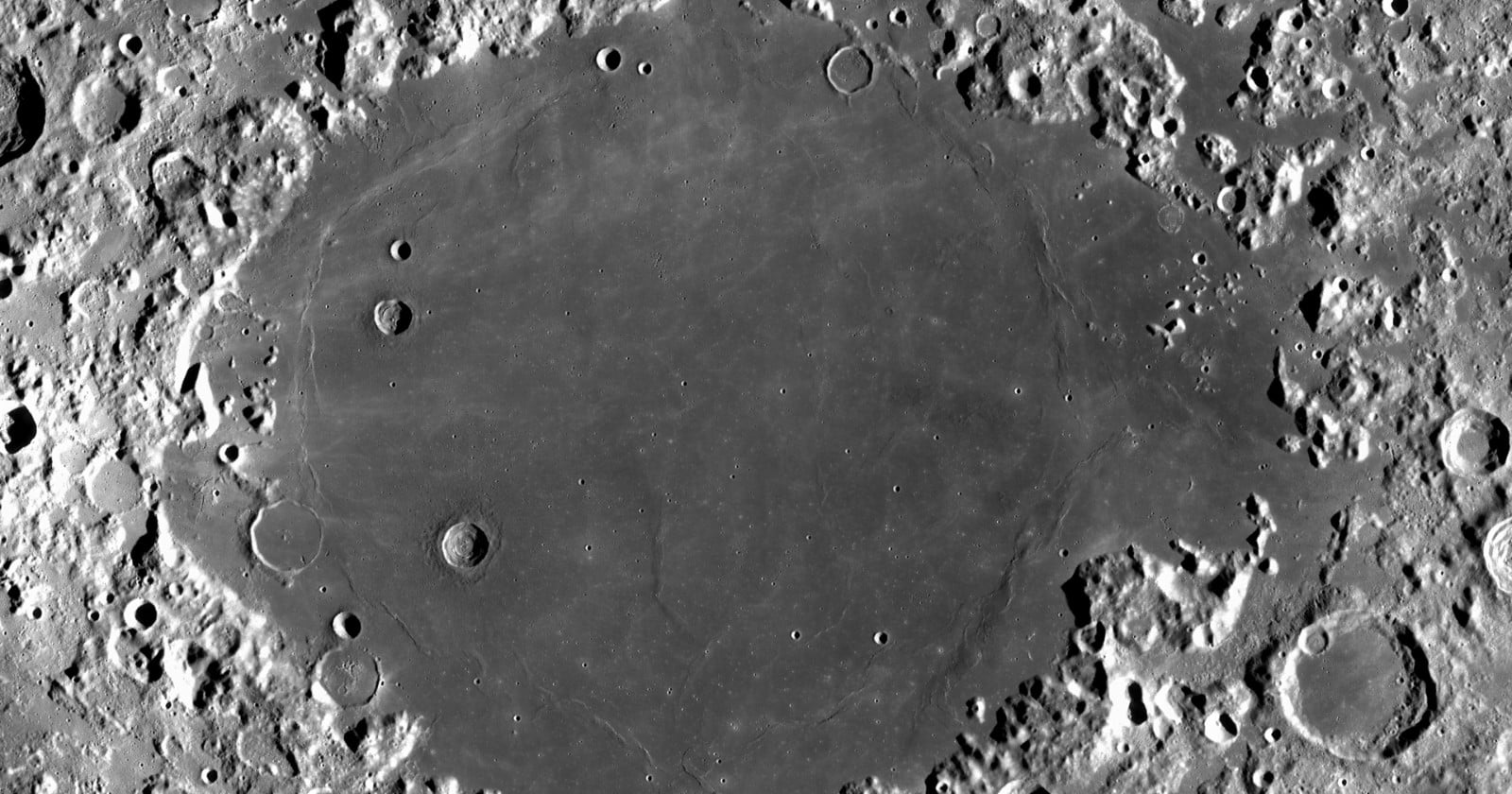
The site sits at 1.3536 degrees north, 67.1765 degrees east, just inside the outer ring of the Crisium basin about 330 kilometres from the edge of Mare Crisium. Before the impact, the ground was an old patch of lunar surface split by an irregular boundary where dark mare basalt met paler highland material—lava that had flowed from an eruptive centre 23 kilometres to the east-southeast and lapped against the highland flank of a 7,200-metre-wide crater called Dubyago N.
That boundary matters. McGetchin’s rim is slightly lopsided: 231 metres across at its widest point on a north-northeast line, 213 metres at its narrowest to the east-southeast. The authors interpret this as excavation into loose granular regolith on one side and a coherent subsurface lava flow on the other. It is a reminder that what an impact looks like depends heavily on what it hits.
The surface was already thoroughly scarred. Within the footprint of the new crater, the largest existing pit was 40 metres across. None survived. Within the continuous ejecta blanket outside the rim, only five of 103 craters between 6 and 12 metres wide remain identifiable, and 12 of 35 in the 12-to-48-metre range—all of them heavily degraded.
The shape of the damage
McGetchin is a funnel 43 metres deep, with a depth-to-diameter ratio of 0.19, typical of the freshest craters this size. Its walls run at a median slope of 24 degrees and reach 41 degrees at the steepest points. The floor is a hummocky patch 15 by 30 metres. A slump boulder 16 by 32 metres sits about 10 metres below the eastern rim. The rim itself stands a median 7.7 metres above the old surface.
About 4.6 metres of that rim height comes from ejecta piled on top, leaving roughly 3.1 metres of target material structurally pushed upward. The largest ejected boulder—13 by 9 by 3 metres—sits on the southern rim, and the second-largest, 8 by 7 by 2 metres, landed on the south-eastern flank. The crater interior holds the brightest material in the entire 9-by-27-kilometre frame, along with material darker than mature mare basalt, read by the authors as enriched in glassy, quenched impact melt.
The ejecta reached further than most people expect. A brighter zone extends about 15 kilometres from the impact site. A fainter, patchier dark zone runs well beyond that—more than 120 kilometres past the bright zone’s edge, roughly a thousand crater radii out, with localized patches reaching 140 kilometres. In places the darkening breaks into a delicate lacy texture, probably where sparse clumps of ejected material landed far from home. Eight kilometres west, a ridge stands 700 metres above the crater. The mare basalt at its base is up to 2.5 percent darker than it was before, meaning material cleared the ridge. The ejection angles required for that sit awkwardly with the conventional picture of jetting at less than two degrees above the surface.
A cold spot that should last
Once McGetchin was found, LRO’s thermal instrument, Diviner, was pointed at it. Its first observations came on 1 November 2025, roughly a year and a half after the impact—far too late to catch any residual heat, which after the LCROSS impact faded to near-undetectability within about four hours.
Instead, Diviner found a cold spot about seven kilometres across. The surface in that zone cools 8 to 9 kelvin further through the lunar night than the surrounding ground, with a measured peak anomaly of 8.61 kelvin. The explanation is decompaction: an impact loosens the top centimetres to decimetres of soil, and looser material holds less heat. Apollo 16 provided in situ evidence for this reading—the crew’s bootprints were deeper in a faint cold spot that turned out to be a weathered ancient impact site.
The mechanism doing the decompacting is not settled. The paper lists granular flow from secondary impacts, impact-generated gas flow, and seismic shaking as candidates. Fitting the cooling curve requires density to climb with depth over a scale height of about 39 centimetres, compared to about 6 centimetres in the untouched regolith nearby. The real profile probably sits somewhere between the model’s two extremes.
This is not unusual for larger new craters. Of the 21 new craters larger than 20 metres that LROC has identified, every one above roughly 30 metres has a detectable cold spot, and the size of the temperature anomaly scales with crater size—though that scaling begins to flatten above about 100 metres, where McGetchin is the only member of that new group.
Cold spots fade over roughly 100,000 to 2 million years. McGetchin’s is virtually unaltered. Watching it decay from a known starting point should give the best calibration yet for how long these signatures last, and may let researchers use cold spots as a rough age estimate for some of the youngest craters on the Moon.
Why the superlative deserves a footnote
McGetchin is the largest crater found to have formed while we were watching. That claim rests on a seventeen-year archive of orbital images set against a surface billions of years old. LRO has catalogued at least 1,000 new craters since 2009. The previous largest was 70 metres.
The discovery paper and NASA both extend the claim to the largest newly formed crater found anywhere in the solar system. None of the sources specifies what baseline supports that wider comparison. Crater production models predict an impact of this size on the Moon about once every 132 years on average, which Robinson’s team reads as a statistically rare, effectively once-in-a-lifetime observation. Read differently, an average interval of that length says nothing about whether the previous comparable event fell 12 years ago or 400.
The impact date is a window, not a moment. No flash was recorded. The crater’s age comes entirely from the gap between two images. And some of what makes McGetchin look unusual—the lopsided rim, the odd tongue of darker ejecta running north—may say more about the terrain it struck than about the object that hit it. The authors searched for definitive evidence of a grazing impact and found none.
What changes next
McGetchin’s value right now is that it has barely changed. That condition is temporary. The distal darkening around the 70-metre crater from 2012 has already measurably faded and may disappear entirely within about fifty years. McGetchin’s cold spot will last far longer, but eventually it too will erode into anonymity.
As of 18 February 2026, Diviner had observed the site across nine campaigns and 43 orbits, twenty of them at night. The authors say the next step is a visit—a mobile surface asset carrying instruments that can measure regolith properties directly and settle what is still uncertain about decompaction mechanisms and ejecta distribution. NASA adds that ground loosened this far from a crater rim could affect how rover wheels behave, which is a practical concern for any mission planning to operate in this terrain.
The find is a reminder that the Moon is not a frozen museum. It is a surface still being rewritten, and the writing happens faster than most people realize. A building-sized rock can strike without warning, reshape a landscape, and leave a thermal signature that lasts for millennia. For lunar exploration, the implication is straightforward: the ground beneath your wheels was not here ten years ago, and it may not be here ten years from now.