Three Central Banks Raise Rates in Lockstep for the First Time Ever
The Fed, ECB, and Bank of Japan all hiked rates in September — a first in modern history. Iran war-driven energy shocks are rewriting the global monetary rulebook.
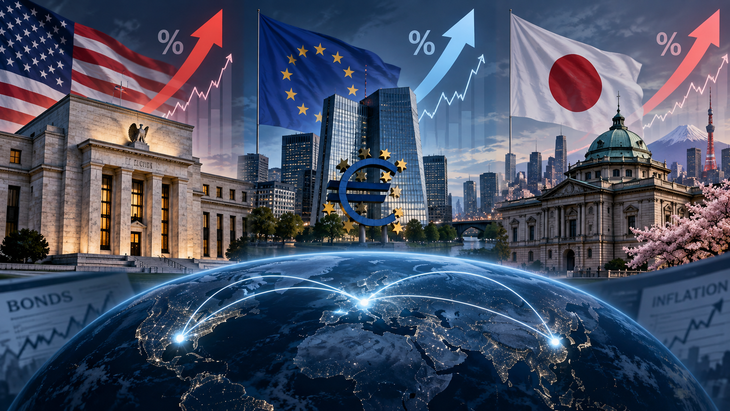
The Unthinkable Happened in September
Three of the world’s largest central banks — the Federal Reserve, the European Central Bank, and the Bank of Japan — all raised interest rates in the same calendar month. Bloomberg confirms it: this has never happened before in modern monetary history.
The Fed moved on Sept. 16, breaking a pause that stretched back to 2023. The ECB followed on Sept. 10, its first increase in three months. The BOJ completed the trio the next day, lifting its policy rate from 1.0% to 1.25%. Three hikes. One month. A new chapter in global finance.
What makes this synchronicity dangerous is not the individual decisions but their coincidence. When major central banks move together, the effect compounds. Borrowing costs rise in parallel across the world’s biggest economies, squeezing growth, debt, and investment at the same time.
The catalyst is almost entirely geopolitical. American-Iranian tensions over the Strait of Hormuz have reignited, pushing oil prices higher and forcing central banks that were preparing to pivot toward easing to rethink everything.
Who Is Driving This
Kevin Warsh, the Fed chair, did not mince words after the September FOMC meeting. Inflation, he said, remains too high and has stayed high for too long. Recent data does not show a meaningful improvement in underlying price trends. Financial conditions, he added, cannot be described as restrictive — meaning the Fed has effectively erased part of its prior tightening cycle and is now moving in the opposite direction.
That last point is critical. The Fed is not just holding steady; it is actively adding restraint after a period of hesitation. Markets are already pricing in more: CME FedWatch data shows a 57.6% probability of another 25-basis-point hike in October, and a 44.1% chance of yet another in December, which would push the federal funds rate to 4.25–4.50%.
On the other side of the Pacific, BOJ Governor Kazuo Ueda framed the September move as a transition to a new phase. Stabilizing inflation around 2% now demands more aggressive action, he argued, and the BOJ must move preemptively to avoid being cornered into sharper hikes later.
But Ueda does not have full control. Two BOJ board members — appointed directly by Prime Minister Sanae Takaichi — voted against the increase. The yen dropped sharply on the news, and some analysts interpret the dissent as a signal that the BOJ may still adjust its pace. Still, Bloomberg reports an 85% market-implied probability of another BOJ hike by December.
In Frankfurt, Christine Lagarde’s ECB lifted its deposit rate to 2.5% and its main refinancing rate to 2.65%, with the marginal lending facility at 2.9%. Greg Fuzesi at JPMorgan warned that the peak rate is uncomfortably tied to Middle East dynamics and that rates could climb above 3%. Reuters reported that the ECB is likely to raise rates a third time this year in December.
The Bank of England held rates steady this week but signaled that further tightening could be necessary if inflation pressures persist. Markets are now pricing in roughly four additional 25-basis-point hikes from the BoE over the next year.
South Korea’s central bank, the Bank of Korea, also accelerated its own tightening cycle, delivering consecutive rate increases in July and August — a first in its history.
The Hormuz Factor
To understand why all this is happening now, you have to look at the map. The Strait of Hormuz is the chokepoint through which roughly 20–21 million barrels of oil per day flow — about one-fifth of global consumption. Any disruption there sends shockwaves through energy markets within hours.
For a brief window in early September, markets believed a US-Iran agreement on the strait was emerging. Energy prices fell. The narrative shifted toward de-escalation.
Then the fighting resumed. Houthi forces expanded operations along the Red Sea, adding a second maritime threat to global supply chains. Oil prices stabilized at levels high enough to reignite inflation concerns across every major economy.
This is the mechanism: war in the Middle East → higher energy costs → sticky inflation → delayed rate cuts or outright hikes → squeezed growth.
The timeline matters. Before September, the dominant market story was “higher for longer” — rates staying elevated but stable. The new story is “tightening again.” That shift is expensive for everyone carrying debt, from governments to corporations to homeowners.
What Changes Now
The most important shift is psychological. For the past two years, financial markets have operated on the assumption that central banks would eventually pivot — that inflation was temporary and growth would force their hand. That assumption is now broken. The pivot is not coming. It is being replaced by a second wave of tightening, and it is being driven by a force that central banks cannot control: geopolitics.
This is not a normal inflation cycle. Typical tightening cycles follow rising wages or demand surges. Central banks can fight those with rate hikes because the problem is domestic. An oil-driven inflation spike caused by a war thousands of miles away is far harder to tackle. Raising rates to combat energy inflation suppresses demand but does nothing to restore oil supply. The policy tool does not match the problem.
The consequence is a worse trade-off. Central banks face either accept higher inflation or crush growth harder than they originally planned. Most are choosing the latter, which means recessions are more likely and deeper than markets priced in before September.
Who Wins, Who Loses
Who benefits from this moment? Savers in the US, Europe, and Japan are finally seeing real returns on deposits and short-term bonds — a group that has been squeezed to near-zero for over a decade. Banks with strong deposit bases may see net interest margins improve. Energy-producing nations and companies stand to gain if oil remains elevated.
Who loses is far broader. Governments with high debt loads — Japan’s is the most obvious case, with debt exceeding 250% of GDP — face steeper borrowing costs at exactly the wrong time. Emerging markets with dollar-denominated debt will feel the pressure as the greenback strengthens. Homebuyers and businesses that counted on falling rates to refinance are now watching those hopes recede. Consumers carrying credit card debt, auto loans, and variable-rate mortgages will see payments rise.
Japan deserves special attention. The BOJ’s move is historic not just for the rate change but for the speed. The three-month gap between hikes is the shortest since 1990. Ueda is trying to get ahead of inflation before it becomes entrenched, but the dissent from Takaichi’s appointees signals political friction that could slow future moves — or make them more abrupt when they come.
What Happens Next
The immediate trajectory is clear: rates will rise further before they fall. The only question is how far and how fast.
If the Iran conflict escalates further — a full blockade of Hormuz, for instance — energy prices could spike again and force even more aggressive central bank responses. If it de-escalates, the pressure eases, but central banks have already signaled they will not rush to cut. Warsh called inflation “too high for too long.” Ueda said the policy regime has changed. Lagarde has left the door open.
The market’s next test will be the October FOMC meeting. A 57.6% probability of another hike is high but not certain. The margin for error at this point is thin. Any upside surprise in inflation data could tip the scales. Any signs of economic distress could force a pause.
One thing is certain: the era of easy money is not returning anytime soon. Central banks have learned, or relearned, that inflation is a political problem as much as an economic one. And geopolitics is now a direct input into their models.
The synchronized September hikes were a symptom. The disease is a global economy that cannot reconcile low inflation with geopolitical instability. Until one of those changes, expect more of the same.