How Turning Tobacco Into A Pharma Factory Could Solve The Taxol Crisis
A new Nature Chemical Biology paper completes the full paclitaxel pathway in tobacco plants, ending a decades-old reliance on Pacific yew forests. Here's what that means for cancer care, pharma manufacturing, and the future of plant biotech.
The end of the yew forest
Paclitaxel has never had a reliable supply story. Discovered in 1967 by Monroe Wall and Mansukh Wani in the bark of the Pacific yew (Taxus brevifolia), it became one of oncology’s most important drugs—but at a cost that was almost impossible to sustain. Producing one kilogram of crude taxol required stripping the bark from nearly three hundred mature yew trees, and the species grows slowly, in remote old-growth forests along the US Pacific Northwest and into British Columbia.
The industry solved that problem only partially. Semi-synthetic routes using 10-deacetylbaccatin III extracted from the needles of European yews (Taxus baccata)—which don’t need to kill the tree—stabilized production. But those supplies remain geographically concentrated, climate-vulnerable, and exposed to the same kind of disruption that rattles any commodity dependent on a narrow farming base. China controls much of the raw yew needle export; COVID-era border closures demonstrated exactly how thin that thread is.
A paper published this week in Nature Chemical Biology aims to cut that thread entirely.
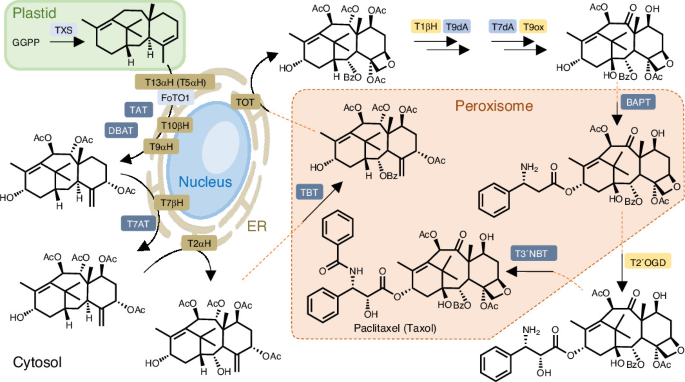
The researchers—based at the University of Copenhagen and the National and Kapodistrian University of Athens—report the first complete reconstruction of the paclitaxel biosynthetic pathway in a single heterologous host: the tobacco relative Nicotiana benthamiana. Using transient Agrobacterium-mediated expression, they drove the conversion of taxa-4(5),11-diene all the way through to paclitaxel in tobacco leaves, assembling a pathway of more than twenty enzymatic steps that had eluded complete reconstitution in any non-yew system until now.
That might sound like incremental metabolite-engineering progress. In practice, it’s a pivot point.
What the paper actually did
The technical achievement sits in the gap between “we know most of the enzymes” and “we can run the whole thing.” The path to this result accumulated work over roughly three years: the minimal gene set for yew in 2023, heterologous reconstitution toward baccatin III in yeast reported in Science in 2024, characterization of a bifunctional cytochrome P450 driving oxetane-ring formation later that year, and now the complete plant-host assembly.
Two of the newly validated enzymes—T2′OGD and T3′NBT—are already covered by pending patent applications filed by the authors. Those filings signal that the intellectual property landscape around plant-made paclitaxel is actively being drawn, not left open.
The host choice matters more than it initially appears. Yeast and bacterial systems have dominated synthetic-biology manufacturing stories. But terpenoid pathways—long chains of lipid-soluble intermediates processed by membrane-associated P450s and acyltransferases—fit naturally into plant cellular architecture. The endoplasmic reticulum compartments, the native lipid environment, the chaperone networks that fold complex multidomain enzymes—these come pre-installed in tobacco. Engineering them de novo in microbial factories is possible; borrowing them from a plant that already uses them is simpler.
Transient expression via Agrobacterium tumefaciens infiltration is not a manufacturing process. It’s a proof-of-concept tool. The real claim here is that the genetic wiring exists: once you prove the pathway runs end-to-end in planta, the work shifts to generating stable transgenic lines, optimizing promoter strength, tuning expression timing, and ultimately growing fields instead of running flasks. That transition usually takes three to five years in crop-trait programs, longer when the product is a regulated pharmaceutical rather than a commodity chemical.
Who wins when Taxol stops being rare
Supply security is the immediate stakeholder. Pharmaceutical manufacturers holding paclitaxel contracts today face a cost structure tied to botanical feedstock procurement, seasonal yield variability, and geopolitical exposure. Plant-made paclitaxel offers insulation from all three. A field of transgenic tobacco in Nebraska or Spain produces its payload regardless of monsoon patterns in Yunnan or export bans in Fujian.
Developing-world patients are the second winner, conditional on economics working out. Paclitaxel is on the WHO Model List of Essential Medicines. In low- and middle-income countries, access remains patchy—not because the molecule is unknown, but because the supply chain is brittle and pricing reflects scarcity premiums. If agricultural-scale plant biosynthesis compresses unit costs below the threshold that botanical sourcing sustains, the drug moves from available-when-you-can-pay to available-wherever-there-is-healthcare-delivery-capability.
Yew-forestry operators are the clear loser. Already displaced by semi-synthesis from needles, they now face complete disintermediation if the economics favor leaf biomass over logged timber. That displacement is morally unambiguous compared to the historical alternative—clear-cutting ancient trees for cancer treatment—but it carries real community-level consequences in regions where yew harvesting provided rural income.
The ethics that nobody is talking about
The dominant narrative around plant-made pharmaceuticals frames them as inherently cleaner than petrochemical routes and inherently safer than animal-derived processes. Both comparisons are true but incomplete.
Tobacco as a pharmaceutical host raises questions that the yew forest model quietly sidesteps. Grow transgenic Taxol-producing tobacco adjacent to food crops, and pollen-mediated gene flow becomes a policy problem, not a scientific curiosity. Containment strategies—male sterility, chloroplast transformation, greenhouse-only production—add cost and complexity that the paper doesn’t address. The same containment debates played out around drug-resistant Bt crops in India and herbicide-tolerant varieties in Brazil; plant-made paclitaxel will encounter them too.
There’s also a symbolic dimension. Tobacco’s reputation as a carcinogen makes it an unusual medicine factory. The irony is productive—increasing public acceptance of plant-based pharmaceuticals requires precisely this kind of cognitive stretch—but it shouldn’t be dismissed as marketing color. Regulatory bodies in markets with strong anti-tobacco sentiment may apply additional scrutiny to a drug manufactured in a crop associated with millions of preventable deaths annually. That scrutiny is not irrational; it’s governance responding to public understanding, not molecular reality.
Why this changes the playbook for rare plant medicines
Paclitaxel is not an isolated case. Dozens of clinically important molecules—artemisinin, vincristine, camptothecin, ginkgolides—share the same supply constraint: their natural sources are slow-growing, geographically restricted, or ecologically fragile. The paclitaxel pathway is simply the most therapeutically consequential one completed to date in a plant chassis.
The demonstration that a twenty-plus-enzyme pathway can be reconstituted in tobacco changes the feasibility calculation for every other plant secondary metabolite that pharmaceutical companies have quietly abandoned because the biosynthetic genetics looked intractable. When the barrier was “we can’t find the genes,” the answer was genomic mining. When the barrier became “we found the genes but can’t wire them together,” the answer is now proven to be solvable in planta.
That shifts the strategic position of synthetic biologists working in yeast and bacteria. Their advantage—fast growth, dense fermentation, well-characterized genetics—remains real. But the plant host gains a counterweight:-native compartmentalization for pathway flux, reduced metabolic burden from avoiding cross-species enzyme incompatibility, and a production scale model based on agronomy rather than bioreactor capital expenditure. The cost curve for plant-made paclitaxel could undercut yeast-made paclitaxel at tonnage scales that matter for generic oncology supply.
What happens next
The paper provides the blueprint. Building a commercial process from it involves steps none of the authors have yet taken: stable transformation, trait stacking without silencing, field trials under Good Agricultural Practice, extraction and purification validated under Good Manufacturing Practice, and phase-appropriate clinical equivalence studies if the new supply stream feeds into branded formulations.
Two patent families covering the new enzymes give the academic team a licensing foundation. Whether they build that into a spin-out, partner with an established pharma contract manufacturer, or license to multiple parties will determine how fast the technology reaches production scale.
The more consequential question is timeto-market. Transgenic-line development for a pharmacological crop rarely accelerates below three years even under ideal conditions. Regulatory approval for a plant-made biologic adds another two to four depending on jurisdiction. Conservative estimate: commercial paclitaxel from tobacco is unlikely before 2030. Optimistic scenario—involving an industry partner with existing Phase-specific infrastructure and willingness to parallelize regulatory pathways—could compress that window.
Either way, the dependency that defined paclitaxel since 1971 is now formally breakable. The trees are no longer the bottleneck. Whatever comes next will be decided by engineers, regulators, and farmers—not foresters.
That shift alone makes this paper worth reading beyond the metabolite peaks and chromatograms.