The Train Diplomacy Behind Trump's Stalled Ukraine Push
Witkoff and Kushner's Kyiv visit reveals a diplomatic off-ramp that exists more in geometry than in substance. A three-day ceasefire from Putin, a train ride from Poland, and European advisors in the room all point to a strategy scrambling for traction.
The Train to Nowhere
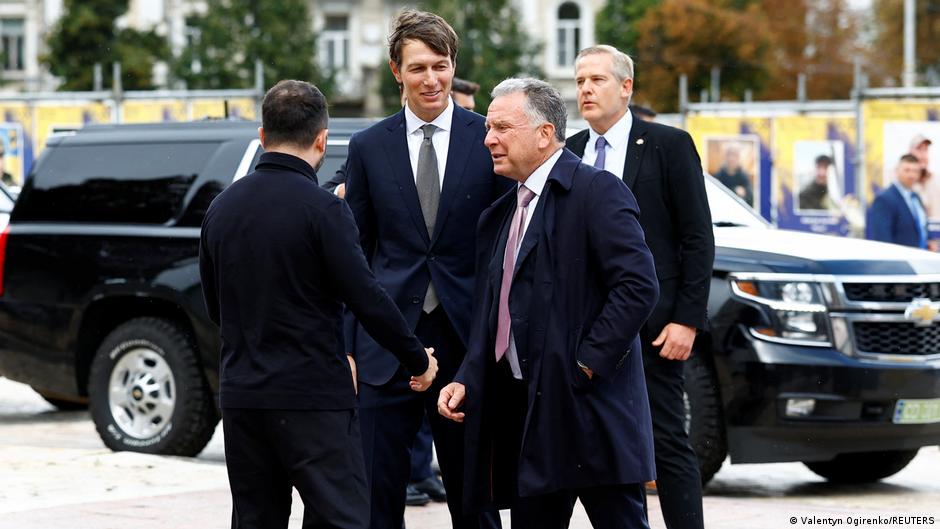
Steve Witkoff and Jared Kushner arrived in Kyiv by train from Poland. Ukraine’s airspace was closed — a detail that says more about the state of the war than any press briefing could. After meeting Vladimir Putin in Moscow the day before, the two Trump envoys needed a route that bypassed the danger zone above eastern Ukraine. Putin, for his part, had declared a three-day ceasefire to ensure their safe passage. That gesture alone — a temporary halt to an escalating conflict for the benefit of American visitors — is the kind of theater that defines this entire diplomatic exercise.
The talks were called “encouraging.” No breakthrough came. This is the pattern that has defined Trump’s Ukraine diplomacy since January, when his first round of talks with Putin at the Kremlin produced nothing. The geometry is the same: Washington bounces between Moscow and Kyiv, asking both sides to meet halfway on issues where neither has moved an inch.
What makes this iteration distinct is not the lack of progress but the visible toll it is taking on both capitals. In Kyiv, officials described the visit as a necessary ritual — something the United States demands before it can claim it tried. In Moscow, the Kremlin treated the envoy’s arrival as validation of its own narrative: that Washington ultimately answers to Trump, not to NATO or the European Union. Neither side gains anything substantive, but both gain the satisfaction of being seen.
What Putin’s Ceasefire Actually Signals
A three-day ceasefire is not a peace offer. It is a stage management tool. Putin declared it because American diplomats were flying — or rather, rail-traveling — through Russian-controlled airspace and into Ukraine. He needed to create a window wide enough for optics, not outcomes. His foreign policy adviser Yuri Ushakov described the Moscow meeting as “constructive, frank, and useful” — the Russian diplomatic equivalent of a shrug. No specifics were discussed, no outcomes announced.
What is specific, though, is the military situation on the ground. Russia is seeking the complete conquest of the Donbas region. Russian drones are striking the Ukrainian capital. Ukraine, in response, has shifted its own drone campaign toward Russia’s energy sector and even targeted online retailers deep inside Russian territory — an effort to bring the war home to the Russian public in a way that might erode domestic support.
The war is escalating, not de-escalating. And yet the envoys were welcomed with hospitality and three rounds of talks. The disjunction between the rhetoric of diplomacy and the reality of the battlefield has created a growing cognitive dissonance among Western observers. Military analysts who followed the Kyiv discussions privately expressed frustration that the envoys appeared to treat the ceasefire as a meaningful signal rather than what it objectively is: a tactical pause with no verification mechanism, no mutual commitment, and no infrastructure for monitoring compliance.
Second-order consequences are already emerging. European defense contractors have noted that the Trump administration’s emphasis on quick deals — even cosmetic ones — is beginning to unsettle procurement timelines. NATO members quietly accelerating defense production see the diplomatic theater as a potential precursor to pressure campaigns that would slow those very efforts. The message from Kyiv, leaked through multiple diplomatic channels, is clear: any settlement that does not account for the current trajectory of the war will be unenforceable.
The European Tell
The most interesting detail in Kyiv was not what was said but who showed up. In the final round of discussions, national security advisers from the United Kingdom, France, and Germany joined the table. Zelenskyy noted, almost wistfully, “Here we are all on the same side.”
That framing is deliberate. Trump’s peace push has increasingly positioned the United States as the sole broker, with Europe on the periphery. The inclusion of European advisors signals that Kyiv is not willing to let Washington negotiate its future in isolation. It is a quiet assertion of leverage — and a reminder that whatever deal emerges from these talks will require European security guarantees to be enforceable.
Zelenskyy was explicit about what Ukraine needs: “serious volumes” of US support, including Patriot missile systems, and what he called a “winter package” if the conflict drags into the colder months. His chief of staff, Kyrylo Budanov, recently told the New York Times he does not expect fighting to end before spring 2027. That timeline is not pessimism — it is an assessment of Russian military capacity and Ukrainian resistance, both of which remain substantial.
The European presence also carries a quieter significance. The UK, France, and Germany each bring intelligence assessments and military expertise that the Trump envoys lack. Their participation suggests that Kyiv is building a paper trail of multilateral engagement — one that could complicate any bilateral arrangement Washington might try to impose. If the United States moves toward a deal that sidelines European security commitments, Kyiv now has documented evidence that its allies were in the room and were not permitted to shape the outcome.
The Hard Problem Kushner Admitted
Kushner did not mince words about the difficulty of the task. “It’s a very, very hard problem, but we’re going to try,” he said. The acknowledgment is notable coming from a presidential advisor whose primary qualification for this role is proximity to the president, not diplomatic experience. It is also an admission that the structural obstacles — territorial concessions, security guarantees, the future of Donbas — have not moved.
The territorial question remains the immovable object. Both Moscow and Kyiv have drawn lines they will not cross. Russia controls approximately a fifth of Ukraine’s territory, including parts of Donbas that Putin has sought to fully conquer. Kyiv’s position, formally and repeatedly stated, is that any settlement must respect Ukraine’s sovereignty and territorial integrity within its internationally recognized borders. There is no evidence that either position has softened.
What has shifted, however, is the calculus of exhaustion. Ukrainian officials privately acknowledge that their manpower reserves are under strain and that continued attrition favors Russia, which has rebuilt its industrial base for total war. This does not mean Kyiv is ready to concede territory — it means the window for a favorable settlement is narrowing, not widening. The Trump administration’s diplomatic sprint is therefore working against a gradient that favors neither side but increasingly punishes hesitation.
What Happens Next
The diplomatic off-ramp is not forming. It is being drafted. Witkoff and Kushner are doing what Trump’s team has been doing since January: creating the conditions for a deal that neither side is ready to make. The value of their visits is not in immediate results but in maintaining a channel — keeping the president’s signature issue alive while the war continues to shape its own terms on the ground.
The next phase will likely involve a shift from general encouragement to specific proposal drafting. Trump’s team has repeatedly signaled that it wants to move from process to product, and the envoys’ upcoming visits to additional European capitals will test whether Kyiv and Moscow are prepared to discuss actual terms or continue the current rhythm of diplomatic theater. The winter package Zelenskyy is demanding will depend entirely on whether Washington interprets “encouraging” as a verdict or a prelude.
What to watch next: whether the US moves from encouragement to specificity, whether European security guarantees take a concrete shape, and whether Putin’s ceasefire discipline holds beyond the arrival and departure of American guests. The European security architecture that emerges from this period will define the continent’s posture for decades — regardless of whether a formal agreement is reached.
Until then, the envoys will keep traveling — by train, by helicopter, by whatever route the war permits — between capitals that are talking but not agreeing. The geometry of diplomacy is intact. The substance is not. And every day that passes without a framework for settlement makes the eventual deal more costly for everyone involved.