Trump Bypasses Congress to Ship 40,000 Bunker Busters to Israel
The Trump administration is pushing a $2.8 billion arms sale to Israel that includes 40,000 one-ton bunker-busting bombs, using emergency powers to sidestep expected Congressional opposition. The move has drawn criticism even from within Trump's base.
A Record Sale, a Bypass Procedure
The Trump administration has submitted a $2.8 billion arms sale request to Congress covering 40,000 one-ton bunker-busting bombs for Israel. That number alone — 40,000 — makes this one of the largest individual categories of munitions ever proposed in a US arms transfer. For context, the Pentagon typically authorizes arms sales in the low hundreds or, in rare cases, low thousands for a single munition type. This proposal exceeds that range by an order of magnitude.
What is more notable than the size, however, is how the administration is handling it. Secretary of State Marco Rubio has informed congressional leadership of the deal and is preparing to invoke emergency powers to push it through regardless of legislative opposition. Overriding that move would require a two-thirds vote in both chambers — a bar that has proven nearly insurmountable in recent years on foreign policy votes, where partisan loyalty and institutional inertia have consistently favored executive action.
The procedure is familiar in architecture but extraordinary in scope. Emergency authorities for arms sales exist on the books under the Arms Export Control Act, which permits the president to waive normal notification and review timelines when a national emergency is declared. They have rarely been used at this scale for Israel, and never for a single munition category of this volume. Legal scholars who have reviewed the administration’s framing note that the statutory language was designed for genuine operational urgency, not for circumventing political friction over prolonged conflicts.
What These Bombs Actually Do
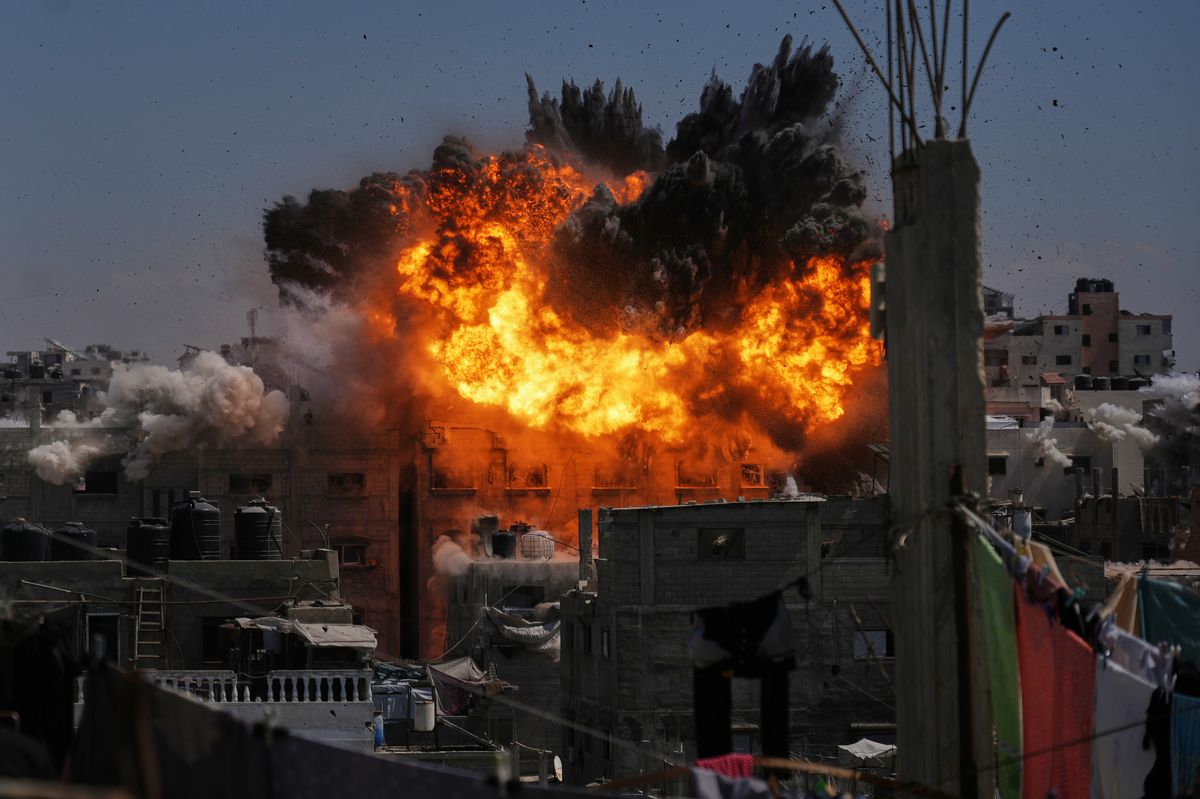
A one-ton bomb does not simply explode on impact. It penetrates before detonating, creating a crater up to 15 meters deep with a blast radius reaching roughly 300 meters. That is the kind of munition designed to take out reinforced underground facilities — the category of target Israel says Hamas and Hezbollah operators bury beneath dense urban terrain across Gaza and southern Lebanon.
The math is stark. Forty thousand of these bombs, dropped across Gaza and Lebanon’s already saturated population centers, represents a volume of explosive ordnance that has no clear precedent in the current conflict. To put it in perspective, estimates suggest that fewer than 5,000 such bombs were deployed across all of Israel’s major military operations combined between 2014 and 2023. This single transfer would effectively multiply that usage by eight.
Human rights organizations have documented that Israel has already used these weapons in ways that produce civilian casualties far exceeding the military targets they were meant to neutralize. Amnesty International and Human Rights Watch have called such use indiscriminate, pointing to structural evidence that underground facilities in densely populated areas cannot be targeted precisely enough to justify the explosive yield. Medical data from Gaza’s Ministry of Health indicates that large-diameter munitions are among the leading causes of civilian fatalities, including in areas designated as safer zones by Israeli forces.
US military analysts, quoted by TIME, have raised similar concerns — not about whether hardened targets exist, but whether smaller alternatives have been given serious consideration before defaulting to this class of bomb. The GBU-39 Small Diameter Bomb and the JDAM family offer precision-strike capability at significantly reduced explosive yield, and both have been used operationally by the Israeli military in earlier phases of the conflict. Those alternatives remain available in US stockpiles and were not included in the administration’s notification package.
The Domestic Fracture
The deal is drawing fire from directions that do not typically overlap. Democrats are calling for a complete halt to military aid to Israel, citing civilian casualty figures and questioning the strategic utility of saturating already-bombed areas. But the more surprising critique is coming from the right.
Tucker Carlson, a former Fox News anchor and influential voice within Trump’s coalition, called Israel’s actions in Gaza a massacre and described the weapons sale as a move to prolong an open-ended war with Iran. That is not marginal commentary. Carlson’s audience skews Republican, and his public positioning signals that the alliance’s unconditional defense has lost its unanimity among at least a segment of the administration’s base. Several Republican lawmakers, including members of the House Foreign Affairs Committee, have privately expressed reservations about the emergency-power maneuver, according to people familiar with the discussions.
This is not the first time Trump and Netanyahu have clashed over military strategy in the region. Reports indicate the two have disagreed recently over the scope of operations in Gaza, Lebanon, and against Iranian targets. The arms deal, whatever its strategic rationale, does not resolve those disagreements — it simply commits hardware regardless of them. That decoupling of policy disagreement from material support is itself unusual and suggests the administration is prioritizing Israel’s operational demands over any conditional leverage it might otherwise hold.
Second-order effects are already emerging. European allies, many of whom have been quietly critical of the war’s escalation, have responded with measured silence rather than the diplomatic pushback typical of major US arms transfers to Israel. Some NATO partners are reportedly reassessing their own defense-planning assumptions, particularly around the threshold at which the United States might unilaterally supply munitions without legislative sign-off. China and Russia have seized on the news to argue that American democracy is functioning as a façade, while Iran’s state media has framed the sale as evidence that Washington is directly complicit in what it characterizes as collective punishment.
What Happens Next
Congressional reaction will determine whether this becomes a landmark case for emergency arms sales or a rare reversal. The two-thirds threshold is high, but the fact that the administration feels the need to invoke emergency powers at all suggests it expects significant resistance. That resistance is likely to come not only from Democratic members but from Republicans who question the strategic wisdom of saturating already-bombed urban areas with this class of weapon — and who may also resist setting a precedent that a future president could exploit against America’s own constitutional checks.
If the sale proceeds, it will set a precedent that extends well beyond Israel. A future administration can bypass normal arms-sale review for any partner it designates as critical, using emergency authority as the default rather than the exception. The volume of munitions involved — 40,000 bunker busters — makes this the test case. Legal challenges are expected. Several civil-liberties organizations and a group of Democratic lawmakers have signaled intent to file suit, arguing that the emergency declaration does not meet the statutory standard and that the scale of the transfer violates the spirit if not the letter of congressional oversight provisions.
If it stalls, it will be the first major Israeli arms sale to face effective legislative friction in years, and it will embolden critics on both sides of the aisle to demand scrutiny of future transfers. The practical effect would likely be slower delivery timelines and potential conditions attached to individual munition types — constraints the Pentagon has indicated it does not want on the ground in the Levant.
Either way, the numbers tell the story before the politics does. Forty thousand one-ton bombs. $2.8 billion. One procedure designed to make the question of congressional consent secondary. This deal will be remembered for what it enables as much as for what it delivers — not just in immediate explosive yield, but in the institutional authority it cedes to the executive branch and the diplomatic ripple effects it generates across an already fragile region.