Trump Opens Door to China Arms Sales, Then Walks It Back
Trump called selling weapons to China 'a good idea'—then the White House backtracked. The rhetorical shift, not the policy flip-flop, is what matters for Washington, Beijing, and Seoul.
The Opening That Wasn’t
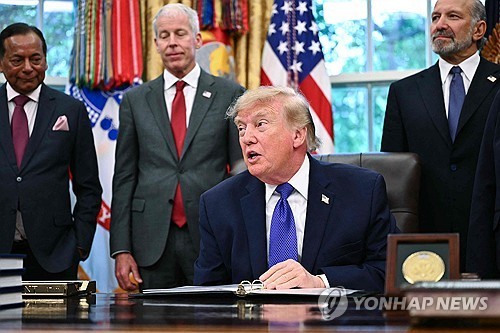
Donald Trump told reporters on September 28 that selling American weapons to China could be “a good idea,” then insisted no such conversation ever happened with President Xi Jinping. Twenty-four hours later, the White House and State Department issued a clarification to the New York Times stating the United States has no plan to sell arms to China. The pivot took roughly a day to execute.
But reading this as a simple walk-back misses the point. Trump’s comment—made publicly, on camera, in the White House press room—was the first time a sitting US president has openly floated the possibility of lifting one of the most durable constraints in American-China relations since the 1989 Tiananmen crackdown triggered the arms embargo. Whether he meant it or was testing the water is impossible to say with certainty. What is clear is that the post-Cold War taboo against arming Beijing has now been breached by rhetoric alone, and the damage to the existing architecture may outlast the news cycle by years.
The timing is itself significant. The remarks came barely a week after Trump’s summit with Xi, an event the president scored at “12 out of 10” and described in language rarely applied to US-China encounters. The arms-sales comment did not emerge in isolation; it arrived as part of a broader package of signals that collectively redraw the boundaries of what is negotiable between the two powers.
The Perdue Complication
The sequence began the day before, when Ambassador Teri Perdue told Fox News that Trump had directly asked Xi whether China would purchase American weapons, framing the question by pointing out that the United States sells arms to countries around the world. If true, that is a significant escalation beyond Trump’s later hedging. An ambassador operating at the president’s direct wavelength does not improvise questions of this magnitude without implicit authorization—or at minimum, without reading the president’s disposition correctly. The White House’s subsequent denial of any sales plan appears aimed at containing the fallout, not at correcting a misstatement by an ambassador who functions as an extension of Trump’s informal diplomacy.
Current US law prohibits the sale of American weapons to China under the Arms Export Control Act and subsequent legislative riders. Any actual transaction would trigger a legal and diplomatic collision with Washington’s Taiwan policy and with longstanding congressional guardrails that have survived multiple administrations and shifting strategic assessments. The clarification to the New York Times was damage control—acknowledging the legal reality while carefully leaving Trump’s rhetorical option open. The administration did not say arms sales were impossible. It said there was no plan. The distinction is everything.
A Summit Rated 12 Out of 10
Trump described his September 24 meeting with Xi as “excellent” and said he wanted to give it a 12 out of 10. The warmth is unusual for leaders who preside over the most consequential strategic rivalry of the century. Trump has also moved aggressively on trade, cutting tariffs on Chinese goods in a move that signals a broader recalibration away from the confrontational posture that defined much of the second term. The tariff reductions are not marginal—they represent a deliberate unwind of the trade architecture that was built specifically to punish and constrain Chinese economic behavior.
Taken together, the tariff relief, the summit praise, and the arms-sales rhetoric paint a picture of a US president treating the China relationship as a set of transactional variables rather than a structural commitment. That framing is liberating for Trump personally and destabilizing for everyone else. It tells allies that no agreement is foundational. It tells adversaries that pressure can be paused. It tells domestic critics that the China challenge is not being abandoned—it is being reclassified.
Who Wins, Who Loses
Beijing gets a gift it did not ask for and cannot easily refuse. A sitting US president publicly calling arms sales a “good idea” creates uncertainty among China’s military planners and among America’s treaty partners. If Washington can flip on arms sales, what is off the table next? The question will not stay confined to Washington’s press room. It will be asked in Taipei, in Tokyo, in Seoul, in Manila—and each capital will draw its own conclusion about the reliability of American commitments.
The Taiwan Strait sits in the crosshairs. Even the talk of Chinese arms purchases subtly undermines the deterrent logic that has underwritten the status quo for decades. The entire architecture of American deterrence in the Taiwan scenario rests on the premise that the United States will supply Taiwan with defensive capabilities and that China will face costs for aggression. If the United States considers selling weapons to the People’s Liberation Army, it has implicitly conceded that China is a legitimate arms customer—a status it has deliberately withheld for thirty-five years. That concession does not need to be acted on to have effect. The mere consideration alters the calculus in Taipei.
Japan watches closely. Tokyo’s security calculus depends on a stable US commitment to the Indo-Pacific that includes an implicit wall against closer US-China defense ties. That wall is now paper. Japanese strategists are already reassessing whether their own military modernization plans—long designed around a stable alliance framework—require acceleration. The Japan Times and Nikkei have both published commentary noting that Washington’s flexibility on China opens space for Beijing to press Tokyo on disputed islands and historical grievances with reduced fear of American intervention.
Korea’s Moment of Vulnerability
South Korea is caught between a US-China thaw and a Japan that is already repositioning. Seoul’s hedging strategy—for years, balancing between Washington’s alliance framework and Beijing’s economic gravity—is becoming structurally untenable. When the United States treats China as a potential buyer and partner simultaneously, Korea loses its leverage. Beijing reads US softness on arms as a green light to pressure Seoul on other fronts: trade restrictions, cultural diplomacy, North Korea negotiations. Washington may see Korea’s diplomatic independence as a liability rather than an asset—a state that refuses to fully align.
The Yonhap reporting highlights how Korean outlets are already tracking the divergent impact: the Sino-American axis warming while Japan tightens its own posture. That divergence is Korea’s problem. Seoul has no equivalent relationship with Beijing to substitute for the alliance, and no margin to absorb a US-China accommodation that discounts Korean interests. The Korean government’s response so far has been characteristically careful—expressing hope that the trend toward dialogue continues while quietly reinforcing its own defense cooperation with Washington. But careful does not solve the structural problem.
Korea’s vulnerability is compounded by North Korea. As Washington diverts attention toward managing a complex relationship with Beijing, Pyongyang reads the shift as an opportunity. Recent missile tests and rhetorical escalations suggest Kim Jong Un is calculating that the United States will be less willing to enforce red lines when it is simultaneously trying to accommodate China. Seoul faces a deteriorating threat environment with diminishing American attention.
Second-Order Effects
The arms-sales rhetoric will reverberate beyond bilateral politics. Defense contractors who have spent years preparing for a sustained Indo-Pacific posture now face ambiguity. Lockheed Martin, Raytheon, and Northrop Grumman have built business cases on predictable alliance commitments. If those commitments are negotiable, so are the contracts. Pentagon procurement planning assumes a certain baseline of allied demand; that assumption is now clouded.
China’s own defense industry will register the shift. The PLAAF and PLA Navy have long viewed American arms sales to regional partners as a strategic encirclement strategy. If Washington opens the door—even rhetorically—to selling weapons to China, Beijing’s military planners must account for the possibility that American suppliers could one day equip their adversary. That paradox creates uncomfortable dependencies for Chinese strategic planning.
The European response deserves attention as well. NATO partners have watched the US-China thaw with growing alarm, particularly as American energy and diplomatic resources shift toward the Indo-Pacific. If the United States can accommodate China on arms sales, European allies will ask what else is on the table. The transatlantic dimension of this story has not received adequate coverage.
What Happens Next
Nothing legally changes today. No weapons are being sold. No law has been repealed. But norms erode faster than statutes. Trump’s rhetoric has shifted the Overton window on US-China defense relations by decades, and that shift will not reverse simply because the White House issued a clarification. Every future administration will inherit a world in which a sitting president publicly questioned a thirty-five-year embargo.
If the administration follows through on actual sales—unlikely in the near term given legal barriers and congressional opposition—it would mark the final death of the post-1989 embargo framework and trigger a cascade of realignments across Asia. If it does not, the conversation still reframes every subsequent discussion about Taiwan, about the South China Sea, about Korea’s role in a US-China deal. The threshold has been crossed. The question is no longer whether arms sales to China are conceivable. The question is under what conditions they become likely.
The 12-out-of-10 summit, the tariff cuts, the arms-sales comments, the backtracking—they form a single arc. Trump is signaling that nothing is locked in. That is the point. And for countries like South Korea that built their strategies on predictable alliances, unpredictability is not a temporary condition. It is the new environment. Seoul’s challenge is no longer choosing between Washington and Beijing. It is surviving in a system where the chooser is no longer reliable.