North Korea's Hypersonic Missiles Expose Alliance Detection Gaps
Pyongyang's latest hypersonic missile test reveals a dangerous detection gap that could undermine US-ROK-Japan deterrence. What happened over the East Sea matters far beyond the peninsula.
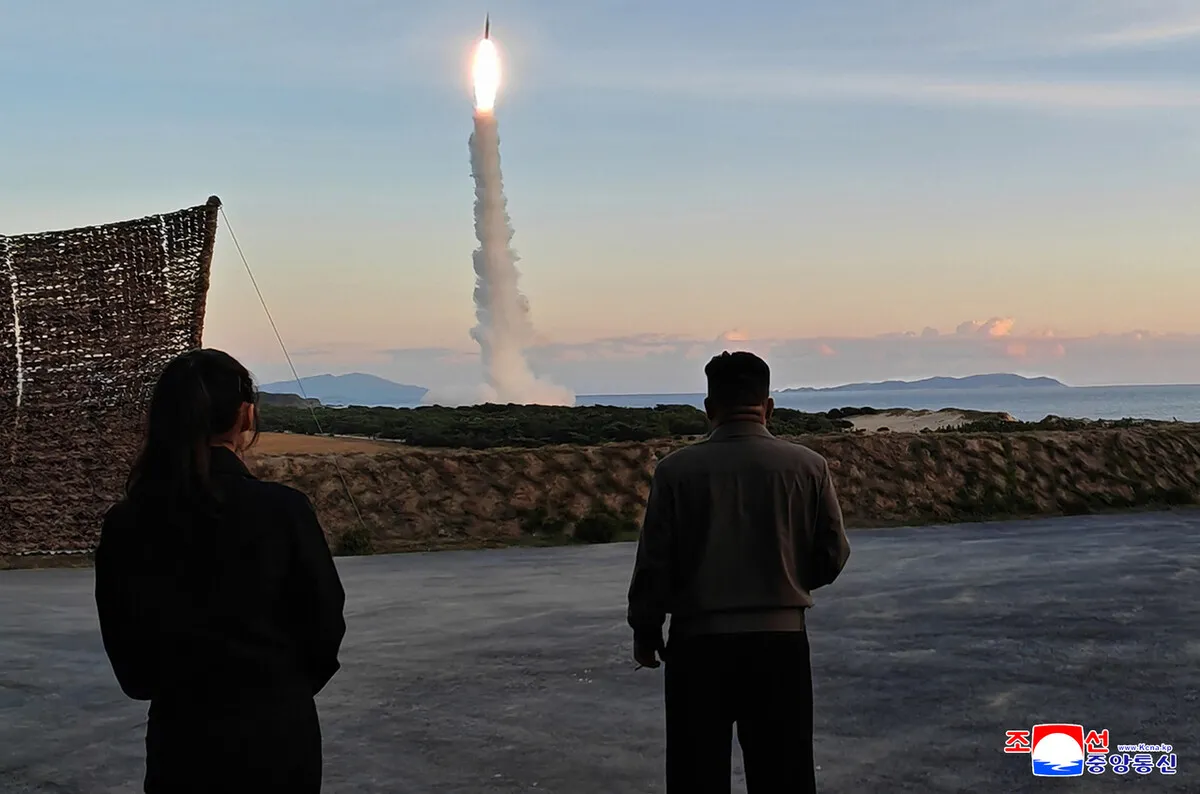
The Flight Path That Changes Everything
North Korea fired a medium-range strategic missile into the East Sea on the early morning of the 3rd, and the details emerging from Pyongyang are more consequential than the headline numbers suggest.
According to the Rodong Sinmun, the missile traveled roughly 1,000 kilometers before striking its target at coordinates 43°36′N, 138°00′E — deep in Korean waters well past Japan’s southern islands. But the trajectory picture released alongside the launch tells a different story than a standard ballistic arc. The red line on the monitor behind Kim Jong-un’s daughter Ju-ae shows the missile pulling up during its descent phase, then gliding for a stretch. That is a hypersonic maneuver profile, not a simple parabola.
This matters because hypersonic glide vehicles fundamentally break the assumptions underpinning missile defense systems deployed across Japan and South Korea. A ballistically-trajectory missile follows a predictable arc. Interceptors can calculate an intercept point. A vehicle that pulls up and glides at hypersonic speeds — meaning Mach 5 or higher — changes its flight path mid-course, making it far harder to track, predict, and kill.
The Detection Gap Is the Real Story
Kim Yo-jong, Kim Jong-un’s sister and a powerful figure in North Korea’s leadership, issued a statement on the same day claiming that South Korean and Japanese military authorities failed to track the missile properly. Whether that claim is fully accurate is difficult to verify independently, but the mere assertion — made publicly, deliberately — signals something important about Pyongyang’s strategy.
The regime is testing not just the missile, but the response architecture around it. If North Korean hypersonic weapons can evade detection long enough to approach their targets, the entire timeline for decision-making by Seoul, Tokyo, and Washington compresses dramatically. What once gave alliance commanders minutes of warning now may offer seconds, or less.
This is the non-obvious escalation. North Korea has been developing hypersonic technology for years. The real breakthrough here is not the technology itself but the confidence to demonstrate it publicly while claiming — convincingly to its audience — that the best military intelligence apparatuses in the region could not follow it.
The Family Stagecraft
The photographs released by state media are carefully composed. Kim Jong-un, smiling broadly, stands with his wife Ri Sol-ju and his teenage daughter Ju-ae. Behind them, screens show the red trajectory tracing the missile’s path. Also present are senior military-industrial officials: Kim Jeong-sik, first vice director of the Labor Party’s Military Industrial Department, and Jang Chang-ha, director of the General Bureau of Missile Development.
Ju-ae’s presence is notable. She has appeared at military inspections before, but this is one of the more prominent displays yet. The message is layered: the next generation is being socialized into the regime’s core narrative of military supremacy, and the family unit itself is being positioned as inseparable from the deterrent project.
But the family tableau also serves a more calculated external function. It humanizes the leadership while reinforcing the permanence of the nuclear state. Western analysts often dismiss these displays as propaganda theater. That is true, but it is also a form of power — the ability to shape how adversaries perceive the regime’s resolve and continuity.
What This Means for the Alliance
The United States has invested heavily in layered missile defense across the region: THAAD batteries in South Korea, Aegis-equipped destroyers stationed in Japan, and Patriot battery deployments. These systems are designed primarily against ballistic missiles. Hypersonic glide vehicles represent a qualitatively different threat, and no deployed system in the region is explicitly designed to counter them at scale.
Japan, in particular, finds itself in a precarious position. The missile’s trajectory — fired eastward from North Korea’s eastern coast — would pass relatively close to Japanese territory before descending into the sea. A warhead on a similar trajectory aimed at Japanese urban centers would have far less flight time than a conventional ballistic missile, giving Tokyo’s early-warning systems less time to alert populations and its interceptors less time to engage.
South Korea faces a similar compression. The detection gap Kim Yo-jong referenced, if real, means that the assumption underlying ROK-Japan-US tripartite coordination — that everyone sees the same threat at the same time — is already under strain.
The Deterrence Recalibration
Kim Jong-un repeated a phrase that deserves careful reading: this training was “a form of deterrence exercise.” The regime is not just building weapons. It is performing deterrence — making it visible, repeatable, and public. Each launch is both a capability demonstration and a signal to adversaries about the cost of aggression.
The implication for the US alliance strategy is stark. Deterrence traditionally relies on the adversary believing they cannot achieve their objectives without unacceptable cost. North Korea is now communicating a different calculus: that the cost of acting against it may be lower than allies assume, precisely because the window for effective response is narrowing.
This does not mean North Korea has achieved strategic invulnerability. It means the math of deterrence in Northeast Asia is changing in real time, and the alliance frameworks built over decades were designed for a different threat environment. The question now is whether Washington, Seoul, and Tokyo can adapt fast enough — or whether the detection gap will become a strategic gap.
The missile hit its target. The real test is whether the alliances can still see what comes next.