Trump Forces Israel to the Table With Syria—A Deal It Didn't Want
Israel and Syria have begun US-mediated peace talks in Jordan, the first senior-level contact since Israel invaded Syrian territory and bombed the transitional government in 2024-2025. The talks reveal how Donald Trump is using American leverage to bend Israel's security calculus toward diplomacy it never sought.
When the Unthinkable Happens
Israel and Syria met in Jordan on August 23 under American supervision for high-level talks about peace, security arrangements, and — perhaps most significantly — an end to Israeli airstrikes on Syrian territory. The meeting included Syria’s foreign minister, Al-Assad Al-Shaibani, reportedly speaking directly with Mossad director Roman Gopman. They discussed establishing a “special operations room” in Jordan under US oversight to manage incidents involving Turkey and prevent spillover violence.
Five years ago, this scenario would have been impossible. Syria’s Bashar al-Assad regime, allied with Iran and used as a conduit for Hezbollah arms supplies, was Israel’s primary northern threat. The two sides had exchanged hostility for half a century. Today, a transitional government in Damascus is actively seeking Washington’s embrace — and the United States is using that leverage to pressure Israel into a corner it never wanted to occupy.
The Regime That Changed Everything
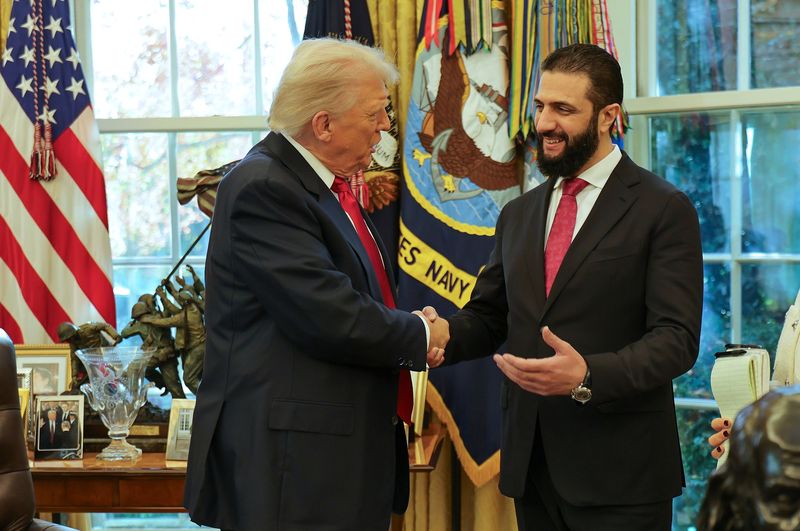
Assad’s fall in November 2024 was not merely a regime change. It was a realignment of the entire Levantine order. The new Syrian leadership, centered around Ahmed al-Shara, pivoted quickly toward the West. Shara became the first Syrian president to visit the White House since the country’s modern founding, meeting Trump in November 2024. That visit was not symbolic theater — it was a signal that Damascus was rewriting its security architecture from scratch.
Israel reacted aggressively. In July 2024 and again in March 2025, it bombed Syria, accusing the transitional government of targeting Druze civilians near the border. On August 18, 2025, Israel struck a Syrian military airport, accusing Turkey of helping rebuild Syria’s air force and expanding its influence north of the Golan Heights. Israeli ground forces had also moved into Syrian territory along the Golan in late 2024, occupying areas that were previously off-limits.
The pattern was clear: Israel saw the post-Assad vacuum not as an opportunity for diplomacy but as a threat multiplier. A stronger Turkey in Syria, Iranian remnants regrouping, and an uncertain Damascus all fed existing Israeli anxieties.
Trump’s Leverage
What is striking about the current situation is not that Israel and Syria are talking — it is who is making it happen.
Donald Trump has positioned himself as Syria’s champion in the corridors of Washington. His frustration with Israel’s military actions is not hidden rhetoric. Tom Barrack, Trump’s Syria envoy and the US ambassador to Turkey, took to social media on August 18 to call Israel’s airstrikes “unnecessary escalation that does not serve regional stability.” That is an extraordinary public rebuke from an American official toward Israel’s defense policy.
Trump’s approach to the Middle East has always been transactional. He sees Syria’s transition as an opening — a chance to establish a US-aligned government in Damascus without the baggage of decades of hostile precedent. Israel, for all its military capability, depends on Washington for diplomatic cover, military aid, and intelligence sharing. Trump is leveraging that dependency to force a conversation Israel would rather avoid.
What the Talks Actually Mean
The immediate demands from Damascus are straightforward: Israeli troops must withdraw from occupied Syrian territory, and aerial bombardments must stop. These are the minimum conditions any Syrian government would need before engaging seriously. The broader discussion involves security arrangements, possibly including the proposed joint operations room in Jordan, and a framework for managing the Turkish dimension that has so visibly irked Israel.
But the underlying tension is unmistakable. Israel bombed Syria’s military infrastructure just weeks ago, believing it was containing Iranian and Turkish threats. Damascus now expects those actions to end as a precondition for any agreement. The gap between where Israel thinks it must stand and where Washington wants it to go is enormous.
Who Wins, Who Loses
Syria’s transitional government wins legitimacy. Engagement with Israel, even under American pressure, elevates its standing domestically and internationally. It signals that the post-Assad era is producing a government capable of negotiation — not just survival.
Trump wins politically. He can claim credit for brokering talks between two countries that spent half a century as adversaries, reinforcing his self-image as a dealmaker who rewrites regional orders.
Israel loses options. Its ability to conduct preemptive strikes against perceived threats in Syria is being constrained by American diplomacy. Netanyahu faces a dilemma: comply with Washington’s pressure and risk looking weak on security, or resist and strain the alliance at a moment when US support remains critical for other regional priorities.
Turkey is the implicit loser if the talks succeed without addressing Ankara’s concerns. Israel’s strikes were partly motivated by Turkish military involvement in Syria. Any durable agreement will need to accommodate or contain Turkish influence, or risk collapsing.
What Happens Next
The Jordan meeting was described as a confidence-building measure, not a breakthrough. Security negotiations are expected to resume, but the timeline is uncertain. Israel has not signaled readiness to withdraw from occupied territory. Damascus has not indicated it will negotiate without that concession first.
The special operations room concept, if realized, would create a new mechanism for crisis management in a region where trust is thin. But it also represents American institutional involvement in Syrian-Israeli relations at a level neither side chose willingly.
Korean readers may notice a parallel: this is a case where a major power is using diplomatic and economic leverage to restrain an ally’s military independence. The dynamics are different from the Korean Peninsula, but the principle is familiar — alliance management as a tool of statecraft, and the uncomfortable reality that even the closest partners are not immune to pressure from Washington.
What is less clear is whether Trump’s approach is sustainable. His Syria strategy rests on the assumption that Damascus will remain reliably pro-Western and that Israel will accept limitations on its military freedom of action. Both assumptions carry risk. The Syrian transitional government faces internal fractures. Israel’s security establishment views any retreat from the Golan as a strategic error.
The talks in Jordan are a starting point, not an endpoint. Whether they lead to something durable or simply pause the violence long enough for the next crisis remains the question.
The Bigger Picture
Israel-Syria peace talks were once considered a distant fantasy. The fall of Assad removed the obstacle that made the fantasy impossible — and replaced it with a far messier reality. The new Syria is not the hostile state of the past, but it is not a reliable partner either. Israel is not the aggressor it sometimes appears to be, but it is not free to act as it sees fit.
Trump’s intervention is reshaping the calculus for everyone involved. The question is whether the resulting architecture will hold — or simply delay the next confrontation under a thin veneer of diplomacy.