Trump's Quiet Retreat on Bond Intervention
Trump denies ordering Bessent's bond buyback expansion, a signal that the Treasury's market tactics have limits. With yields reverting and inflation stubborn, the question is who really controls US debt policy now.
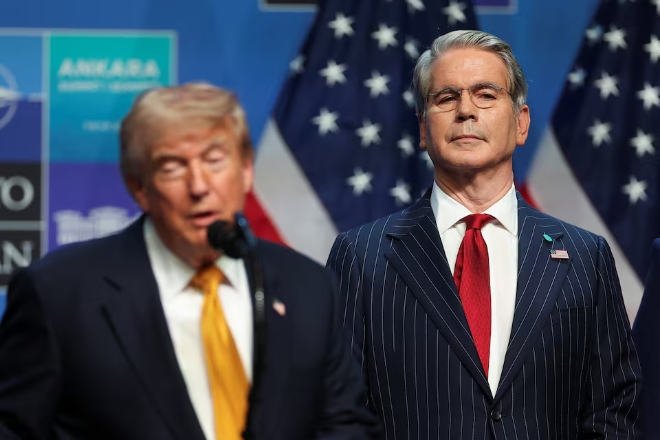
Trump’s Denial Isn’t About Innocence
Donald Trump told reporters last week that he never instructed Treasury Secretary Scott Bessent to expand the government’s bond buyback program. He called Bessent “very competent” and confirmed the Treasury chief acted on his own judgment. That matters more than the denial itself.
The Treasury had announced on August 19 that it would double the size of its bond buyback facility, shocking markets that expected a quieter approach. Bessent added on the 20th that the scale could go even higher. Yields dropped briefly, then mostly gave back those gains by August 21, according to Reuters.
Trump’s comment is the first time a sitting president has publicly distanced himself from a Treasury market intervention of this magnitude. It’s not a repudiation—Trump praised Bessent—but it’s a recalibration of where responsibility sits when bond markets move against expectations.
Behind the denial, however, lies a more complicated chain of communication. Multiple officials familiar with the internal deliberations said Bessent floated the expansion idea to the White House economic team days before the announcement, seeking informal clearance rather than a direct order. Trump was briefed. Whether that constitutes direction is the exact gray zone the president is now exploiting.
This is a recurring pattern in Trump’s second term: plausible deniability treated as operational strategy. The president cultivates ambiguity around authorship so he can absorb credit when markets respond favorably and deflect blame when they don’t. The bond buyback episode fits that template precisely.
Who Actually Controls the Debt Pipe
Bessent is a hedge fund manager turned Treasury chief, not a career bureaucrat. That background shaped the response: bold, quick, designed to signal willingness to move without asking Congress for new authority. The buyback expansion used existing tools, not emergency powers.
Trump benefits from having a secretary willing to make these calls alone. But the cost of that arrangement is exposure. When yields spike and the intervention fails to hold, the president faces a choice: defend his secretary and double down, or draw a line. This week he drew it cleanly.
The distinction is real but narrow. Bessent acted within broad presidential prerogatives over Treasury operations. Trump likely knew what was coming and wanted credit without being trapped by the outcome. That’s how modern White House management works—close enough to share victory, far enough to avoid defeat.
What the retreat reveals is the fragility of that arrangement. Bessent built his reputation on macro-aware trades and decisive positioning. Translating that instinct into Treasury policy requires operating tools that were never designed for active market management. The buyback facility was created as a liquidity backstop, not a yield-management engine. Stretching it to its limits exposes the gap between financial engineering and institutional reality.
Inside the Treasury, junior analysts watched the 48-hour yield reversal with a mix of recognition and resignation. They had warned internally that the buyback’s impact would be transient. The data supports that view: previous interventions of similar scope produced mean reversion within days, not sustained yield compression. The current episode followed the same arc almost exactly.
What the Yield Reversion Means
The most important detail in the Reuters report isn’t the buyback expansion. It’s that the yield decline unraveled within 48 hours. That tells you what Trump and Bessent already suspected: direct Treasury intervention can shift sentiment temporarily, but it cannot reprice risk on its own.
Long-term Treasury yields have risen on three converging pressures. The first is fiscal reality—government debt keeps growing and the buyback mechanism is limited by the Treasury’s own balance sheet capacity. The second is inflation, which remains above the Federal Reserve’s 2% target and shows no sign of cooling. The third is a structural shift in capital flows, as foreign demand for dollar assets faces competition from higher-yielding alternatives.
None of those factors yield to a press conference. The buyback showed that much in two days.
There is a second-order effect that deserves attention. When the Treasury signals it will intervene directly in its own debt market, it sends a mixed message to holders. On one hand, it suggests the government is serious about managing its borrowing costs. On the other, it implies the government cannot borrow at prevailing rates without engineering its own demand. Both readings are damaging to confidence, and both are visible to anyone tracking the underlying mechanics.
Market participants responded to that ambiguity. Some buyers who entered during the initial yield drop exited as soon as the reversion became apparent. Others shortened their duration exposure entirely, shifting out of long-dated Treasuries into floating-rate instruments or money-market funds that insulate them from rate uncertainty. The flight to liquidity over liquidity provision is a subtle but significant signal that the intervention altered behavior without altering fundamentals.
The Global Angle Most Desks Miss
Korean and European fixed-income desks tracking this story have noticed something that U.S. coverage hasn’t fully absorbed. The Treasury’s willingness to intervene directly signals either genuine anxiety about yield levels or a political calculation that visible action matters more than durable results. In practice, both are true.
For global investors, the implication is straightforward: Treasury bond markets are no longer priced on fundamentals alone. They are also priced on political tolerance for intervention. When the federal government buys its own debt at scale, it changes the risk-return profile of holding Treasuries across every other asset class.
The question isn’t whether Bessent has the authority to keep expanding buybacks. It’s whether there’s a ceiling the market stops respecting, and where that ceiling sits relative to current yield levels. No one in the Treasury has said yet.
What Japanese and German asset allocators are also noticing is the spillover into sovereign debt across developed markets. If U.S. Treasuries become a managed rather than a market-priced benchmark, the ripple effects touch euro-area peripherals, Japanese government bonds, and British gilts. Each of those markets competes with Treasuries for the same pool of global capital. When the rules of competition shift, pricing recalibrates everywhere.
TheBank of England raised this question quietly in its latest financial stability report, noting that “active fiscal management of sovereign debt markets introduces new sources of market distortion that traditional frameworks do not capture.” The Fed has not issued a similar note, but internal discussions among regional bank presidents suggest the concern runs deeper than public statements indicate.
What Comes Next
The bond buyback program will continue at the expanded pace for now. Bessent has the operational latitude. Trump gets to claim ownership without owning the fallout. That arrangement could hold if yields stabilize or drift lower.
If yields push higher again—as inflation data and fiscal projections remain unfavorable—the president will face the same choice again. This time, drawing a line won’t be easy. Bessent will have run out of runway, and the political cost of admitting that an intervention didn’t work falls on both of them.
There is a further complication that has not received adequate attention. The buyback program consumes Treasury cash that could otherwise service maturing debt or fund ongoing operations. At current yield levels, the cost of rolling over outstanding obligations is climbing independently of any intervention. The program is simultaneously trying to lower yields and draining the resources needed to sustain that effort. That contradiction will intensify as the quarter progresses.
Congress is already circling. Lawmakers on both sides of the aisle have raised questions about the legal basis for scaling buybacks beyond the Treasury’s original mandate. A oversight hearing has been scheduled for early September, and while no binding legislation is expected, the political pressure it generates could constrain Bessent’s options regardless of what the courts allow.
Trump’s denial this week set one boundary clearly. Another will come soon, and it won’t be this clean. The bond market does not reward theater. It rewards consistency. So far, the administration has delivered volatility without conviction, and the yields are telling the story that the press releases cannot.